
Incheon Airport guide for travelers — immigration, baggage, SIM cards, T-money and transport to Seoul, plus the Korean phrases you need at each step, in order.
You just stepped off a 14-hour flight, your ears are still popping, and suddenly you're standing under a sea of signs at Incheon International Airport. Everyone around you seems to know exactly where they're going. You... do not.
Take a breath. Incheon is one of the smoothest, most traveler-friendly airports in the world — and with a handful of Korean phrases in your pocket, you'll move through it like you've done it a hundred times. Let's walk through it together.
Why Knowing a Few Korean Phrases Matters at Incheon
Incheon Airport (인천공항, incheon-gonghang) is huge, modern, and surprisingly easy to navigate. Signs are in Korean and English, and most staff at the airport speak at least basic English. So do you really need Korean here?
Not to survive — but to make everything faster, warmer, and less stressful. A quick 감사합니다 (gamsahamnida), "thank you," to an immigration officer changes the whole tone of the interaction.
And the moment you leave the airport — the taxi driver, the convenience store clerk, the person you ask for directions — English gets thinner fast. The airport is where you warm up your Korean before you actually need it. Think of it as your practice runway.
The Core: Incheon Airport Step by Step
Incheon has two terminals: Terminal 1 and Terminal 2. Most airlines use Terminal 1, but Korean Air, Delta, Air France, and KLM (among others) use Terminal 2. Check your boarding pass before you land — the terminals are 15–18 minutes apart by shuttle.
Here's the arrival flow in order, so nothing surprises you:
| Step | What happens | Where you go |
|---|---|---|
| 1. Arrival | Get off the plane, follow 도착 (dochak), "arrival," signs | Follow the crowd + purple signs |
| 2. Quarantine / Health | Occasional health check or Q-code scan | Usually a quick walk-through |
| 3. Immigration (입국심사) | Passport + fingerprints + photo | 입국심사 (ipguk-simsa), "immigration" |
| 4. Baggage claim | Grab your suitcase | 수하물 찾는 곳 (suhamul channeun got), "baggage claim" |
| 5. Customs | Hand over your declaration form | 세관 (segwan), "customs" |
| 6. Arrival hall | Exit into Korea! | SIM cards, exchange, transport |
The two words that will save you the most time are 입국심사 (ipguk-simsa) for immigration and 수하물 (suhamul) for baggage. Learn to recognize those two signs and half the airport instantly makes sense.
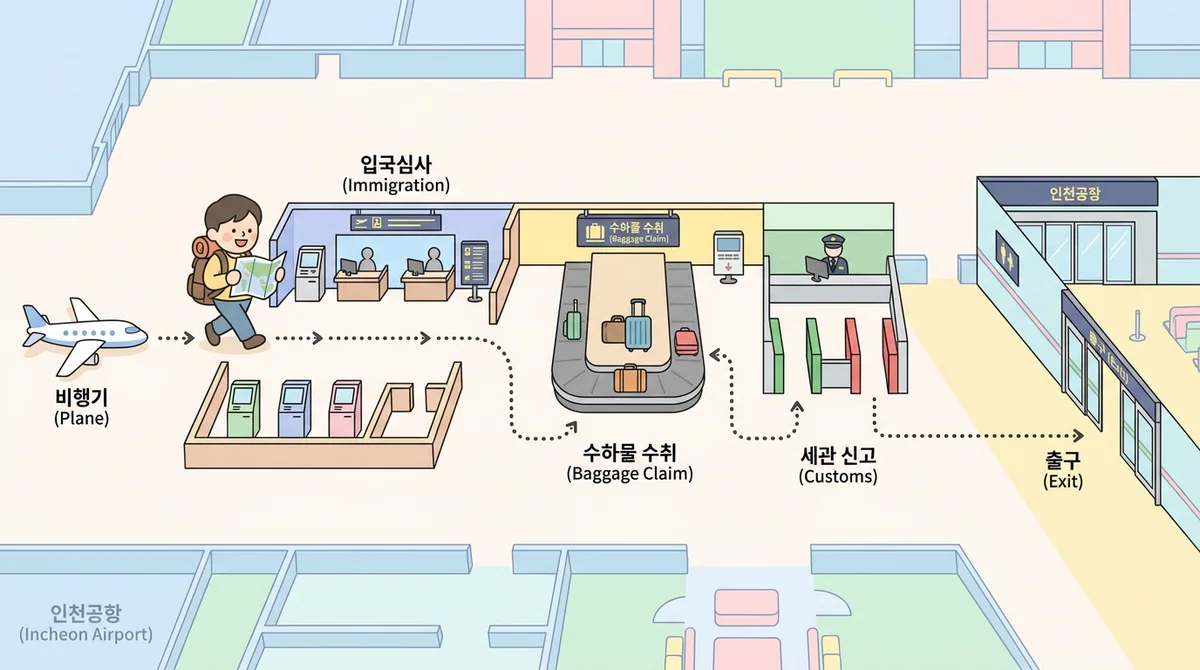
Once you're through customs, your big decisions are: how to get connected (SIM/eSIM), how to get cash, and how to get into the city (AREX train, bus, or taxi). We'll cover the phrases for all three below.
Common Mistakes Travelers Make at Incheon
Assuming both terminals are the same building. They are not. If your connecting flight or pickup is at the other terminal, you need the free shuttle bus. Ask staff: "터미널 2 어떻게 가요?" (teomineol i eotteoke gayo?), "How do I get to Terminal 2?"
Skipping the arrival card or Q-code. Depending on your nationality, you may need an arrival card or a pre-filled health form. Fill it out on the plane while you have a pen and a tray table.
Exchanging all your money at the airport. Airport exchange rates are convenient but not the best. Change a small amount for immediate needs, then use ATMs or exchange booths in the city.
Panicking at immigration. The officer will ask short, simple questions — where you're staying, how long you're here. You don't need perfect Korean. A calm answer in English is completely fine.
Not knowing the word for "taxi stand" vs "bus." Many travelers wander looking for transport. The signs exist — you just need to recognize 택시 (taeksi), "taxi," and 버스 (beoseu), "bus."
Step-by-Step: The Phrases to Use, In Order
Let's match real phrases to each moment you'll hit. Say them out loud now so they feel familiar later.
At immigration, if you're asked something you don't catch:
- 영어 할 수 있어요? (yeongeo hal su isseoyo?) — "Can you speak English?"
- 여행하러 왔어요. (yeohaenghareo wasseoyo.) — "I'm here to travel."
At baggage claim, if a bag is missing:
- 제 가방이 안 나왔어요. (je gabangi an nawasseoyo.) — "My bag didn't come out."
Finding your way, the all-purpose direction phrase:
- ~ 어디예요? (~ eodiyeyo?) — "Where is ~?"
- Just add the place: 화장실 어디예요? (hwajangsil eodiyeyo?) — "Where is the bathroom?"
Getting connected at a SIM counter:
- 심 카드 사고 싶어요. (sim kadeu sago sipeoyo.) — "I'd like to buy a SIM card."
Getting into the city:
- 서울역까지 얼마예요? (seouryeok-kkaji eolmayeyo?) — "How much to Seoul Station?"
The magic building block here is 어디예요? (eodiyeyo?), "where is it?" Learn that one phrase and you can find anything — just point at a sign, say the word, and add it.
Real-Life Mini-Dialogues at the Airport
Here are three short exchanges you'll realistically have. Read both roles out loud.
1. At immigration:
Officer: 방문 목적이 뭐예요? (bangmun mokjeogi mwoyeyo?) — "What's the purpose of your visit?"
You: 여행이요. (yeohaengiyo.) — "Tourism."
Officer: 얼마나 있을 거예요? (eolmana isseul geoyeyo?) — "How long will you stay?"
You: 일주일이요. (iljuiriyo.) — "One week."
2. Asking for directions to the train:
You: 저기요, 공항철도 어디예요? (jeogiyo, gonghang-cheoldo eodiyeyo?) — "Excuse me, where is the airport railroad?"
Staff: 저쪽으로 쭉 가세요. (jeojjogeuro jjuk gaseyo.) — "Go straight that way."
You: 감사합니다! (gamsahamnida!) — "Thank you!"
3. Buying a SIM card:
You: 심 카드 있어요? (sim kadeu isseoyo?) — "Do you have SIM cards?"
Clerk: 며칠 쓰실 거예요? (myeochil sseusil geoyeyo?) — "How many days will you use it?"
You: 오 일이요. (o iriyo.) — "Five days."
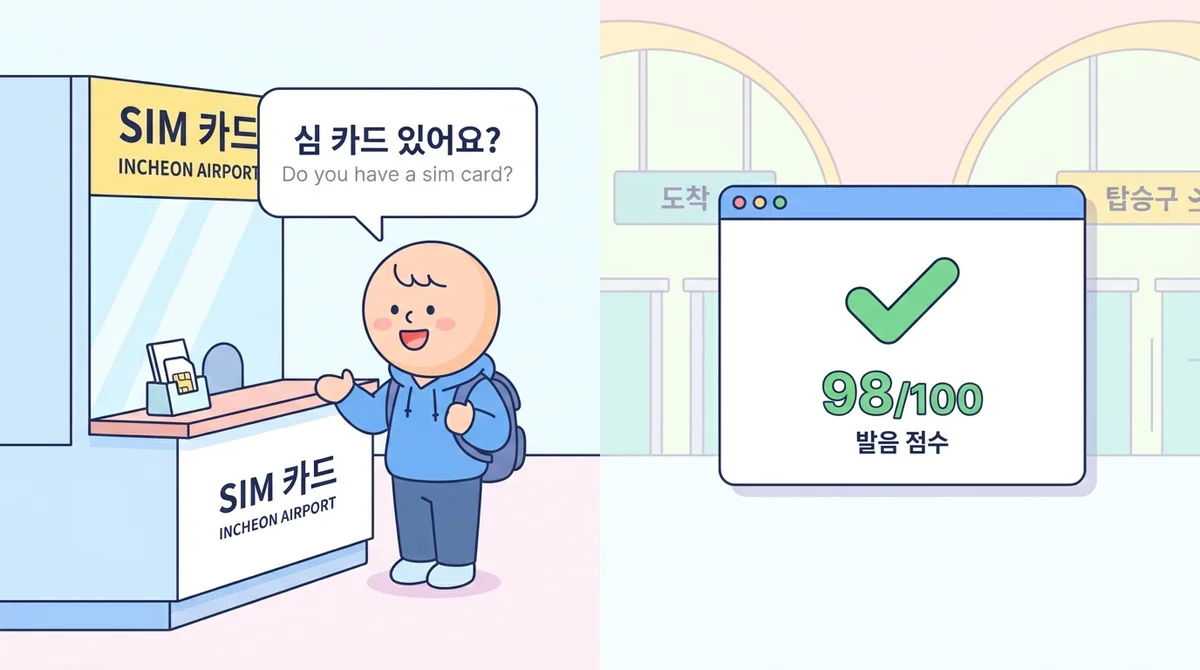
Notice how short the travelers' lines are. You don't need long sentences. A single clear word — 여행이요 (yeohaengiyo), 일주일이요 (iljuiriyo) — does the whole job. That's real, useful Korean.
Practice Tips: Make These Stick Before You Fly
Reading these phrases once is not the same as being able to say them when a real officer is looking at you. The only thing that actually works is saying them out loud, over and over, until your mouth knows them without your brain scrambling.
Here's a simple pre-trip routine:
- Pick five phrases from this post — the ones you're most likely to need.
- Say each one out loud ten times, not in your head. Feel the rhythm.
- Record yourself and compare it to a native speaker.
- Role-play the whole scene — pretend you're at immigration, at the SIM counter, in the taxi.
That last step is exactly what Teuida is built for. Teuida is a speaking-first app — instead of grinding flashcards, you talk from day one. You can role-play these real airport and travel situations out loud, and Teuida's AI pronunciation feedback scores how you say each phrase and helps you fix it — the next best thing to practicing with a Korean friend before you land.
Work through the travel and everyday scenarios in Teuida's Korean course and you'll arrive at Incheon already comfortable with 어디예요? (eodiyeyo?) and 감사합니다 (gamsahamnida) — because you'll have said them dozens of times, not just read them.
You've Got This
Incheon Airport is genuinely one of the easiest big airports in the world to move through, and now you know the flow: arrival → immigration → baggage → customs → the city. Add a handful of warm, simple phrases and you turn "surviving the airport" into a confident first taste of Korea.
You don't need to be fluent. You need to be ready — a few words said clearly, a smile, and a 감사합니다 that lands. That's what makes locals light up and your trip feel smoother from minute one.
Practice these Incheon phrases out loud in Teuida's Korean course before you fly, and step off the plane already sounding like you belong.


