
Korean autumn explained — 단풍 leaf season, 천고마비 crisp skies, fall foods and festivals, plus the Korean words and phrases you need to enjoy and talk about it.
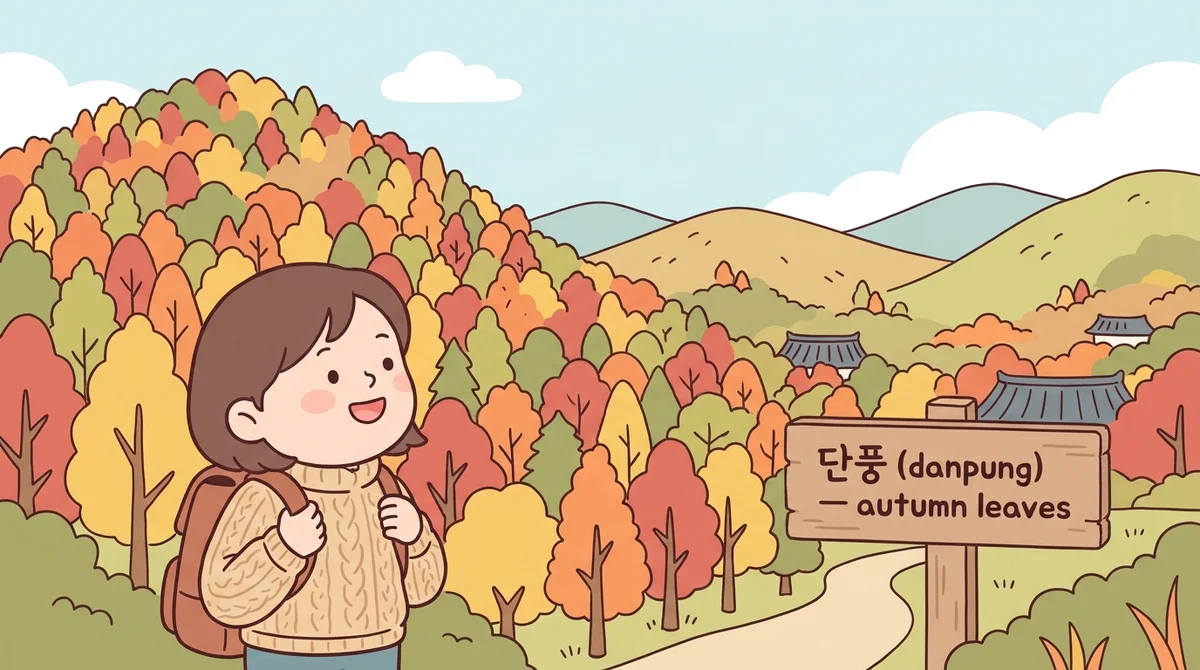
You step off the bus at Naejangsan, look up, and the whole mountain is on fire — reds, oranges, and yellows layered like someone spilled paint over the ridge. Everyone around you is pointing their phone at the same tree and saying the same word: 단풍 (danpung), "autumn leaves."
That single moment tells you almost everything about why Koreans love fall so much. It's short, it's gorgeous, and the whole country seems to slow down to enjoy it together. Let's talk about what actually makes Korea's autumn special — and the words you'll want in your pocket when you go.
Why Autumn Is a Big Deal in Korea
Korea has four very distinct seasons, and after a long, sticky summer, fall feels like a reward. From roughly late September through November, the humidity drops, the sky turns a crisp deep blue, and the temperature settles into that perfect "light jacket" range.
Koreans even have a phrase for this: 천고마비 (cheongomabi), literally "the sky is high and horses grow fat" — meaning the weather is so pleasant that everything (and everyone) thrives. It's the season people describe as 독서의 계절 (dokseoui gyejeol), "the season for reading," and 식욕의 계절 (sigyogui gyejeol), "the season of appetite."
So autumn isn't just pretty scenery. It's a cultural mood — cozy, reflective, and a little bit indulgent. Understanding that mood makes the trip (and the language) click into place.
The Core of Korean Fall: Leaves, Food, and Festivals
Three things carry the season. Here's a quick breakdown of what each one gives you and the key word to know.
| Element | Korean word | What it means | Why it matters |
|---|---|---|---|
| Foliage | 단풍 (danpung) | Autumn leaves | The main event — people travel across the country to see it |
| Ginkgo trees | 은행나무 (eunhaengnamu) | Ginkgo tree | Golden leaves line whole streets; they smell strong, though! |
| Harvest holiday | 추석 (chuseok) | Korean thanksgiving | Family, food, and full trains home |
| Seasonal food | 제철 음식 (jecheol eumsik) | Seasonal food | Persimmons, chestnuts, crab — fall is a food event |
| Weather | 선선하다 (seonseonhada) | To be cool/crisp | The word you'll hear for that perfect breeze |
The star is 단풍놀이 (danpungnori), "autumn leaf viewing." It's an actual planned activity — people check foliage forecasts the way they check weather, then head to famous mountains like Seoraksan, Naejangsan, or Bukhansan.
Then there's 추석 (chuseok), Korea's harvest thanksgiving. Families gather, share 송편 (songpyeon) — small chewy rice cakes shaped like half-moons — and honor their ancestors. If you visit around Chuseok, expect crowded stations and some closed shops, but also a warm, festive feeling everywhere.
Common Mistakes Learners Make About Korean Fall
A few things trip up travellers every year. Knowing them saves you real trouble.
Assuming fall foliage lasts all season. It doesn't. Peak color moves south over a few weeks, and a single windy day can strip a tree. Locals track it closely — so should you.
Mixing up 단풍 and 낙엽. 단풍 (danpung) is the colored leaves on the tree. 낙엽 (nakyeop) is the fallen leaves on the ground. Beautiful in different ways, but not the same word.
Underestimating Chuseok travel. Booking a train the day before Chuseok is nearly impossible. Millions travel at once. Plan around it or book far ahead.
Thinking "cool weather" means warm afternoons everywhere. Mountains and evenings get genuinely cold. Bring layers. The word 쌀쌀하다 (ssalssalhada), "to be chilly," will suddenly feel very relevant at 6 p.m.
Saying 가을 wrong. 가을 (ga-eul), "autumn," has two soft syllables — don't crush it into one. We'll practice that below.
A Simple Guide to Enjoying (and Talking About) Korean Fall
Here's how to actually do it, step by step, with the language you'll use at each stage.
1. Check the foliage forecast. Search 단풍 예보 (danpung yebo), "foliage forecast." It tells you when each region hits peak color, called 절정 (jeoljeong), "peak."
2. Pick your spot and go early. Famous mountains fill up. A useful sentence: 사람이 많아요 (sarami manayo), "there are a lot of people."
3. Dress in layers. Say to yourself — or a friend — 오늘 좀 쌀쌀해요 (oneul jom ssalssalhaeyo), "it's a bit chilly today."
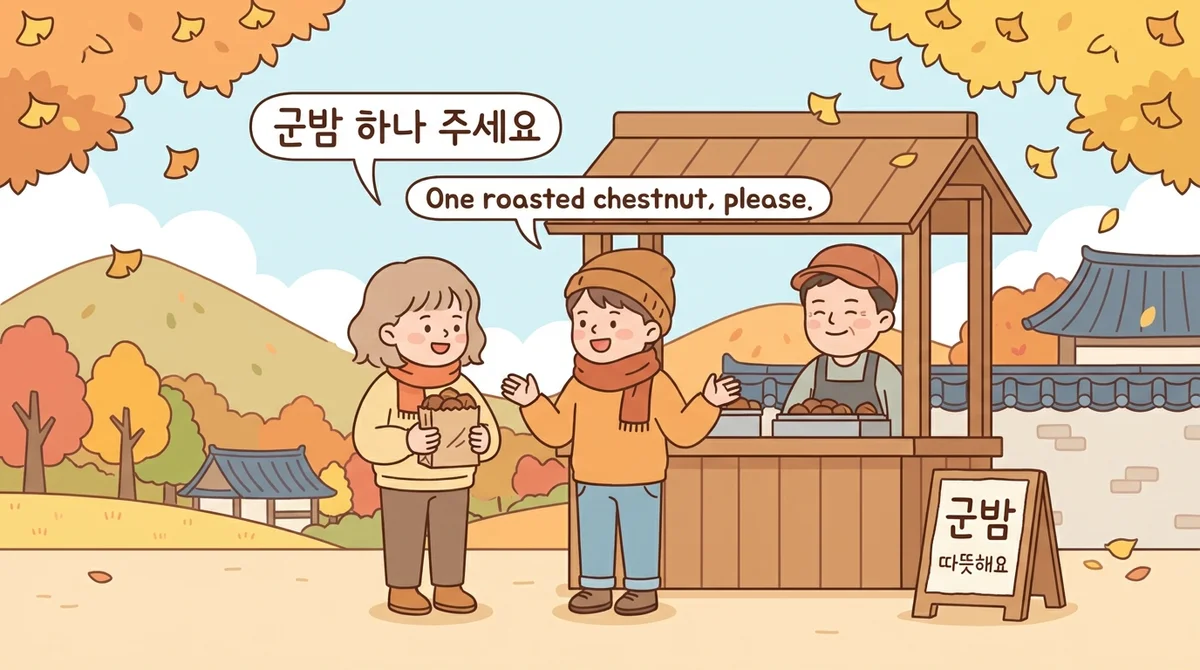
4. Eat with the season. Order 군밤 (gunbam), "roasted chestnuts," or 호떡 (hotteok), a warm sweet pancake sold at street stalls in cold weather. Perfect autumn snack.
5. Take the photo — and name what you see. Point and say 단풍이 정말 예뻐요 (danpungi jeongmal yeppeoyo), "the autumn leaves are so pretty."
Real-Life Example Sentences and Mini-Dialogues
Here's the language in action. Read these out loud — that's the whole point.
Talking about the weather:
- 가을 날씨가 정말 좋아요. (ga-eul nalssiga jeongmal joayo.) — "The autumn weather is really nice."
- 하늘이 너무 높고 파래요. (haneuri neomu nopgo paraeyo.) — "The sky is so high and blue."
At the foot of the mountain:
A: 우리 단풍놀이 갈까요? (uri danpungnori galkkayo?) — "Shall we go leaf-viewing?"
B: 좋아요! 어디로 갈까요? (joayo! eodiro galkkayo?) — "Sounds great! Where should we go?"
A: 내장산이 지금 절정이래요. (naejangsani jigeum jeoljeongiraeyo.) — "They say Naejangsan is at peak color right now."
At a street food stall:
A: 군밤 하나 주세요. (gunbam hana juseyo.) — "One bag of roasted chestnuts, please."
B: 네, 여기 있어요. 따뜻해요. (ne, yeogi isseoyo. ttatteuthaeyo.) — "Sure, here you go. They're warm."
A: 감사합니다! 날씨가 딱 좋네요. (gamsahamnida! nalssiga ttak jonneyo.) — "Thank you! The weather is just perfect."
Around Chuseok:
- 추석 잘 보내세요! (chuseok jal bonaeseyo!) — "Have a happy Chuseok!"
- 송편 정말 맛있어요. (songpyeon jeongmal masisseoyo.) — "The songpyeon is really delicious."
Notice how simple these are. You don't need advanced grammar — you need the right handful of phrases said with confidence.
Practice Tips: Make These Words Stick
Reading these phrases is easy. Remembering them when you're cold, hungry, and standing in front of a street vendor is the hard part. The only fix is saying them out loud until they feel automatic.
Try this: pick three phrases from above — maybe 단풍이 정말 예뻐요, 군밤 하나 주세요, and 오늘 좀 쌀쌀해요 — and repeat each one ten times. Focus on rhythm. 가을 (ga-eul) is two beats, not one. 쌀쌀해요 (ssalssalhaeyo) starts with a tense, doubled "ss" sound that's stronger than the English "s."
This is exactly where Teuida helps. Teuida is a speaking-first app, so instead of memorizing lists you actually speak the language from day one. In the Korean course you can role-play real autumn situations — ordering street food, asking a friend to go leaf-viewing, chatting about the weather — and the built-in AI pronunciation feedback scores how you say each phrase and shows you what to fix.
That means you can rehearse 군밤 하나 주세요 out loud, hear whether your 쌀쌀해요 lands, and walk into that Korean autumn already sounding natural. It's the next best thing to having a local friend correct you in real time.
Go Enjoy Your Korean Fall
Korea's autumn is short, and that's part of the magic — for a few crisp weeks the whole country looks up at the same golden trees and slows down together. When you can name what you're seeing and order that warm 호떡 in Korean, the season stops being scenery and starts being yours.
You don't need to be fluent. You need a handful of phrases and the confidence to say them. So pick your favorite line from this post, open the Korean course in Teuida, and practice it out loud until it's ready for the mountain.


