
Pink seats on the Korean subway are 임산부 배려석, priority seats for pregnant women. What they mean, how they differ from 노약자석, and polite phrases to use.
You step onto the subway in Seoul, exhausted after a long day of walking. You spot an empty seat — a bright pink one — and sink into it with relief. Then you notice a few people glancing your way, and you suddenly feel unsure.
Did you just sit somewhere you shouldn't have? If you've ever had that little jolt of "wait, am I doing something wrong?" on the Korean subway, this post is for you.
What the Pink Seats Actually Are
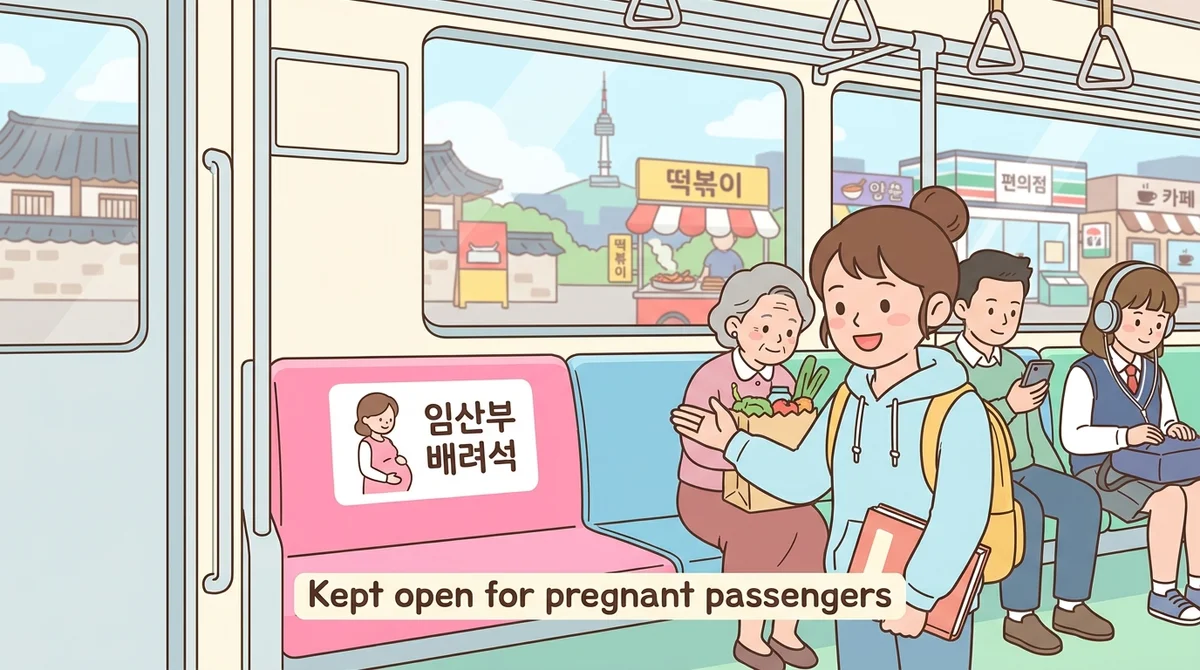
Those bright pink seats you see on Korean subways are 임산부 배려석 (imsanbu baeryeoseok), which means "priority seats for pregnant women." You'll usually find one or two of them near the doors in each train car, wrapped in a soft pink color that's impossible to miss.
The word breaks down nicely. 임산부 (imsanbu) means "pregnant woman," and 배려석 (baeryeoseok) means "consideration seat" or "courtesy seat." Put together, it's a seat set aside out of consideration for expectant mothers.
Why does this matter for you as a learner or traveler? Because Korea takes these little social rules seriously, and knowing them helps you move through daily life with confidence instead of anxiety. Understanding the pink seat is a small window into Korean culture — and a chance to learn some genuinely useful vocabulary.
Pink Seats vs. Other Priority Seats
Korean subways actually have a few kinds of special seating, and it's easy to mix them up. Here's a clean breakdown so you know exactly what you're looking at.
| Korean | Romanization | Meaning | Who it's for |
|---|---|---|---|
| 임산부 배려석 | imsanbu baeryeoseok | Pregnant women's priority seat | Expectant mothers (pink seat) |
| 노약자석 | noyakjaseok | Priority seat | Elderly, disabled, pregnant, injured |
| 교통약자석 | gyotong-yakjaseok | Transit vulnerable seat | People who need mobility support |
The 임산부 배려석 (imsanbu baeryeoseok) — the pink one — is a bit unique. Unlike the seats at the ends of each car, it's usually placed in the middle section and kept empty even when no pregnant person is visible.
That's the part that surprises many visitors. The pink seat is meant to stay open, so a pregnant woman can sit down immediately without having to ask anyone to move. It's the "consideration" part in action.
Common Mistakes Learners Make
The most common mistake is simple: sitting in the pink seat when you're tired and it's empty. It feels wasteful to leave a seat unused, especially on a crowded train. But in Korea, leaving it open is exactly the point.
Some travelers assume the rule is only enforced when a pregnant woman is standing right there. In practice, many Koreans treat the pink seat as reserved at all times. You won't get fined, but you may get uncomfortable looks.
Another mix-up is confusing the pink 임산부 배려석 (imsanbu baeryeoseok) with the general 노약자석 (noyakjaseok), the priority seats near the ends of the car. The end seats are for elderly and disabled passengers too, and they're also best left open — but the pink middle seat is specifically for pregnant women.
Finally, some learners overthink it and stress about every seat. Don't. Most subway seats are completely normal and free for anyone. Only the specially marked ones need your attention.
Simple Rules for Riding Politely
Here's a short, practical guide so you never feel unsure again.
1. Recognize the pink seat. If it's pink and says 임산부 배려석 (imsanbu baeryeoseok), leave it empty.
2. Leave the end seats open too. The 노약자석 (noyakjaseok) priority seats are best kept free for those who need them.
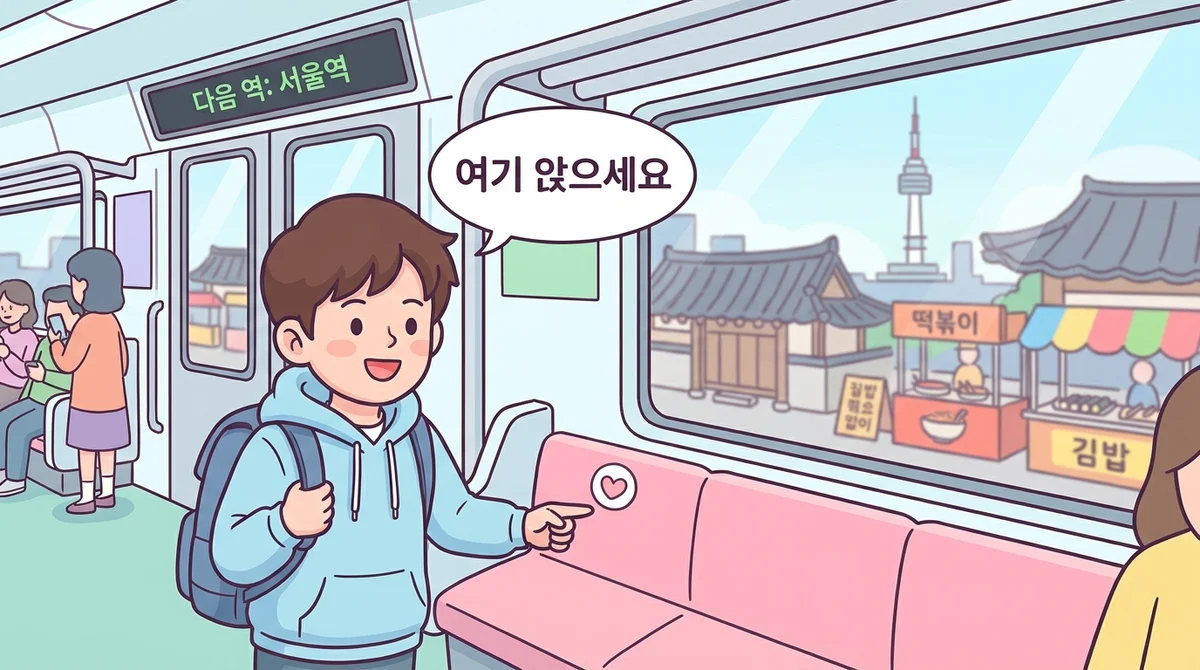
3. Give up your seat if needed. If you're in a regular seat and see someone who clearly needs it — an elderly person, a pregnant woman, someone with a cane — offer it. You can say 여기 앉으세요 (yeogi anjeuseyo), meaning "Please sit here."
4. Move without fuss. If someone quietly gestures that a seat is theirs or needed, just stand up with a small nod. No big apology required.
5. When in doubt, stand. On a short ride, standing is easy and saves you any worry.
Following these keeps you polite and relaxed. Locals will notice a foreigner who respects these small customs, and it earns real goodwill.
Real-Life Example Sentences and Mini-Dialogues
Let's put some useful Korean into your pocket. These are natural phrases you might actually use or hear on the subway.
Offering your seat:
- 여기 앉으세요. (yeogi anjeuseyo.) — "Please sit here."
- 괜찮아요, 여기 앉으세요. (gwaenchanayo, yeogi anjeuseyo.) — "It's okay, please sit here."
Politely declining or thanking:
- 감사합니다. (gamsahamnida.) — "Thank you."
- 아니에요, 괜찮아요. (anieyo, gwaenchanayo.) — "No, it's okay / I'm fine."
Asking about a seat:
- 여기 앉아도 돼요? (yeogi anjado dwaeyo?) — "Is it okay if I sit here?"
- 이 자리 비어 있어요? (i jari bieo isseoyo?) — "Is this seat empty?"
Here's a quick mini-dialogue you might overhear or take part in:
A: 여기 앉으세요. (yeogi anjeuseyo.) — "Please sit here."
B: 아, 감사합니다. (a, gamsahamnida.) — "Oh, thank you."
And one where you check before sitting in a regular seat next to someone:
You: 여기 앉아도 돼요? (yeogi anjado dwaeyo?) — "Is it okay if I sit here?"
Passenger: 네, 앉으세요. (ne, anjeuseyo.) — "Yes, please sit."
Notice how short and gentle these phrases are. You don't need long sentences to be polite in Korean. A simple 감사합니다 (gamsahamnida) or 괜찮아요 (gwaenchanayo) does a lot of work.
Practice Tips: Say It Before You Need It
Here's the truth every learner eventually discovers: you can read all about pink seats and polite phrases, but the words vanish the moment you actually need them. When someone offers you a seat, your brain freezes and you nod silently instead of saying 감사합니다 (gamsahamnida).
The fix is simple but real — you have to say these phrases out loud, again and again, until they come out automatically. Reading isn't speaking. The mouth needs its own practice.
This is exactly where Teuida helps. Teuida is a speaking-first Korean app where you role-play real-life situations out loud — including everyday scenes like riding the subway, offering your seat, and responding to strangers. Instead of memorizing a list, you actually speak lines like 여기 앉으세요 (yeogi anjeuseyo) in a realistic conversation.
Even better, Teuida's AI listens and scores your pronunciation, then shows you what to fix. It's the next best thing to practicing with a real Korean friend, and it means the first time you say 감사합니다 (gamsahamnida) on a real subway, it won't be your first time at all.
A few practice habits that work well:
- Repeat each phrase out loud five times before moving on.
- Shadow the mini-dialogues above — play both roles.
- Practice in short daily bursts, not one long cram session.
- Say the phrase while imagining the real scene: a crowded car, a tired traveler, a kind offer.
Do this and the words stop being "study" and start being reflex.
Wrap-Up
The pink subway seats are a small thing, but they say something lovely about Korea — that everyday spaces are designed with quiet consideration for others. Leaving that seat open, offering yours when it's needed, and knowing a few gentle phrases makes you a thoughtful guest in the city.
You don't need perfect Korean to be polite. You just need a handful of phrases and the confidence to say them out loud when the moment comes.
So take a minute today and practice this out loud in Teuida — role-play offering your seat on the subway and get your pronunciation scored, so you're ready the next time you ride.


