
Korean convenience stores compared: CU, GS25, 7-Eleven, Emart24, Ministop. What each is known for, plus essential 편의점 phrases like 봉투 주세요 and 데워 드릴까요 for the counter.
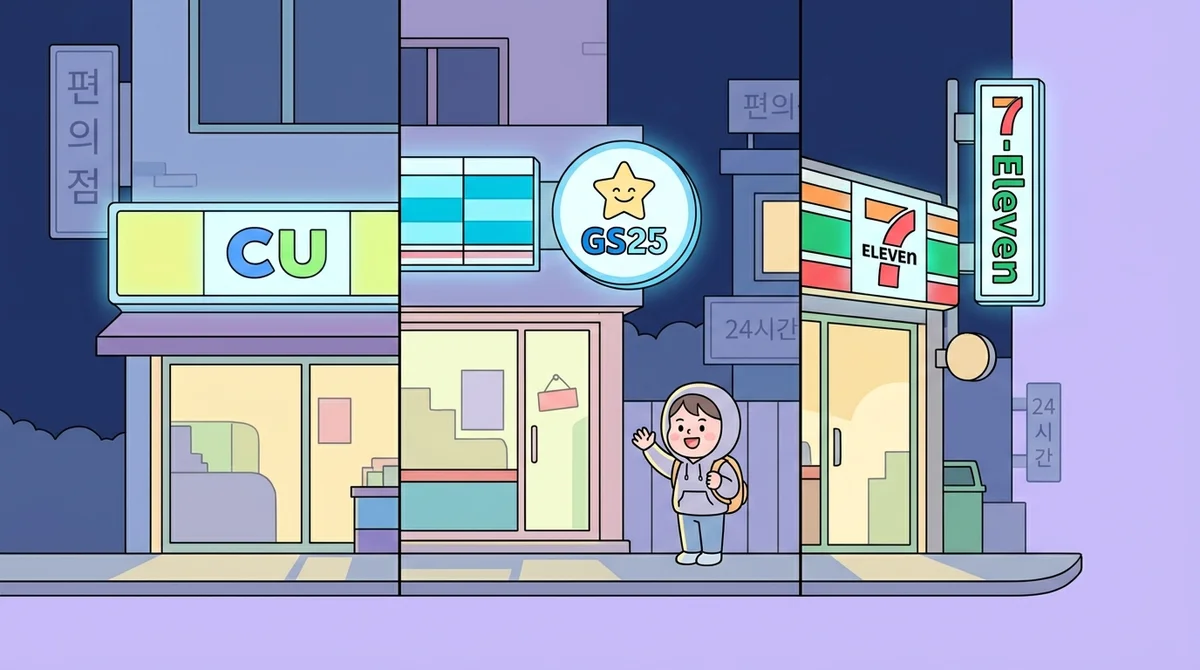
It's 11 p.m., you're back at your hotel, and your stomach growls. You walk outside and see three glowing signs within a block: CU, GS25, and a 7-Eleven. Which one do you walk into?
If you've spent even a day in Korea, you know the 편의점 (pyeonuijeom), "convenience store," is basically a second kitchen, a bill-payment center, and a late-night snack heaven all in one. But they're not all the same — and knowing the differences (plus a few key phrases) makes your trip smoother and your Korean stronger.
Why Convenience Stores Matter So Much in Korea
In many countries, a convenience store is a quick stop for gum and water. In Korea, it's a lifestyle.
Koreans call them 편의점 (pyeonuijeom), literally "convenience shop." They're open 24 hours, they're everywhere, and they sell far more than snacks. You can pay bills, ship packages, charge your transit card, sit down and eat a hot meal, and even buy concert tickets.
For a language learner, they're gold. Every visit is a tiny, low-pressure Korean conversation. You'll hear the same phrases over and over, which means you'll actually start remembering them.
So learning the differences between chains isn't just trivia — it helps you know where to find your favorite instant food, and it gives you natural reasons to practice speaking.
The Big Chains, Side by Side
Korea has a handful of major convenience store brands, and each has its own personality. Here's a quick breakdown of the ones you'll bump into most.
| Store | Korean name | Known for | Watch out for |
|---|---|---|---|
| CU | 씨유 (ssi-yu) | Most locations nationwide, great PB (private brand) snacks, RATIO coffee | Can get crowded near stations |
| GS25 | 지에스25 (ji-e-seu i-sip-o) | Strong food lineup, Café25 coffee, popular desserts | Prices sometimes slightly higher |
| 7-Eleven | 세븐일레븐 (se-beun-il-le-beun) | Good hot food counter, imported goods | Fewer branches in some areas |
| Emart24 | 이마트24 (i-ma-teu i-sip-sa) | Cleaner/bigger layouts, some sell alcohol focus | Not as dense as CU/GS25 |
| Ministop | 미니스톱 (mi-ni-seu-top) | Fresh soft-serve ice cream, fried snacks | Shrinking number of stores |
CU and GS25 are the two giants — you'll see them constantly, and they compete hard on new products. If a viral snack blows up on Korean social media, it's usually one of these two behind it.
Common Mistakes Learners Make
Before we get to phrases, let's clear up a few things that trip up visitors.
Thinking they're all identical. They're not. If you loved a specific 삼각김밥 (samgak-gimbap), "triangle rice ball," at GS25, you might not find that exact one at CU. Brands make their own products.
Not knowing you can eat inside. Many stores have a counter or tables, sometimes with a microwave and hot water. Tourists often buy 라면 (ramyeon), "instant noodles," then wander off looking for somewhere to cook it — when the store itself has everything.
Forgetting to ask for a bag. Korea charges for plastic bags, and staff won't automatically give you one. If you don't say anything, you'll be juggling items in your arms.
Assuming card is always fine. It almost always is, but for tiny purchases some learners panic. Don't — cards work virtually everywhere.
Step-by-Step: How to Shop Like a Local
Here's the natural flow of a convenience store visit, with the Korean you'll need at each step.
1. Walk in. You'll hear 어서 오세요 (eoseo oseyo), "welcome / come in." You don't have to reply, but a small nod or 안녕하세요 (annyeonghaseyo), "hello," is warm and polite.
2. Grab what you want. Snacks, drinks, a lunchbox — Koreans call these 도시락 (dosirak), "lunchbox meal."
3. Ask for help if you can't find something. Try 이거 어디 있어요? (igeo eodi isseoyo?), "Where is this?" while pointing at a photo or the shelf area.
4. Heating your food. If you buy a 도시락 (dosirak), the cashier will often ask 데워 드릴까요? (dewo deurilkkayo?), "Shall I heat it up for you?" Say 네 (ne), "yes," if you want it hot.
5. Pay. Hand over your card or cash. If you want a bag, ask 봉투 주세요 (bongtu juseyo), "A bag, please."
6. Leave. You'll hear 안녕히 가세요 (annyeonghi gaseyo), "goodbye (to someone leaving)." Easy.
That's the whole routine. Once you've done it two or three times, it becomes automatic — and suddenly you're having real Korean interactions every single day.
Real-Life Example Sentences and Mini-Dialogues
Let's put it together. Here are the kinds of exchanges you'll actually have.
Ordering hot food:
Cashier: 데워 드릴까요? (dewo deurilkkayo?) — "Shall I heat it up?"
You: 네, 데워 주세요. (ne, dewo juseyo.) — "Yes, please heat it up."
Asking where something is:
You: 저기요, 라면 어디 있어요? (jeogiyo, ramyeon eodi isseoyo?) — "Excuse me, where are the instant noodles?"
Cashier: 저쪽에 있어요. (jeojjoge isseoyo.) — "They're over there."
Buying a bag and paying by card:
You: 봉투 하나 주세요. 카드 돼요? (bongtu hana juseyo. kadeu dwaeyo?) — "One bag, please. Can I pay by card?"
Cashier: 네, 돼요. (ne, dwaeyo.) — "Yes, you can."
Asking about a drink you don't recognize:
You: 이거 뭐예요? (igeo mwoyeyo?) — "What is this?"
Cashier: 그건 식혜예요. (geugeon sikhyeyeyo.) — "That's sikhye (a sweet rice drink)."
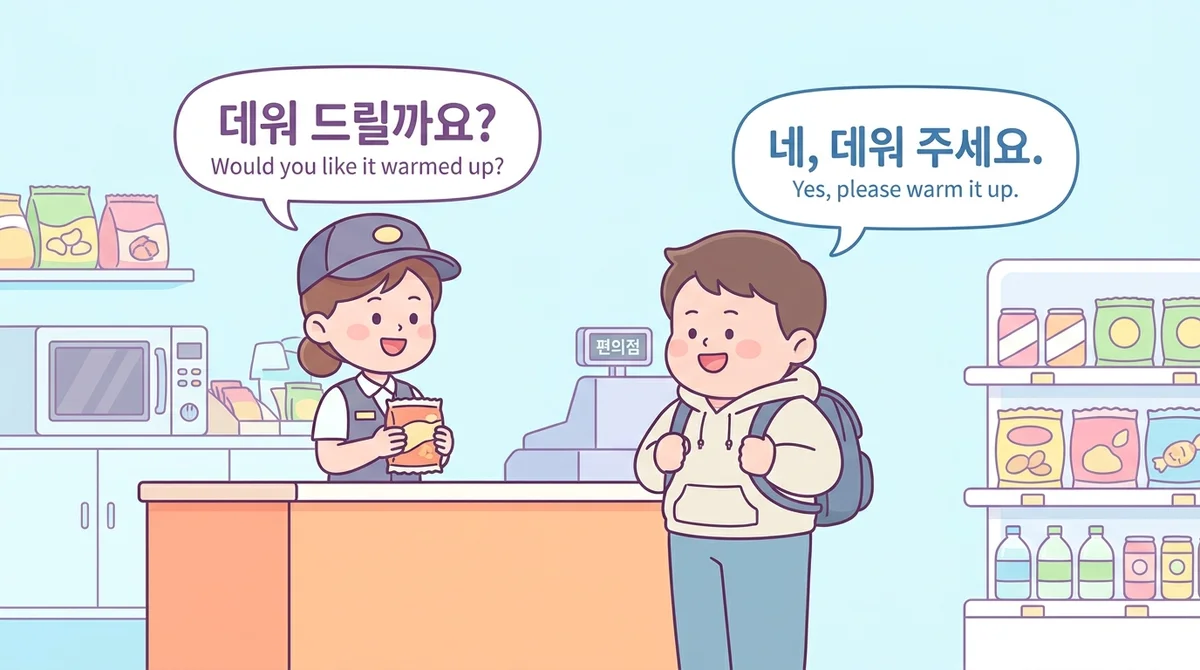
Notice how short these are. Convenience store Korean is beginner-friendly because the same handful of phrases repeat everywhere. Master these and you'll feel instantly more confident.
Practice Tips: Make These Phrases Stick
Here's the honest truth: reading these phrases once won't cut it. The moment a real cashier asks 데워 드릴까요? (dewo deurilkkayo?), your brain freezes if you've never said the answer out loud.
The fix is simple — practice speaking before you're standing at the counter. Say the phrases aloud right now. Say 네, 데워 주세요 (ne, dewo juseyo) three times. Feel your mouth make the shapes. That muscle memory is what saves you in the real moment.
This is exactly what Teuida is built for. Instead of grinding flashcards, you speak Korean from day one inside real-life scenarios — including convenience store role-plays that mirror the exact exchanges above. You play the customer, the app plays the cashier, and you talk through the whole visit out loud.
Even better, Teuida's AI pronunciation feedback scores how you say each phrase and shows you what to fix — the next best thing to having a Korean friend beside you. So when you're actually in a CU at midnight, 봉투 주세요 (bongtu juseyo) rolls off your tongue naturally.
Try running the convenience store scenario in Teuida's Korean course a few times before your trip. It turns nervous silence into a real, smooth conversation.
Wrap-Up: Pick Your Store, Speak Your Order
There's no single "best" convenience store in Korea — CU and GS25 win on sheer numbers and snacks, 7-Eleven and Ministop have their own treats, and Emart24 gives you space to breathe. Half the fun is comparing them yourself.
But the real win is walking in confidently and handling the whole visit in Korean. That's a small, daily victory that adds up fast, and it makes Korea feel like a place you belong in rather than just visit.
So don't just memorize these phrases — practice this convenience store conversation out loud in Teuida's Korean course and get your pronunciation scored before you ever set foot in a CU.


