
Why every language app copies Duolingo's tap-and-match loop, what it actually trains, and how Teuida's speaking-first Korean role-plays close the speaking gap.
You've probably felt it. You hit a 200-day streak on a language app, you can tap the right answer in half a second, and then a Korean speaker says "안녕하세요?" (annyeonghaseyo — hello) and your mind goes completely blank.
That gap is real, and it isn't your fault. It's the design. Almost every language app you've tried copies the same formula — and that formula quietly trains you to recognize Korean without ever learning to say it.
Why every app looks the same
Open ten language apps and you'll notice something strange: they all feel like siblings. Colorful buttons, a cartoon mascot, a streak counter, and endless tap-the-matching-word exercises.
There's a reason for that. Duolingo proved that this style is addictive — it keeps people opening the app daily. So dozens of competitors copied the loop: bite-sized taps, points, streaks, guilt notifications. It's brilliant for retention. It's a business model as much as a teaching method.
But "opens the app daily" and "can actually speak Korean" are not the same goal. The copycat formula is optimized for the first one. And once you understand that, a lot of your frustration suddenly makes sense.
What the tap-and-match formula actually trains
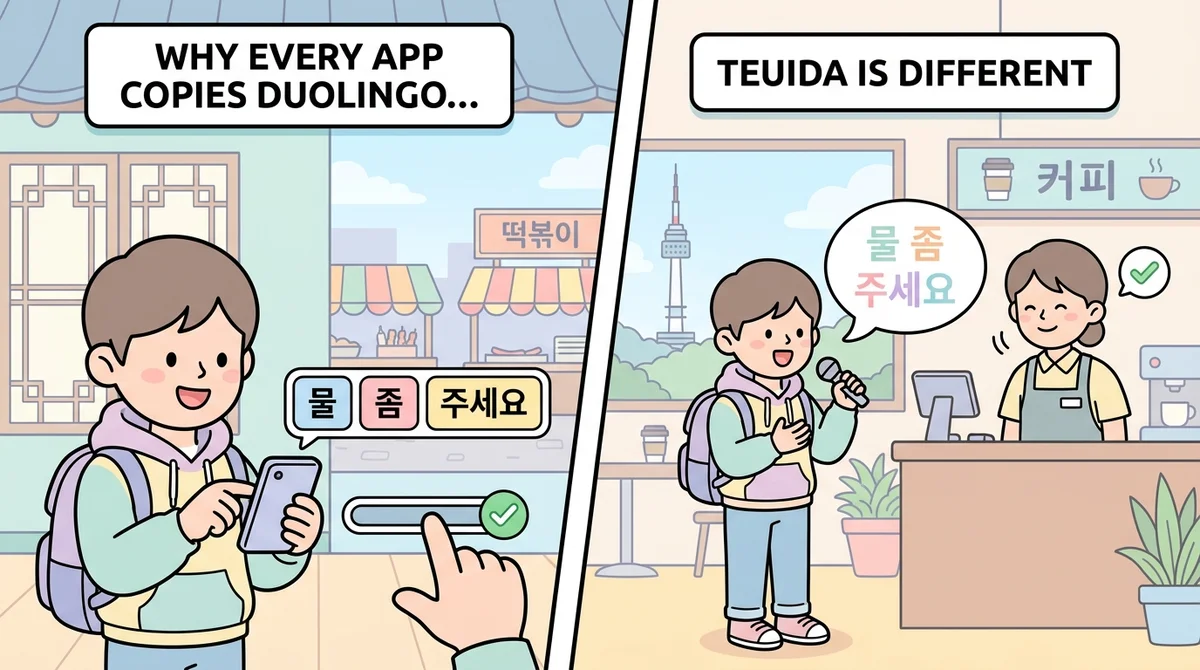
Here's the uncomfortable truth. When you tap a word from a word bank, you're doing recognition, not production.
Recognition means you can spot the right answer when it's shown to you. Production means you can pull the words out of your own head and say them out loud, in real time, when no answer bank exists. Real conversation is 100% production. The copycat apps drill 90% recognition.
Let me show you the difference with one small phrase, 물 좀 주세요 (mul jom juseyo — please give me some water).
| Tap-and-match apps | Real conversation | |
|---|---|---|
| What you do | Tap the 4 correct tiles in order | Say the whole line out loud, unprompted |
| Help available | Words shown, wrong ones grayed out | Nothing — it's all from memory |
| Skill trained | Recognizing Korean | Producing Korean |
| Feedback | "Correct!" ✅ | Did they understand you? |
| Pronunciation | Never tested | The whole point |
You can ace the left column for a year and still freeze in the right column. That's the trap so many learners fall into.
Common mistakes this design creates
The formula doesn't just fail to teach speaking. It actively builds habits that get in your way. Here are the ones I see most.
Mistaking your streak for progress. A 365-day streak feels like an achievement, and it is — for showing up. But it measures consistency of tapping, not ability to speak. Learners assume the number means fluency. It doesn't.
Never hearing your own voice. If an app never asks you to speak, you never find out that your 감사합니다 (gamsahamnida — thank you) sounds a little off. You only discover it in the wild, mid-conversation, at the worst possible moment.
Word-bank crutch. When the correct words are always on screen, your brain learns to select, not recall. Remove the bank and the words vanish. This is why people say "I understand more than I can say" — the apps trained exactly that imbalance.
Zero context. Tapping "the woman eats bread" fifty times doesn't prepare you for ordering at a 카페 (kape — café) or asking for directions. Real Korean lives inside situations, not isolated sentences.
How to actually build speaking skill
So what should you do instead? The fix isn't complicated, but it demands something the copycat apps avoid: opening your mouth. Here's the sequence that works.
Step 1 — Learn the phrase with sound, not just text. When you meet a new line like 얼마예요? (eolmayeyo — how much is it?), listen to it several times before you even read the romanization. Your ears lead, your eyes follow.
Step 2 — Say it out loud immediately. Not in your head. Out loud. Even whispering forces your mouth to form the sounds — the muscle memory that recognition can never build.
Step 3 — Get feedback on your pronunciation. This is the step almost everyone skips because it's hard to do alone. You need to know if your 어 (eo) and 오 (o) sound different, because to a Korean ear they change the word entirely.
Step 4 — Practice inside a real situation. Don't drill the phrase in a vacuum. Practice 얼마예요? as part of actually buying something — greeting, asking the price, paying, saying thank you. That's how it sticks.
Step 5 — Repeat the whole exchange until it's automatic. Fluency isn't knowing the phrase; it's saying it without pausing to translate in your head.
Notice that every single step involves producing Korean, not selecting it. That's the whole difference.
Real-life examples: recognition vs. speaking
Let me make this concrete with a mini-scene. Imagine you're at a small restaurant in Seoul.
The waiter: 어서 오세요! 몇 분이세요? (eoseo oseyo! myeot buniseyo? — Welcome! How many people?)
You: 두 명이요. (du myeong-iyo — Two people.)
The waiter: 이쪽으로 오세요. (ijjogeuro oseyo — Come this way.)
A tap-and-match app can teach you to recognize each of those lines on a quiz. But this exchange happens in about four seconds, out loud, with no word bank. If you've never said 두 명이요, you'll hesitate — and hesitation is what breaks the flow.
Here's another everyday one, ordering a coffee:
You: 아메리카노 한 잔 주세요. (amerikano han jan juseyo — One Americano, please.)
Barista: 따뜻한 거요, 아이스요? (ttatteuthan geoyo, aiseuyo? — Hot or iced?)
You: 아이스로 주세요. (aiseuro juseyo — Iced, please.)
Simple, right? But "simple to read" and "smooth to say under pressure" are different skills. The only way to close that gap is to rehearse the speaking, not the reading.
How to practice this — out loud, with feedback
Here's the honest bottom line: the only way speaking sticks is by speaking. You cannot tap your way to a conversation. You have to hear the Korean, say it back, find out where your pronunciation slips, and fix it — over and over, inside real situations.
That's exactly the gap Teuida was built to fill, and it's why it isn't just another Duolingo clone. Instead of a word bank, Teuida drops you into K-drama-style conversation scenarios — ordering at that café, asking for directions, meeting someone new — and you actually speak your lines out loud to move the scene forward.
Then its AI pronunciation feedback scores how you said it and shows you what to fix. If your 아이스로 주세요 comes out muddy, you'll know immediately, in private, instead of getting a confused look from a real barista. It's the next best thing to a patient tutor sitting beside you.
Because it was built by bilingual tutors, the scenarios use the Korean people actually say, not textbook sentences. And because you're speaking from day one, the confidence builds fast — you're not preparing to someday speak, you're speaking right now.
So take one scene from this post — the café order or the restaurant greeting — and run it in Teuida tonight. Say it out loud five times and let the app grade you. That's five reps of real production, which is worth more than five hundred taps.
You already have more Korean than you think
If you've been grinding a tap-and-match app and feeling stuck, please hear this: you're not bad at Korean. You've just been training the wrong muscle. All that recognition you built is real — it's a foundation. You only need to add the missing half, which is your voice.
The moment you start saying Korean out loud instead of tapping it, everything shifts. Phrases you "sort of knew" become phrases you can actually use. And the freeze-up in real conversations gets shorter and shorter until it disappears.
Pick one phrase from today — maybe 얼마예요? or 아이스로 주세요 — and practice it out loud in Teuida until the app scores you green. That's the difference between recognizing Korean and speaking it. Go make the leap.


