
Spanish is the easiest language for English speakers: thousands of cognates, five clean vowels, and phonetic spelling. See why, plus common mistakes to avoid.
You've probably heard someone say it at a party: "Oh, Spanish? That's the easy one." And maybe you rolled your eyes a little, because if it were that easy, wouldn't you already speak it?
Here's the thing — that person wasn't entirely wrong. Spanish really does give English speakers a head start that most languages don't. You already know more than you think, and once you see why, the whole thing stops feeling like a mountain and starts feeling like a hill you can actually walk up.
What Makes Spanish "Easy" for English Speakers
Let's be clear about what "easy" means here. No language is effortless — you still have to show up and practice. But some languages are closer to English than others, and closeness is what saves you time.
Spanish and English share a huge chunk of history. Both borrowed heavily from Latin, so thousands of words overlap. On top of that, Spanish spelling matches its sound almost perfectly, so once you learn the rules, you can read any word out loud correctly — even one you've never seen.
Compare that to something like Japanese, where you learn three writing systems before you can read a menu, or French, where half the letters in a word stay silent. Spanish plays fair. What you see is what you say.
That's why the U.S. Foreign Service Institute — the folks who train diplomats — rank Spanish in their easiest category for English speakers, alongside French and Italian. It typically takes English speakers far fewer hours to reach conversational fluency in Spanish than in, say, Korean or Arabic.
The Core Reasons, Side by Side
Let's break down exactly where the English–Spanish advantage lives. Here's a quick comparison of the features that make Spanish friendlier than most other popular languages.
| Feature | Spanish | Why it helps English speakers |
|---|---|---|
| Vocabulary overlap | Thousands of cognates | Words like hospital, animal, color are nearly identical |
| Spelling & sound | Fully phonetic | Read any word aloud correctly once you know 5 vowel sounds |
| Alphabet | Same Latin script (+ ñ) | No new writing system to memorize |
| Vowel sounds | Only 5, always the same | English has ~15 messy vowels; Spanish is simpler |
| Word order | Similar to English (S-V-O) | Yo como pan = "I eat bread" — same order |
| Availability | Spoken by ~500 million people | Easy to find shows, music, and people to practice with |
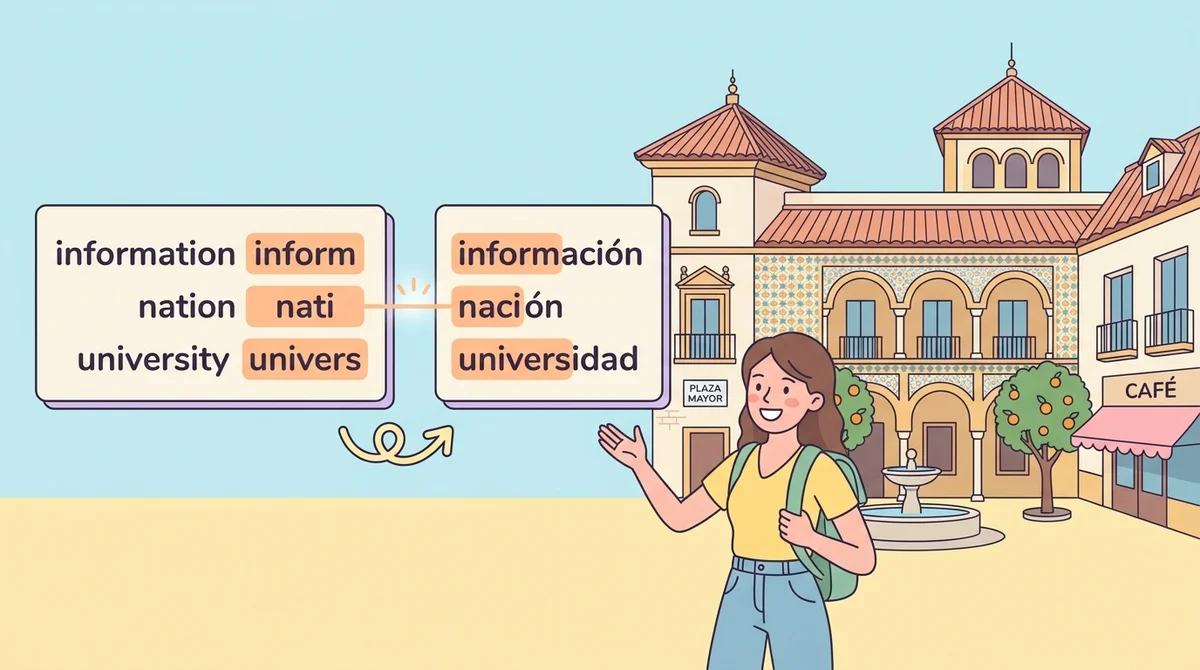
Look at that vocabulary row again. English words ending in -tion usually become -ción in Spanish: information → información (in-for-ma-see-OHN), "information." Nation → nación (na-see-OHN), "nation." Learn that one pattern and you've unlocked hundreds of words in a single afternoon.
Words ending in -ty often become -dad: university → universidad (oo-nee-ver-see-DAD), "university." City → ciudad (see-oo-DAD), "city." These aren't lucky coincidences — they're reliable rules you can lean on.
The Five Vowels That Change Everything
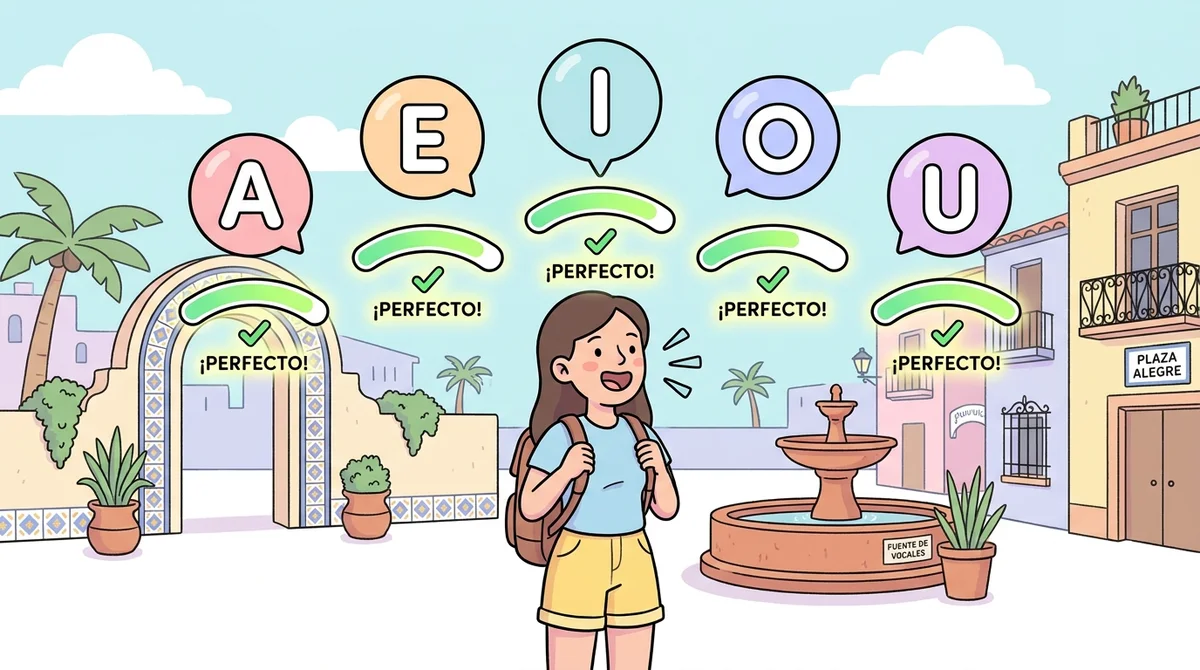
If you take one thing from this post, make it this: Spanish has exactly five vowel sounds, and they never change.
- a — like the "a" in father: casa (KA-sa), "house"
- e — like the "e" in bet: mesa (MEH-sa), "table"
- i — like the "ee" in see: sí (see), "yes"
- o — like the "o" in more: hola (OH-la), "hello"
- u — like the "oo" in food: luna (LOO-na), "moon"
In English, the letter "a" sounds different in cat, car, cake, and about. That inconsistency is why English is genuinely hard for foreign learners. Spanish doesn't do that to you. Once you lock in those five sounds, your pronunciation gets dramatically more consistent than it ever was in your own language.
Common Mistakes English Speakers Make
Easy doesn't mean mistake-proof. Here are the traps that trip up almost every English speaker early on.
1. English vowels sneaking in. New learners say "casa" like "KAH-suh," letting that lazy English uh sound at the end. In Spanish, that final "a" stays a clean, crisp "ah." Every vowel gets its full value.
2. Trusting false friends. Some words look like English but mean something else. Embarazada (em-ba-ra-SA-da) does not mean "embarrassed" — it means "pregnant." Ropa (RO-pa) means "clothes," not "rope." Actualmente (ak-too-al-MEN-te) means "currently," not "actually." Learn the famous ones early to avoid awkward moments.
3. Forgetting gendered nouns. Every Spanish noun is masculine or feminine: el libro (el LEE-bro), "the book," but la mesa (la MEH-sa), "the table." English has no equivalent, so it feels strange at first. Just memorize the article with the noun and it becomes automatic.
4. Fear of the rolled "r." The rr in perro (PEH-rro), "dog," scares people off. But you don't need a perfect roll to be understood — you just need to try. A soft attempt is far better than avoiding the word.
5. Waiting until you're "ready" to speak. This is the biggest one, and it has nothing to do with grammar. People study for months in silence and then freeze the first time a real person answers back.
A Simple Step-by-Step Way to Start
You don't need a textbook the size of a brick. Here's a practical order that plays to Spanish's strengths.
- Master the five vowels first. Spend one session just saying a, e, i, o, u until they feel natural. Everything else builds on this.
- Learn the -ción and -dad patterns. In a single week you can absorb hundreds of words for free by recognizing cognates.
- Grab 20 survival phrases. Greetings, ordering food, asking for directions. These get you through a real trip immediately.
- Add the present tense of common verbs. Start with ser (to be), estar (to be), tener (to have), and querer (to want). These four unlock endless sentences.
- Speak out loud from day one. Don't wait. Say every phrase aloud, even alone in your kitchen. Your mouth needs the reps as much as your brain does.
Real-Life Example Sentences and a Mini-Dialogue
Let's put it together. Notice how the word order mostly matches English — that's the shared-DNA advantage in action.
- Hola, ¿cómo estás? (OH-la, KO-mo es-TAS) — "Hi, how are you?"
- Quiero un café, por favor. (kee-EH-ro oon ka-FEH, por fa-VOR) — "I want a coffee, please."
- ¿Dónde está el baño? (DON-de es-TA el BA-nyo) — "Where is the bathroom?"
- No hablo mucho español todavía. (no A-blo MOO-cho es-pa-NYOL to-da-VEE-a) — "I don't speak much Spanish yet."
- La comida está deliciosa. (la ko-MEE-da es-TA de-lee-see-OH-sa) — "The food is delicious."
Now a short café exchange you might actually use on a trip:
You: Buenos días. ¿Me da un café con leche? (BWE-nos DEE-as. me da oon ka-FEH kon LE-che) — "Good morning. Can I have a latte?"
Barista: Claro. ¿Algo más? (KLA-ro. AL-go mas) — "Of course. Anything else?"
You: Sí, un croissant, por favor. (see, oon krwa-SAN, por fa-VOR) — "Yes, a croissant, please."
Barista: Son cuatro euros. (son KWA-tro EU-ros) — "That's four euros."
You: Aquí tiene. Gracias. (a-KEE tee-EH-ne. GRA-see-as) — "Here you go. Thank you."
Read that whole conversation out loud right now. Notice how much of it you could already follow before the translations. That's Spanish being kind to you.
How to Actually Make It Stick
Here's the honest truth that no vowel chart can fix: recognizing Spanish and speaking Spanish are two completely different skills. You can ace every quiz and still freeze when a real barista looks at you and waits.
The only fix is talking — out loud, in real situations, over and over, until the words come without thinking. That's exactly what Teuida is built for. Instead of grinding flashcards, you speak Spanish from day one by role-playing real-life scenarios, like ordering that café con leche or asking where the bathroom is.
Even better, Teuida's AI pronunciation feedback listens to how you say café or gracias and scores it, then shows you where to fix it — the next best thing to having a native friend correcting you in real time. So those five vowels and that rolled "r" stop being theory and become muscle memory.
In Teuida's Spanish course, the scenarios walk you through the exact conversations from this post — greetings, cafés, directions — so you're not memorizing, you're rehearsing for the real thing. Do a five-minute conversation a day and within weeks you'll answer a Spanish speaker without that panicked pause.
You're Closer Than You Think
Spanish hands English speakers a genuine gift: shared words, honest spelling, five clean vowels, and word order that feels familiar. You're not starting from zero — you're starting from a running head start most learners of other languages would love to have.
So don't let it stay theory. Pick one phrase from this post, say it out loud, and build from there. Practice ordering a café con leche out loud in Teuida's Spanish course and get your pronunciation scored — your first real conversation is closer than you think.


