
Spanish vs Portuguese: gracias or obrigado, nasal vowels, and false friends like embarazada. See what really differs and why Spanish is the easier start.
You booked a trip to Spain, opened a language app, and someone told you, "Oh, Spanish and Portuguese are basically the same thing." So you shrugged and figured you'd wing it. Then a friend from Brazil said something that sounded nothing like the Spanish you'd been practicing, and now you're not sure what you're actually learning.
It's a fair confusion. These two languages are close cousins — but "cousins" is exactly the point. They look similar on paper and drift apart the moment someone opens their mouth. Let's clear it up so you know precisely what you're signing up for when you choose Spanish.
Why This Comparison Trips People Up
Spanish and Portuguese both grew out of Latin, in neighboring regions of the Iberian Peninsula. That shared root means a huge chunk of their vocabulary overlaps, their sentence structures rhyme, and a Spanish speaker reading Portuguese can often guess the gist.
But here's the twist most beginners don't hear until later: reading each other is easy, understanding the spoken language is not. Portuguese sounds have shifted in ways Spanish never did. So you can stare at a Portuguese menu and follow along, then be completely lost when a waiter reads it aloud.
If your goal is Spain, Mexico, Argentina, or most of Latin America, you want Spanish. Portuguese is the language of Brazil and Portugal. Knowing which one you're chasing saves you months of accidentally mixing them up.
The Core Differences, Side by Side
Let's look at the big buckets: sounds, spelling, grammar, and a few key words. This is where the two really separate.
| Feature | Spanish | Portuguese |
|---|---|---|
| "Thank you" | gracias (GRAH-see-as) | obrigado / obrigada (oh-bree-GAH-doo) |
| Nasal vowels | almost none | many (ão, ãe, õe) |
| "The" (masc./fem.) | el / la | o / a |
| "And" | y (ee) | e (ee) |
| "Yes" | sí (see) | sim (seeng) |
| Question "how much?" | ¿cuánto? (KWAN-toh) | quanto? (KWAN-too) |
| Written accents | á, é, í, ó, ú, ñ | á, â, ã, ç, õ and more |
Notice how the written words often look like siblings — quanto vs cuánto, e vs y. But Portuguese piles on nasal sounds and softer, more swallowed endings. Spanish, by contrast, is famously crisp: you tend to pronounce every vowel clearly and consistently.
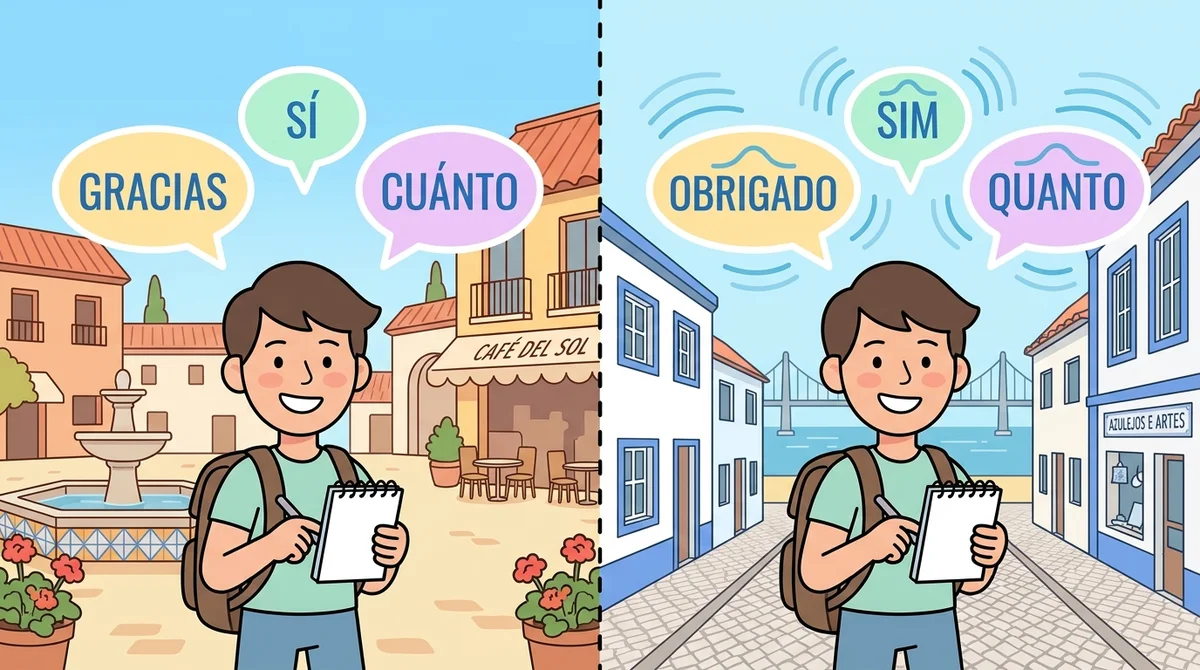
That crispness is exactly why many learners find Spanish the friendlier starting point. What you see is very close to what you say.
The Sound Gap Nobody Warns You About
If you take away one thing, take this: Spanish vowels are steady and Portuguese vowels wander. Spanish has five clean vowel sounds — a, e, i, o, u — and they barely change. Portuguese has open vowels, closed vowels, and nasal vowels, which is why it can sound "mushier" or more musical to a newcomer.
Take the ending -ão in Portuguese, as in coração ("heart"). There's no Spanish equivalent for that nasal glide — your nose does the work. Spanish just doesn't ask that of you.
Another one: the letter j. In Spanish, j is a throaty "h" sound — jamón (ha-MOHN), "ham." In Portuguese, j sounds like the "s" in "measure." Same letter, completely different mouth.
And the Spanish ñ, as in mañana (ma-NYAH-na), "tomorrow / morning," is written nh in Portuguese. So the sound survives the border, but the spelling changes clothes.
Common Mistakes Learners Make
When you know a little of one, the other sneaks in. Here are the traps to watch for.
Mixing "gracias" and "obrigado." These are the most common words you'll say, and it's shockingly easy to blurt the wrong one. If you're learning Spanish, drill gracias until it's automatic.
Assuming words mean the same thing. These languages are full of false friends. In Spanish, exquisito means "delicious/exquisite" and is a compliment. Portuguese has esquisito, which means "weird / strange." Same-looking word, opposite vibe.
Here's a short false-friend list to keep in your back pocket:
| Word | Spanish meaning | Portuguese meaning |
|---|---|---|
| exquisito / esquisito | exquisite, delicious | weird, strange |
| largo | long | wide |
| oficina | office | workshop / garage |
| embarazada / embaraçada | pregnant | embarrassed |
That last one has ended a lot of conversations awkwardly, so remember: in Spanish, embarazada (em-ba-ra-SAH-da) means pregnant, not embarrassed.
Copying Portuguese pronunciation onto Spanish spelling. If you've heard Brazilian Portuguese, you might nasalize or swallow endings that Spanish wants you to pronounce fully. Say the whole word, every vowel, out loud.
How to Keep Them Straight — A Simple Plan
You don't need a linguistics degree. You need a few habits that anchor you in Spanish.
Step 1 — Pick your target and commit. Traveling to Spain or Latin America? You're learning Spanish. Say it out loud so your brain stops hedging.
Step 2 — Learn the sound rules first, not last. Nail the five clean Spanish vowels and the throaty j. This alone builds an accent that won't drift into Portuguese.
Step 3 — Anchor with 5 "identity" words. These instantly signal you're speaking Spanish, not Portuguese:
- gracias (GRAH-see-as) — "thank you"
- sí (see) — "yes"
- por favor (por fah-VOR) — "please"
- hola (OH-la) — "hello"
- ¿cómo estás? (KOH-mo es-TAHS) — "how are you?"
Step 4 — Say full endings. In Spanish, don't swallow the last syllable. Buenos días ends with a clear "s."
Step 5 — Practice out loud daily. Recognizing Spanish and speaking it are two different skills. Speaking is the one that fails you on the ground, so train that one first.
Real Spanish in Action
Here are mini-dialogues in Spanish so you can hear the rhythm — and see how it differs from the Portuguese you might mix it up with.
At a café:
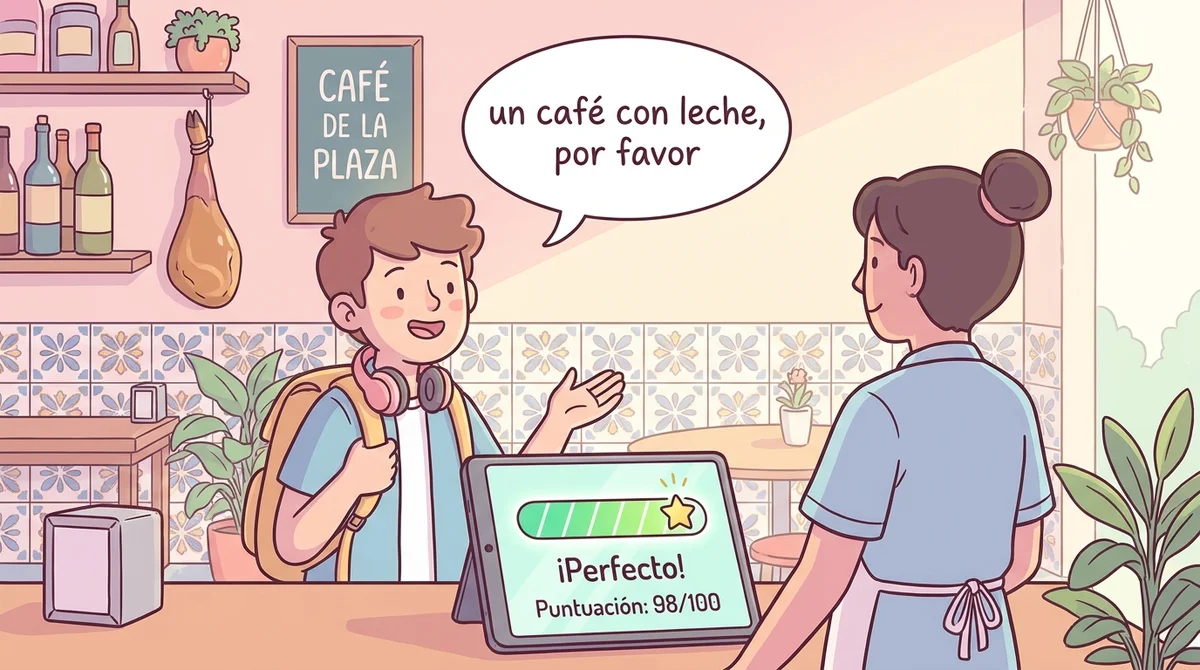
- A: Hola, ¿me da un café con leche, por favor? (OH-la, meh da oon kah-FEH kon LEH-cheh, por fah-VOR) — "Hi, could I have a latte, please?"
- B: Claro. ¿Algo más? (KLAH-ro. AL-go mas) — "Of course. Anything else?"
- A: No, gracias. ¿Cuánto es? (no, GRAH-see-as. KWAN-toh es) — "No, thank you. How much is it?"
Notice gracias and cuánto — in Portuguese you'd hear obrigado and quanto. That one exchange already sounds distinctly Spanish.
Meeting someone:
- A: Hola, ¿cómo te llamas? (OH-la, KOH-mo teh YAH-mas) — "Hi, what's your name?"
- B: Me llamo Marta. ¿Y tú? (meh YAH-mo MAR-ta. ee too) — "My name's Marta. And you?"
- A: Encantado. (en-kan-TAH-do) — "Nice to meet you."
The ll in llamo sounds like a "y" in most of Spain and Latin America. Small detail, big giveaway that you're in Spanish territory.
How to Actually Make It Stick
Here's the honest part. You can memorize every table above and still freeze the moment a real person answers you. That's because reading and listening live in one part of your brain, and speaking lives in another — and speaking is the one that only grows when you use your mouth.
The fix is embarrassingly simple: talk out loud, every day, in real situations. Not silently reading Spanish. Not just tapping flashcards. Actually forming the words, hearing yourself, and correcting the sounds that drift toward Portuguese.
This is exactly what Teuida's Spanish course is built for. Instead of grinding grammar tables, you jump into real conversation scenarios — ordering that café con leche, introducing yourself, asking ¿cuánto es? — and you say them out loud from day one. Teuida's AI pronunciation feedback scores how you say each phrase and shows you where to fix it, so those clean Spanish vowels and that throaty j actually land instead of sliding into a Portuguese sound.
It's the next best thing to standing at a café in Madrid with a patient friend. You role-play the scene, you speak, you get scored, you try again — and the words move from "I recognize that" to "I can say that." That's the whole difference between studying Spanish and speaking Spanish.
You've Got This
So, Spanish and Portuguese: cousins, not twins. They share roots and a lot of spelling, but Spanish rewards you with clean, steady vowels and a "what you see is what you say" honesty that makes it a wonderful place to start. Now that you can hear the difference, you won't blur the two — you'll sound unmistakably Spanish.
The next step isn't more reading. It's opening your mouth. Practice these exact phrases out loud in Teuida's Spanish course and get your pronunciation scored until gracias, sí, and ¿cuánto es? roll off your tongue like second nature.


