
The best media to learn Spanish, ranked by level: kids' shows, podcasts, music, and telenovelas. Plus a 5-step routine to turn watching into real speaking.
You finish a Spanish lesson, feel good about it, then sit down to watch a Spanish show that night. Ten seconds in, everyone's talking at once, the subtitles fly by, and you catch maybe three words. You pause, rewind, catch two more, and quietly wonder if you learned anything at all.
That feeling is completely normal — and it's not a sign you're bad at Spanish. It's a sign you haven't matched the right media to your current level yet. Let's fix that.
Why Media Matters for Learning Spanish
Textbooks teach you the Spanish that should be spoken. Media teaches you the Spanish that people actually speak — with slang, interruptions, regional accents and real speed.
When you consume Spanish media regularly, you soak up rhythm and intonation, you meet vocabulary in context (which is far stickier than a word list), and you start to feel what sounds natural. This is called input, and you need a lot of it.
But here's the catch most people miss: input alone won't make you speak. You can watch a hundred hours of telenovelas and still freeze when a waiter asks what you'd like. Media builds understanding; speaking builds output. You need both, and we'll come back to that.
The Best Types of Spanish Media, Ranked by Level
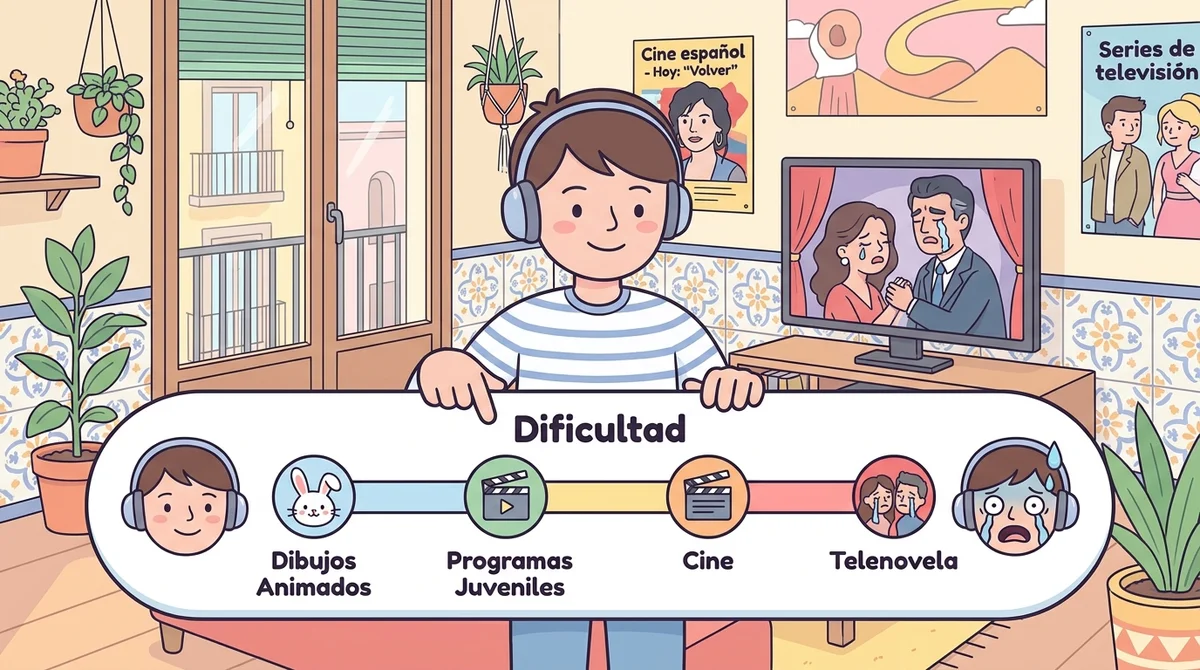
Not all media is equal, and the biggest mistake is jumping straight into content made for native speakers. Here's a clear breakdown of what to reach for depending on where you are.
| Media type | Best for level | Why it works | Watch out for |
|---|---|---|---|
| Kids' shows & cartoons | Absolute beginner | Slow speech, simple vocab, clear pronunciation | Can feel too easy fast |
| Learner podcasts | Beginner → intermediate | Speed-controlled, explained in context | Not "real" conversation speed |
| Music | Any level | Trains ear & rhythm, easy to repeat | Lyrics bend grammar for rhyme |
| YouTube vloggers | Beginner → intermediate | Casual, visual, subtitled | Fast, lots of slang |
| Telenovelas / drama series | Intermediate | Emotional context, everyday phrases | Very fast, dramatic register |
| News broadcasts | Intermediate → advanced | Clear "neutral" Spanish | Formal, dense vocabulary |
| Movies for natives | Advanced | Full natural speed & culture | Overwhelming early on |
The golden rule: pick content that's just slightly above your comfort level. If you understand almost nothing, drop down a tier. If you understand everything effortlessly, go up.
Specific Recommendations Worth Your Time
Let me get concrete, because "watch some Spanish shows" is useless advice.
For beginners: Start with dubbed animated films you already know by heart. When you rewatch a favorite in Spanish, your brain fills gaps with memory, so you learn faster. Kids' series with slow, clear speech are gold here.
For learner podcasts: Look for shows made for Spanish learners that speak slowly and repeat key phrases. Many offer transcripts, which lets you read and listen at the same time — one of the most effective things you can do.
For music: Pick songs with clear singing and pull up the lyrics. Reggaetón and Latin pop are catchy, but slower ballads are easier to sing along to. Singing forces your mouth to make Spanish sounds, which quietly trains pronunciation.
For intermediate learners: Telenovelas and streaming dramas are perfect because the emotions carry the plot even when words escape you. You'll hear the same everyday phrases over and over — greetings, arguments, apologies, flirting — which is exactly the vocabulary you'll use.
For a real ear workout: Try YouTube vloggers who film daily life in Spanish. It's casual, visual, and full of the phrases textbooks skip.
Common Mistakes Learners Make with Spanish Media
Watching feels productive, which is exactly why it's easy to do it wrong. Here are the traps I see most often.
Relying on English subtitles. If you read English the whole time, your brain reads instead of listens. You finish an episode having "watched Spanish" without processing a single Spanish word. Switch to Spanish subtitles, or none, as soon as you can bear it.
Choosing content that's way too hard. Jumping into a fast crime drama on day one just teaches your brain to tune Spanish out as noise. Frustration isn't progress.
Being passive. Letting three hours of Spanish wash over you while scrolling your phone does very little. Twenty focused minutes beat three distracted hours.
Never speaking. This is the big one. Media makes you a great listener and a great recognizer, but recognizing isn't speaking. Plenty of learners understand telenovelas yet can't order a coffee out loud, because they never practiced producing the language themselves.
A Step-by-Step Way to Learn from Any Spanish Media
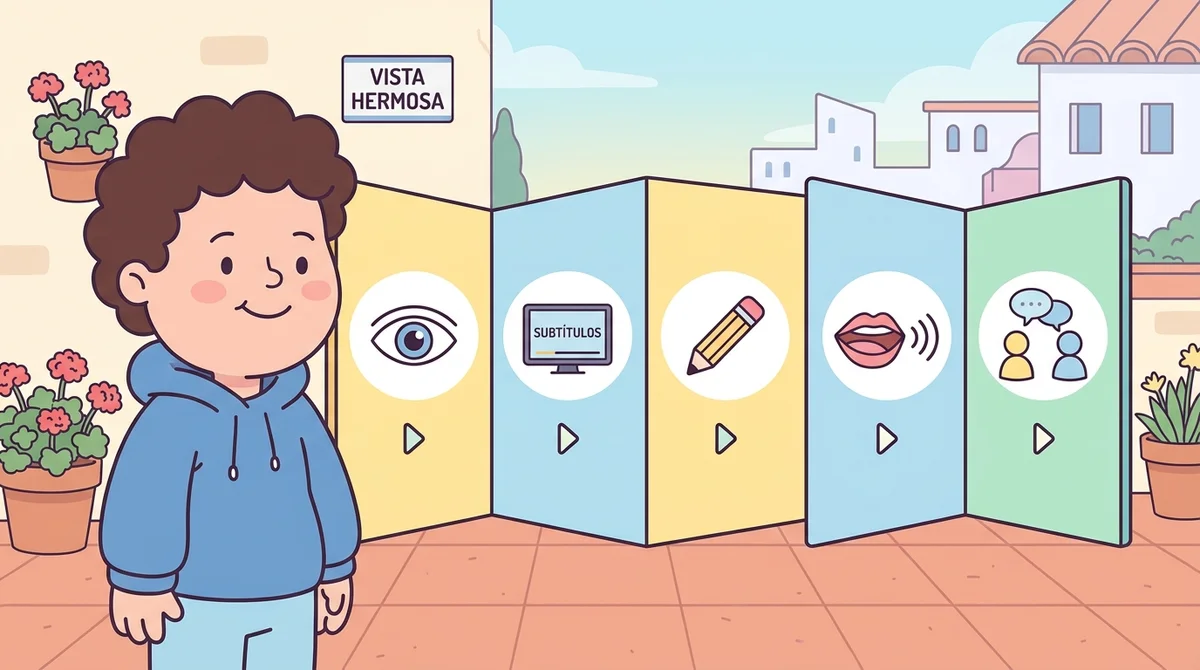
Here's a simple routine that turns passive watching into real learning. Use it on a single short clip — five to ten minutes is plenty.
- Watch once for the gist. No pausing, no subtitles if you can manage. Just get the general idea and don't panic about details.
- Watch again with Spanish subtitles. Now match what you hear to what you see. Pause when something clicks.
- Mine 3–5 phrases. Don't collect every word — pick a handful of useful, reusable phrases and write them down with their meaning.
- Shadow them out loud. Play a line, pause, and repeat it copying the speaker's rhythm and intonation exactly. This is where pronunciation is born.
- Reuse them. Later that day, say those phrases in your own sentences, out loud, even to an empty room.
That last step — reusing phrases out loud — is what separates people who understand Spanish from people who speak it.
Real Spanish Phrases You'll Pick Up from Media
To show you how quickly media phrases become useful, here are lines you'll genuinely hear in dramas, songs and vlogs — the kind worth stealing.
- ¿Qué pasó? (keh pa-SOH) — "What happened?" / a casual "What's up?" in many countries.
- No te preocupes. (noh teh pre-oh-KOO-pes) — "Don't worry."
- Te lo juro. (teh loh HOO-roh) — "I swear (to you)." Pure telenovela drama fuel.
- ¿En serio? (en SEH-ree-oh) — "Seriously? / For real?"
- Déjame en paz. (DEH-ha-meh en pas) — "Leave me alone."
Now here's a mini-dialogue like one you'd hear in a drama, so you see the phrases living together:
— ¿Qué pasó? Te ves preocupada.
(What happened? You look worried.)
— Perdí mi teléfono. Te lo juro, estaba aquí.
(I lost my phone. I swear, it was right here.)
— No te preocupes, te ayudo a buscarlo.
(Don't worry, I'll help you look for it.)
Read that out loud right now. Feel how te lo juro rolls differently than it looks? That's exactly the kind of thing media teaches your ear and speaking cements in your mouth.
Practice Tips: Turn Watching into Speaking
Here's the honest truth about media: it's the perfect input engine and a terrible output engine. To actually speak Spanish, you have to leave the couch and open your mouth.
So pair every media session with speaking practice. Shadow lines out loud. Pause a scene and answer a character as if you were in it. Describe what just happened in your own Spanish. It feels silly, and it works.
The problem is most learners have no one to speak to and no way to know if their pronunciation is even close. That's exactly the gap Teuida's Spanish course is built to fill. Instead of just recognizing phrases from a show, you step into real-life conversation scenarios — ordering food, meeting someone, handling a little drama of your own — and you speak the responses out loud from day one.
Even better, Teuida's AI pronunciation feedback scores how you say each line and shows you what to fix, so the phrases you pick up from telenovelas and songs come out sounding natural, not memorized. Think of it as the next best thing to a patient native friend who never gets tired of you repeating te lo juro.
So the routine that actually builds a Spanish speaker looks like this: watch a scene for input, then jump into Teuida to say those same kinds of lines out loud and get scored on them. Media fills your ears; speaking practice trains your mouth.
Wrap-Up: Watch Smart, Then Speak
You don't need to understand every word tonight. Pick media that's just past your level, watch it actively, steal a handful of phrases, and — this is the part that changes everything — say those phrases out loud until they feel like yours.
Spanish stops being something you study and starts being something you live in the moment you combine great input with real speaking. So choose one show or song this week, mine three phrases from it, and practice them out loud in Teuida's Spanish course to hear exactly how close you are.


