
A quick history of the French language: from Vulgar Latin to modern French, why silent letters exist, and how the Norman conquest makes French easier for you.
Have you ever wondered why French spelling looks nothing like it sounds? Why you write beaucoup but say something closer to "bo-KOO," with half those letters staying totally silent?
You are not imagining it, and you are not bad at French. Those quirks are fossils — little leftovers from a language that has been changing for two thousand years. Once you know a bit of the story behind them, French stops feeling random and starts feeling like it makes sense.
Why the history of French matters for learners
Most beginners treat French history as a museum topic — interesting, but useless for actually speaking. That is a mistake.
When you understand where French came from, a lot of the "weird" stuff clicks into place. Silent letters, gendered nouns, strange verb endings, words that look almost English but mean something else — they all have a reason.
And that reason usually starts with one thing: Latin. French is what happened when spoken Latin met the people of Gaul, got mixed with other languages, and kept evolving for centuries. Knowing that arc gives you shortcuts instead of just rules to memorize.
From Latin to French: the core story
Let's walk through the big stages. Don't worry about dates — focus on the shape of the change.
| Era | What was spoken | What it gave modern French |
|---|---|---|
| Before Rome | Gaulish (a Celtic language) | A handful of words like chêne (shen), "oak tree" |
| Roman times | Vulgar Latin (everyday spoken Latin) | The backbone of French vocabulary and grammar |
| ~5th–9th century | Latin mixed with Frankish (Germanic) | Many common words, and the name français itself |
| Old French (~9th–14th c.) | The first recognizable French | Early spellings we still keep today |
| Middle French (~14th–17th c.) | Standardizing, spreading | Silent letters "frozen" into spelling |
| Modern French (17th c.–now) | Standardized, taught worldwide | The French you're learning today |
Here's the key idea. When the Romans arrived in Gaul (roughly modern France), they didn't speak the polished Latin of poems. Soldiers, traders and farmers spoke Vulgar Latin — "vulgar" just meaning "of the common people." That casual, spoken Latin is the true parent of French.
Over centuries, the pronunciation drifted. Sounds got softer, endings dropped off, and vowels shifted. But writing changed much more slowly than speech. That gap — between how words were written and how they were actually said — is exactly why modern French spelling looks the way it does.
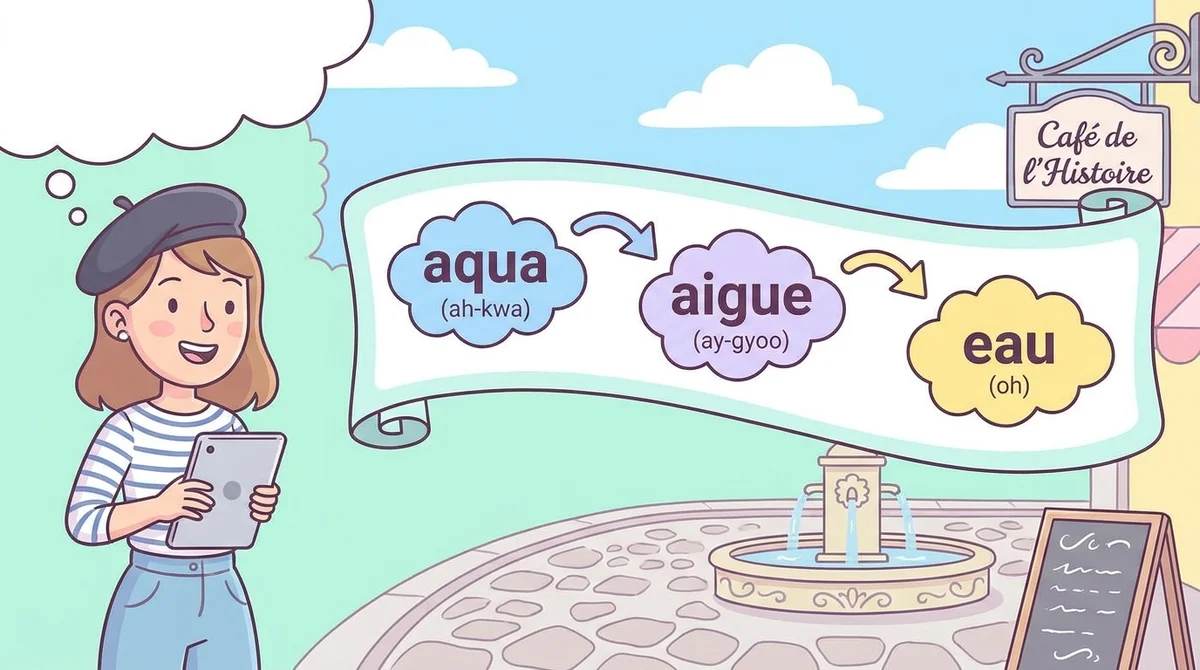
Take the word for "water." Latin aqua slowly softened over centuries until it became eau (oh), spelled with three vowels but pronounced as a single simple sound. Nothing about that is random — it's a thousand years of mouths taking the easy path.
Common mistakes learners make about French history
Because French feels so tied to elegance and rules, learners pick up a few myths that quietly hurt their progress.
Mistake 1: Thinking French is "just fancy Latin." French is a descendant of Latin, not a polished version of it. It grew, absorbed other languages, and became its own thing. Treating it like decoded Latin makes you overthink.
Mistake 2: Assuming spelling shows pronunciation. It often doesn't, and that's historical. Many silent letters were pronounced centuries ago and simply got kept in writing. So don't trust the letters — trust your ears.
Mistake 3: Believing English and French words always match. They share thousands of words thanks to history (more on that below), but many are faux amis (foh-zah-MEE), "false friends" — words that look identical but mean different things. Actuellement does not mean "actually"; it means "currently."
Mistake 4: Thinking older = harder. The long history actually helps you. So much English vocabulary came from French that you already recognize far more than you think.
The Norman connection: why English is your secret weapon
If your first language is English, French history handed you a huge gift.
In 1066, French-speaking Normans conquered England. For centuries afterward, the ruling class in England spoke a form of French, while ordinary people spoke English. The result? English soaked up thousands of French words.
That's why so much French feels familiar:
- la nation (lah nah-see-ON), "the nation"
- la question (lah kess-tee-ON), "the question"
- le restaurant (luh ress-toh-RAHN), "the restaurant"
- impossible (an-poh-SEEBL), "impossible"
Notice these are spelled almost like English. That's not a coincidence — it's shared history. As a learner, this means your reading vocabulary starts big. Your job is mostly to learn how to say these familiar words the French way, not to learn them from zero.
Just stay alert for those faux amis. Here are a few classic traps:
| French word | Looks like | Actually means |
|---|---|---|
| librairie (lee-brair-EE) | library | bookshop |
| actuellement (ak-tü-el-MAHN) | actually | currently |
| assister (ah-sees-TAY) | to assist | to attend |
| sensible (sahn-SEEBL) | sensible | sensitive |
How to use this history while you learn — step by step
You don't need a degree in linguistics. Just fold these habits into your daily practice.
Step 1: Learn sounds first, spelling second. When you meet a new word, say it out loud and lock the sound in before you stare at the letters. History guarantees the two won't fully match.
Step 2: Group the silent-letter patterns. Final consonants are often silent, especially -s, -t, -d, -x. Once you expect them to be quiet, they stop tripping you.
Step 3: Lean on the English–French overlap. When you see a long, formal-looking word, guess it might mirror English — it often will. Then double-check it isn't a false friend.
Step 4: Notice the Latin roots that repeat. Words like école (ay-KOL), "school," and étoile (ay-TWAL), "star," often have an accented é where Latin (and English) had an "s" — school, star. Spotting the pattern helps you read new words faster.
Step 5: Speak it, don't just admire it. History is fun to read about, but French only becomes yours when it comes out of your mouth. That's the step most learners skip.
Real French in action: putting the history to work
Let's see how these historical quirks show up in everyday French. Read each line out loud and notice the silent letters.
Mini-dialogue at a bookshop:
- — Bonjour, je cherche une librairie.
(bon-ZHOOR, zhuh shairsh ün lee-brair-EE)
"Hello, I'm looking for a bookshop." (Remember — librairie, not library!)
- — C'est juste ici. Vous cherchez un livre en français ?
(say zhüst ee-SEE. voo shair-SHAY an leevr ahn frahn-SEH)
"It's right here. Are you looking for a book in French?"
- — Oui, quelque chose de facile, s'il vous plaît.
(wee, kel-kuh shohz duh fah-SEEL, seel voo PLEH)
"Yes, something easy, please."
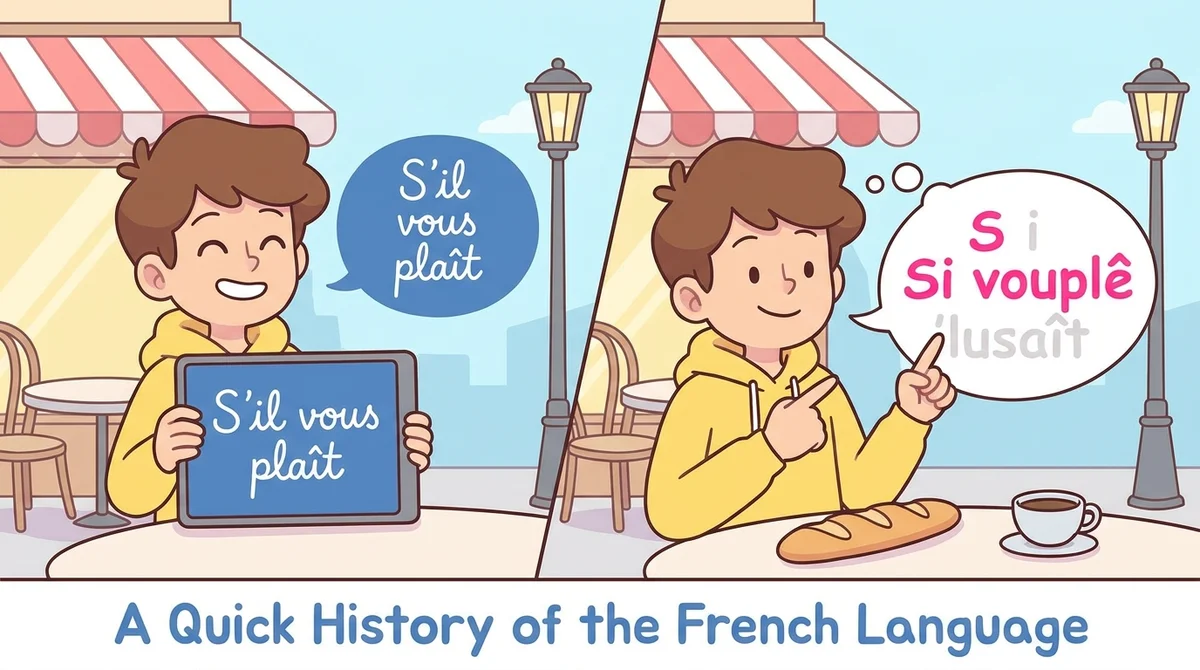
Look at plaît — that final t is completely silent, a frozen leftover from older spelling. And français ends in a silent s. Your ears would never guess those letters were there.
A few more everyday lines:
- Beaucoup de mots français viennent du latin.
(bo-KOO duh moh frahn-SEH vee-en dü lah-TAN)
"Many French words come from Latin."
- L'eau est fraîche aujourd'hui.
(loh eh fresh oh-zhoor-DWEE)
"The water is cool today." (eau = three letters, one little "oh" sound.)
- Ce mot ressemble à l'anglais.
(suh moh ruh-SAHMBL ah lahn-GLEH)
"This word looks like English."
See how the history explains every strange spelling? Once you expect the silent letters, reading and speaking get much less scary.
Practice tips: make the sounds stick
Here's the honest truth. You can read the entire history of French and still freeze the moment a French person actually talks to you. Knowledge in your head is not the same as words in your mouth.
The only fix is speaking out loud, over and over, until those silent-letter patterns become automatic. You need to feel that the t in plaît disappears, that eau collapses into one sound, that français ends softly. Reading about it won't build that muscle. Saying it will.
That's exactly what Teuida's French course is built for. Instead of drowning you in grammar charts, it drops you into real conversation scenarios — asking for directions, ordering, chatting at a shop — where you speak the language out loud from day one. So the words you just read above? You practice them as living dialogue, not dead vocabulary.
The best part is the AI pronunciation feedback. When you say s'il vous plaît or eau, Teuida scores how close you are and shows you what to fix. It's the next best thing to standing next to a patient French tutor — which is exactly what you need for a language where the spelling actively tries to mislead you.
Built by bilingual tutors and designed around daily habit-building, it turns "I recognize this word" into "I can actually say it." That's the whole point of learning a language, after all.
Keep going — your French story starts now
The history of French is really a story about change: Latin loosened up, mixed with other tongues, drifted in sound, and froze in spelling. Every silent letter and gendered noun you meet is a tiny piece of that two-thousand-year journey.
You don't have to master the timeline. You just have to let it reassure you — French isn't out to get you, it's just old. And that age is on your side, because you already recognize more of it than you realize.
So take these words, open your mouth, and start speaking. Practice these exact phrases out loud in Teuida's French course and get your pronunciation scored — history makes a lot more sense when you're saying it yourself.


