
Korean vs Japanese grammar: same SOV order and particles, but 한글, 은/는 vs 이/가, and Korean sounds differ. Key differences and mistakes to avoid explained.
"Wait, if you already know Japanese, Korean should be easy, right?"
I hear this a lot from learners who studied a little Japanese in school or picked it up from anime. And they're half right — the two languages share a surprising amount of grammar. But that "half wrong" part is exactly what trips people up, because the languages feel similar until they suddenly don't.
Why This Comparison Matters
Korean and Japanese are famous for having almost identical sentence structure. Both put the verb at the end, both use little grammar markers called particles, and both have polite and casual speech levels.
If you know one, the other feels like déjà vu. That's a huge head start, and you should absolutely lean into it.
But here's the trap. Because the two look so alike on the surface, learners assume the details match too — and they don't. The particles behave differently, the sounds are totally different, and some grammar habits from Japanese will actively lead you astray in Korean.
So whether you're coming from Japanese or just curious how the two stack up, understanding the differences helps you learn Korean faster and avoid the classic "so close, yet wrong" mistakes.
The Core Similarities and Differences
Let's start with the big picture. Both languages share the same basic skeleton, which is why they feel like cousins.
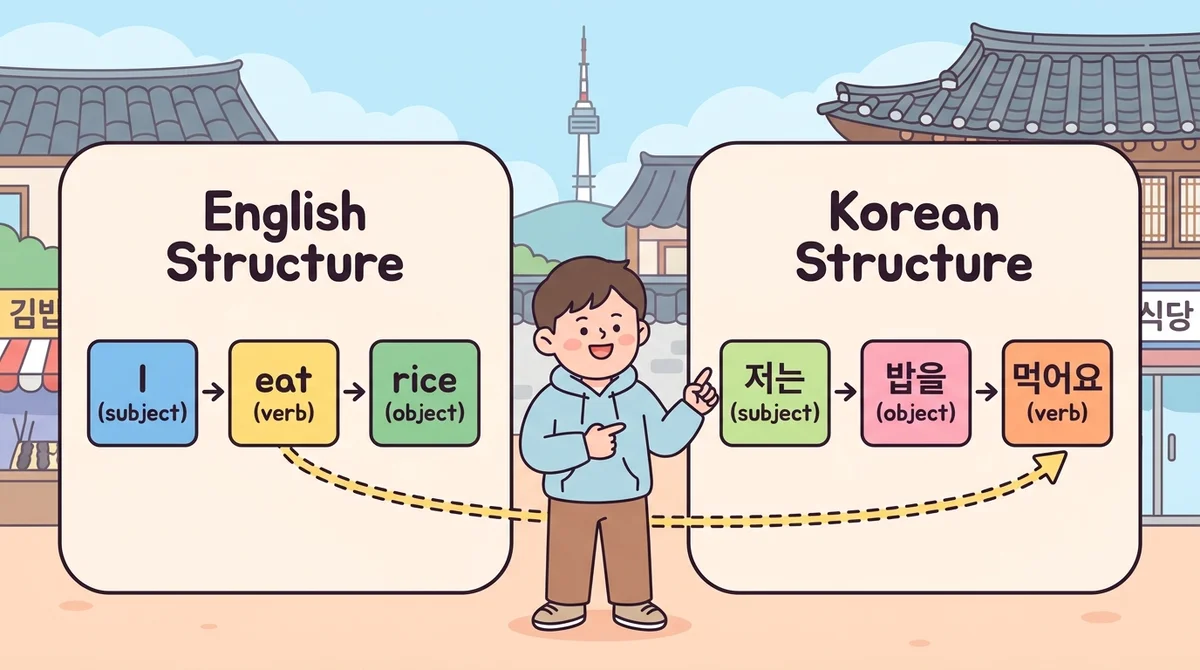
The word order is the same: Subject – Object – Verb (SOV). In English we say "I eat rice." In both Korean and Japanese, it's "I rice eat."
- Korean: 저는 밥을 먹어요 (jeoneun bapeul meogeoyo) — "I eat rice."
- The verb 먹어요 (meogeoyo, "eat") sits at the very end, just like Japanese.
Both languages also use particles — tiny words that tag a noun to show its job in the sentence (subject, object, topic, and so on). English doesn't have these, so this is the concept that feels most foreign to native English speakers.
Here's a clean side-by-side of the shared structure versus where they split.
| Feature | Korean | Japanese | Same or Different? |
|---|---|---|---|
| Word order | Subject–Object–Verb | Subject–Object–Verb | ✅ Same |
| Uses particles | Yes (은/는, 이/가, 을/를) | Yes (は, が, を) | ✅ Same idea |
| Politeness levels | Yes | Yes | ✅ Same idea |
| Writing system | Hangul (한글) — an alphabet | Kanji + kana | ❌ Different |
| Sounds/pronunciation | Own system | Own system | ❌ Very different |
| Verb conjugation rules | Own patterns | Own patterns | ❌ Different details |
So the architecture matches, but the materials are different. That's the key takeaway.
Where Korean and Japanese Grammar Really Differ
Now let's get into the parts that actually change how you speak. These are the details that Japanese speakers get wrong and English speakers need to learn fresh.
1. The writing system is completely different.
Japanese mixes kanji (Chinese characters) with two syllable-based scripts. Korean uses 한글 (hangul), which is a true alphabet with 14 consonants and 10 basic vowels. You can learn to read hangul in a weekend — no thousands of characters to memorize. This is honestly one of the friendliest features of Korean.
2. Particles look parallel but aren't interchangeable.
Both languages have a "topic" particle and a "subject" particle. In Korean, the topic particle is 은/는 (eun/neun) and the subject particle is 이/가 (i/ga). They shift form depending on whether the noun ends in a consonant or vowel — Japanese particles don't do this shape-shifting.
3. Korean has sound-based rules Japanese doesn't.
Korean loves matching particle forms to the ending sound of a word. Ends in a consonant? Use one form. Ends in a vowel? Use the other. This "does it end in a consonant or vowel?" question is everywhere in Korean grammar.
| Ends in... | Topic particle | Subject particle | Object particle |
|---|---|---|---|
| Consonant | 은 (eun) | 이 (i) | 을 (eul) |
| Vowel | 는 (neun) | 가 (ga) | 를 (reul) |
For example: 책은 (chaegeun, "the book" — 책 ends in a consonant) versus 사과는 (sagwaneun, "the apple" — 사과 ends in a vowel).
4. Pronunciation is a whole different world.
Korean has tense consonants (ㄲ, ㄸ, ㅃ) and aspirated ones (ㅋ, ㅌ, ㅍ) that don't exist the same way in Japanese. Korean also has sound-change rules where letters shift when they bump into each other. This is where a lot of Japanese speakers stumble — the grammar transfers, but the mouth muscles don't.
Common Mistakes Learners Make
Here are the errors I see most, especially from learners who already know some Japanese.
Assuming particles map one-to-one. Yes, 은/는 (eun/neun) feels like Japanese は (wa). But Korean particles change shape based on sound, and the nuance of when to use "topic" versus "subject" doesn't line up perfectly. Don't translate particle-for-particle — learn Korean particles on their own terms.
Forgetting the consonant/vowel check. Beginners often just grab one form and stick with it — saying 사과을 (sagwaeul) instead of the correct 사과를 (sagwareul). The word 사과 (sagwa, "apple") ends in a vowel, so it needs 를 (reul). Small error, but native ears catch it instantly.
Carrying over Japanese pronunciation. If you pronounce Korean like Japanese, tense and aspirated consonants collapse into one blurry sound. 불 (bul, "fire"), 뿔 (ppul, "horn"), and 풀 (pul, "grass") are three different words. Mix them up and you'll confuse people.
Expecting kanji. Some learners come to Korean looking for characters to memorize and feel lost without them. Relax — hangul is all you need, and it's beautifully logical.
Step-by-Step: How to Approach Korean Grammar
If you want to build Korean grammar the smart way, follow this order.
Step 1: Learn hangul first. Before anything else, get the alphabet down. Once you can read 한글 (hangul), everything else clicks faster. It really does take just a few days of focused practice.
Step 2: Master the SOV skeleton. Get comfortable with the verb going last. Practice building simple sentences: 저는 커피를 마셔요 (jeoneun keopireul masyeoyo) — "I drink coffee." Notice the verb 마셔요 (masyeoyo, "drink") at the end.
Step 3: Drill the consonant/vowel particle rule. Every time you add a particle, ask: does this noun end in a consonant or a vowel? Make it a habit until it's automatic.
Step 4: Learn the main particles in pairs.
- 은/는 (eun/neun) — topic ("as for...")
- 이/가 (i/ga) — subject
- 을/를 (eul/reul) — object
Step 5: Practice politeness levels. Start with the friendly-polite 요 (yo) ending that works in almost any everyday situation. You'll sound respectful without overthinking it.
Step 6: Train your ears and mouth. Because Korean sounds differ so much from Japanese (and English), listening and speaking out loud matters more than reading grammar charts. Say every new sentence aloud.
Real-Life Example Sentences and Mini-Dialogues
Let's see these differences in action with natural sentences.
Notice how particles change based on the noun's ending:
- 저는 학생이에요 (jeoneun haksaengieyo) — "I am a student." (학생 ends in a consonant → uses 은/는 as 는 after 저)
- 물을 주세요 (mureul juseyo) — "Give me water, please." (물, "water," ends in a consonant → 을)
- 커피를 좋아해요 (keopireul joahaeyo) — "I like coffee." (커피, "coffee," ends in a vowel → 를)
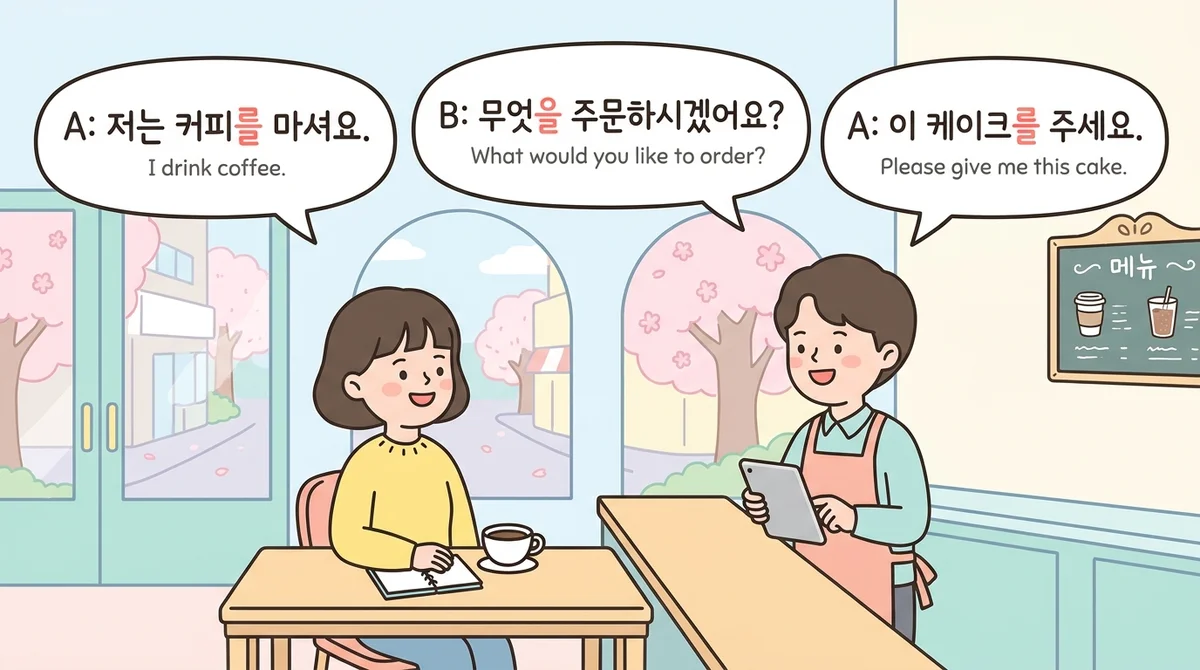
Here's a short café dialogue showing the SOV order and everyday politeness:
A: 뭐 마실래요? (mwo masillaeyo?) — "What would you like to drink?"
B: 저는 아메리카노를 마실게요. (jeoneun amerikanoreul masilgeyo.) — "I'll have an americano."
A: 케이크도 드실래요? (keikeudo deusillaeyo?) — "Would you like some cake too?"
B: 네, 초콜릿 케이크 주세요. (ne, chokollit keikeu juseyo.) — "Yes, chocolate cake please."
See how every verb lands at the end? 마실래요 (masillaeyo), 마실게요 (masilgeyo), 주세요 (juseyo) — all final. That's the SOV rhythm you're training your brain to expect.
Practice Tips That Actually Work
Here's the honest truth: you can read about particles and word order all day, but it won't stick until you say it out loud. Grammar you can only recognize on paper vanishes the moment you try to speak in real life.
The consonant/vowel particle rule especially needs mouth practice. When you say 커피를 (keopireul) enough times, your tongue starts choosing the right particle automatically — no more freezing mid-sentence to think about it.
This is exactly where Teuida helps. Teuida is a speaking-first Korean app, so you role-play real conversations — like ordering in that café dialogue above — and actually speak the Korean out loud from day one. Instead of memorizing particle tables, you use them in context until they feel natural.
Even better, Teuida's AI pronunciation feedback scores how you say each line and shows you what to fix. That's huge for anyone coming from Japanese, because it catches the tense and aspirated consonants (like 뿔 versus 풀) that your ears might glide right past. It's the next best thing to having a patient tutor sitting next to you.
Built by bilingual tutors, Teuida is designed to turn "I understand this grammar" into "I can actually say this" — which is the whole point. Practice a few minutes a day and the SOV rhythm becomes second nature.
Wrap-Up
So, Korean and Japanese grammar are cousins, not twins. They share the same SOV skeleton, particles, and politeness levels — a genuine head start. But hangul, the consonant/vowel particle rules, and Korean's unique sounds are all their own, and that's where the real learning happens.
Don't let the similarities make you lazy, and don't let the differences scare you. Lean on what transfers, learn what's new, and above all, say it out loud.
Ready to feel the difference for yourself? Practice these Korean sentences out loud in Teuida, role-play a real café order, and let the AI score your pronunciation — you'll lock in the particles and the sounds at the same time.


