
Speaking, reading, or writing Korean — which is easiest? 한글 makes reading fastest, writing is mid, speaking is hardest but the goal. A smart learning order.
You've just started learning Korean, and you're staring at three big mountains: speaking, reading, and writing. Which one do you climb first? Which one is going to make you cry the least?
It's a fair question, and honestly, it's one of the smartest things a beginner can ask. Picking the right starting point saves you months of frustration. So let's break it down honestly — no sugar-coating, just what's actually easier and why.
Why This Question Matters So Much
Most people who quit Korean don't quit because it's impossible. They quit because they started with the hardest thing first, got discouraged, and decided they "aren't language people."
Here's the truth: Korean is not one skill. It's three very different skills that use different parts of your brain and take different amounts of effort. Treating them as one big blob is a recipe for burnout.
When you understand which skill gives you quick wins and which one takes a slow burn, you can plan smarter. You get early confidence, which keeps you going long enough to tackle the harder stuff.
So let's rank them — reading, writing, and speaking — from easiest to hardest to start, and then talk about which one actually deserves your time first.
The Honest Comparison: Reading vs. Writing vs. Speaking
Let's lay it out plainly. Each skill has a different "cost to start" and a different "payoff."
| Skill | How hard to start | Why | Payoff |
|---|---|---|---|
| Reading | Easiest | 한글 (Hangeul), the Korean alphabet, is logical and fast to learn | Read signs, menus, names in days |
| Writing | Medium | Same alphabet, but you must produce it, spell correctly, and use grammar | Texting, notes, deeper memory |
| Speaking | Hardest to feel confident, but most rewarding | Real-time thinking, pronunciation, listening all at once | Actual conversations, real connection |
Notice something interesting. Reading is the easiest to begin, but speaking is the one you actually came here for. Nobody dreams of silently reading Korean signs forever — you want to talk to people, order food, understand your favorite drama without subtitles.
So the real answer isn't "just do the easiest thing." It's "start with the easy win, then aim straight at speaking."
Let me explain why each skill sits where it does.
Breaking Down Each Skill
Reading is genuinely the fastest to learn. This surprises everyone. 한글 (Hangeul) was designed in the 1400s to be easy for ordinary people to learn. It's not thousands of symbols like Chinese characters — it's 24 basic letters that combine into neat blocks.
For example, 밥 (bap) means "rice/meal." It's built from three simple pieces: ㅂ (b), ㅏ (a), ㅂ (b). Once you know the letters, you can sound out almost anything. Most learners can read basic Korean in a week or two.
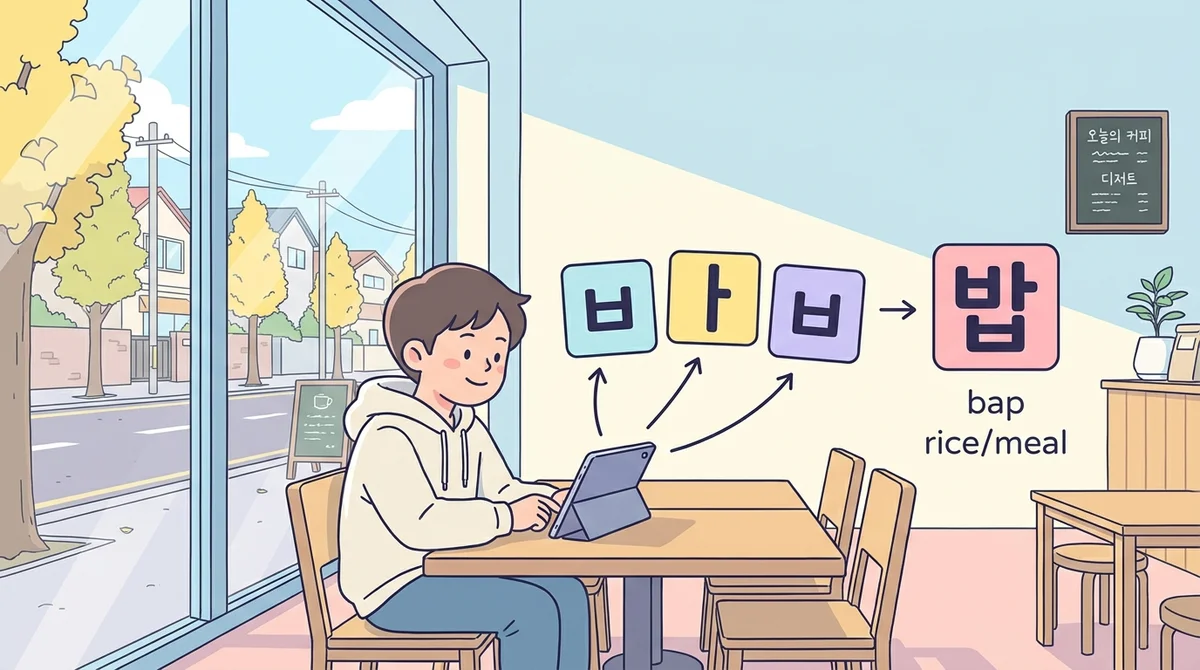
Writing is a step harder. Reading is recognition — you see something and decode it. Writing is production — you have to pull it out of your own head. You need to remember spelling, spacing, and grammar all at once.
For instance, saying you know the word 감사합니다 (gamsahamnida, "thank you") is one thing. Writing it correctly from memory, with the right final consonants, is another. Writing also forces you to learn grammar rules like particles, which we'll touch on later.
Speaking is the hardest to feel confident with — but not for the reason you think. The words aren't harder. What's hard is doing everything at once: forming the sentence, pronouncing it, listening to the reply, and responding before your brain freezes.
Speaking is also emotional. There's a real person waiting, and fear of embarrassment kicks in. That pressure is what makes speaking feel like the tallest mountain, even when the actual Korean is simple.
Common Mistakes Learners Make
Here's where good intentions go wrong. Watch out for these traps.
Mistake 1: Skipping 한글 (Hangeul) and relying on romanization forever. Romanization (writing Korean with English letters, like "annyeonghaseyo") is a crutch. It's fine for day one, but if you never learn to read 한글, your pronunciation stays wrong and your progress stalls. Learn the alphabet early — it's the single best investment you'll make.
Mistake 2: Treating writing as the same skill as speaking. Some learners write beautiful Korean sentences but can't say a single one out loud in real time. Writing gives you time to think. Speaking doesn't. If you only practice writing, you'll be shocked at how hard live conversation feels.
Mistake 3: Delaying speaking until you're "ready." This is the big one. Learners wait until their grammar is "perfect" before they open their mouths. That day never comes. The longer you wait, the scarier speaking gets.
Mistake 4: Studying silently. Reading Korean in your head does almost nothing for your speaking. Your mouth needs to physically practice the sounds. Silent study builds a reader, not a speaker.
A Smart Order to Learn Korean
So what should you actually do? Here's a clear, beginner-friendly sequence that plays to the easy wins first and builds toward speaking.
Step 1: Learn 한글 (Hangeul) first — reading and basic writing. Spend one to two weeks getting comfortable with the alphabet. Read it, then write it by hand. This gives you a fast confidence boost and kills your dependence on romanization.
Step 2: Learn to read simple words out loud. Don't read silently. When you see 물 (mul, "water") or 사랑 (sarang, "love"), say them out loud. This quietly connects reading to speaking from day one.
Step 3: Start speaking basic phrases immediately. You don't need much vocabulary. Start with survival lines like 안녕하세요 (annyeonghaseyo, "hello") and 이거 주세요 (igeo juseyo, "this one, please"). Say them until they feel automatic.
Step 4: Add light writing to lock in grammar. Once you're speaking a little, write short sentences. Writing forces you to notice grammar patterns and particles, which makes your speaking more accurate.
Step 5: Prioritize speaking practice above all. Reading and writing support speaking, but speaking is the goal. Give it the most daily time. This is the skill that turns "I studied Korean" into "I speak Korean."
Real-Life Examples and Mini-Dialogues
Let's see how these skills stack together in real situations. Notice how reading, speaking, and writing all show up naturally.
At a café — reading the menu, then speaking:
You read the menu and see: 아메리카노 (americano, "americano")
You: 아메리카노 하나 주세요. (Americano hana juseyo.) — "One americano, please."
Staff: 네, 잠시만요. (Ne, jamsimanyo.) — "Sure, one moment."
See how reading and speaking work as a team? You read the word, then you say it. That's the everyday reality of using Korean.
Texting a friend — writing in action:
Friend: 오늘 뭐 해? (Oneul mwo hae?) — "What are you doing today?"
You: 나 카페 가. 같이 갈래? (Na kape ga. Gachi gallae?) — "I'm going to a café. Wanna come?"
Texting is where writing quietly builds your grammar without pressure. You have a second to think, and it reinforces sentence patterns.
A quick face-to-face exchange — speaking under pressure:
Stranger: 저기요, 화장실 어디예요? (Jeogiyo, hwajangsil eodiyeyo?) — "Excuse me, where's the bathroom?"
You: 저쪽이에요. (Jeojjogieyo.) — "It's over there."

That last one is speaking at its purest: no time to prepare, just react. It feels hard at first, but with practice it becomes second nature.
How to Actually Make Speaking Stick
Here's the part nobody wants to hear but everyone needs to: you cannot become a Korean speaker by reading and writing alone. Speaking is a physical skill, like a sport. You get good at it by doing it, out loud, over and over.
The problem is obvious — most learners don't have a Korean friend on call to practice with. You can read a textbook silently at midnight, but you can't exactly grab a stranger to rehearse ordering coffee.
This is exactly why Teuida exists. Teuida is a speaking-first Korean app, which means you actually speak Korean from day one instead of just memorizing charts. You role-play real-life scenarios — ordering at a café, asking for directions, chatting with a friend — the same situations from this post, out loud.
The best part is the AI pronunciation feedback. When you say 아메리카노 하나 주세요 (americano hana juseyo), Teuida scores how you said it and helps you fix the sounds that are off. It's the next best thing to talking with a real person, and it takes the fear out of speaking because there's no one to judge you.
Built by bilingual tutors, it's designed around daily habit-building — short sessions that make speaking automatic. So instead of hoping you'll be ready to talk someday, you practice the real thing today. Role-play that café order in Teuida and get your pronunciation scored before you ever set foot in Korea.
Pair Teuida with a little daily reading and light writing, and you'll cover all three skills — with speaking, the one that matters most, leading the way.
Wrap-Up: Start Easy, Aim for Speaking
So what's easiest? Reading is the easiest to start, thanks to the beautifully logical 한글 (Hangeul). Writing is a solid middle step that locks in your grammar. And speaking is the hardest to feel confident with — but it's the whole point.
The winning strategy isn't to only do the easy thing. It's to grab the quick win from reading, use writing to sharpen your grammar, and pour your real energy into speaking every single day. That's how you go from recognizing Korean to actually using it.
Don't wait until you feel "ready." Ready comes from speaking, not before it. Open Teuida, role-play a real Korean conversation out loud today, and let the pronunciation feedback turn those nervous first words into confident ones.


