Confused by Korean SOV word order? See real-life dialogues that show how subjects, objects and verbs work so you can build natural sentences, even as korean for beginners.
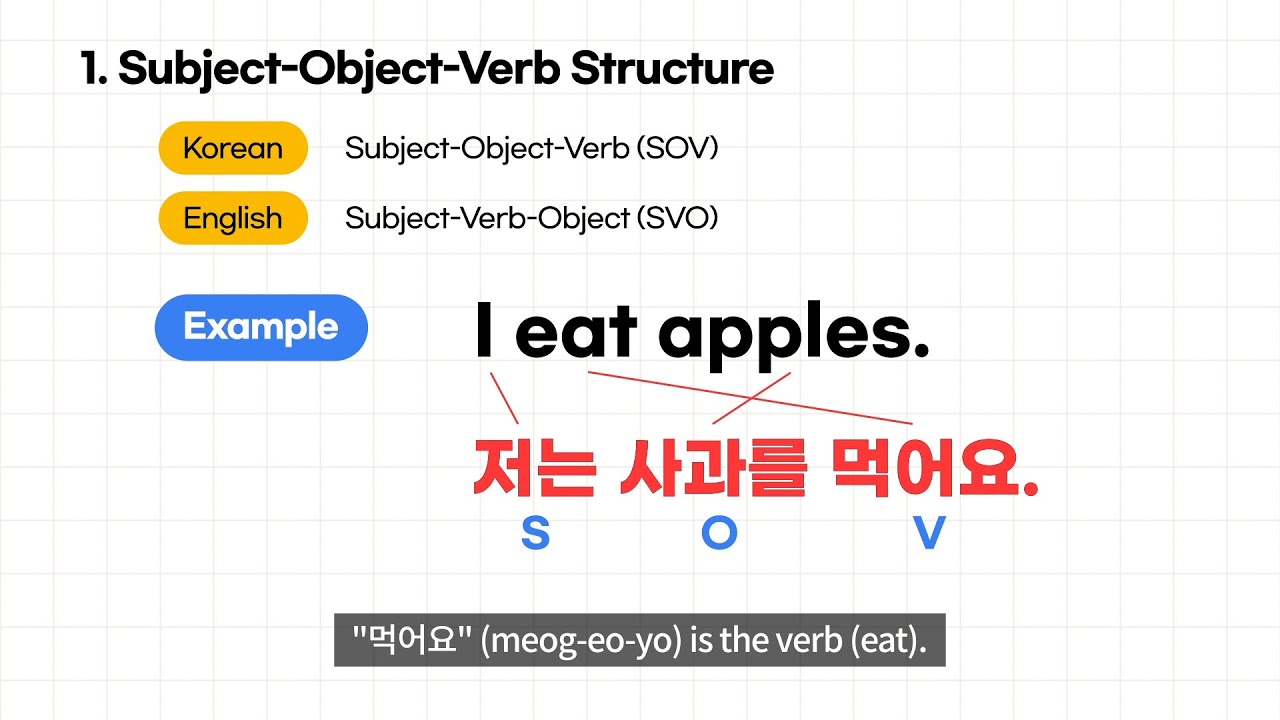
If you are korean for beginners or just starting to learn korean, Korean sentence order can feel upside down.
In English we say:
I (subject) eat (verb) lunch (object).
But in Korean, the verb goes at the end:
나(는) 점심을 먹어요.
I topic lunch object eat.
So the pattern is:
Subject – Object – Verb (SOV)
If this feels strange at first, that is completely normal. Let us walk through this slowly with real conversation examples, so you can see how Korean sentences really work in daily life.
You are doing great already just by being here.
1. The basic Korean SOV pattern
Before we jump into dialogue, let us look at one clear sentence and break it down.
저는 커피를 마셔요.
- 저 – I
- 는 – topic marker
- 커피 – coffee
- 를 – object marker
- 마셔요 – drink
Order: Subject (저는) + Object (커피를) + Verb (마셔요)
In English: “I drink coffee.”
In Korean: “I coffee drink.”
This is the heart of Korean sentence order. The verb waits politely at the end.
You will use this SOV pattern in so many korean phrases, like:
- 저는 한국어를 공부해요. – I study Korean.
- 친구를 만나요. – I meet a friend.
- 영화를 봐요. – I watch a movie.
Once this pattern feels familiar, building korean vocabulary into longer sentences becomes much easier.
2. Word markers that help you see the structure
Korean has small particles that show which word is the subject and which is the object. These are very important for understanding sentence order in the korean language.
2.1 Subject markers: 이 / 가, topic markers: 은 / 는
- 이 / 가 – subject markers
- 은 / 는 – topic markers
Examples:
- 내가 먹어요. – I (as subject) eat.
- 나는 먹어요. – Speaking of me, I eat.
As a beginner, you can treat them both as “I” for now. The main thing is that they attach to the korean words that act as your subject.
2.2 Object markers: 을 / 를
- 을 / 를 – show the object of the verb
Examples:
- 밥을 먹어요. – I eat rice.
- 책을 읽어요. – I read a book.
Try reading the sentence and asking:
- Who is doing the action? → subject (with 이/가 or 은/는)
- What is receiving the action? → object (with 을/를)
- What is the action? → verb at the end
This is a simple way to train your brain while you learn to speak korean.
3. Real dialogue 1: At a café
Let us look at a short café conversation with SOV order.
First, read it. Then we will break it into small pieces.
A: 뭐 마실래요?
B: 저는 아이스 아메리카노를 마실게요.
A: 저는 라떼를 마실래요.
Meaning
- A: What do you want to drink?
- B: I will drink an iced americano.
- A: I want to drink a latte.
3.1 Line by line breakdown
1) 뭐 마실래요?
- 뭐 – what
- 마실래요 – want to drink
The object (뭐) comes first, then the verb (마실래요) at the end.
2) 저는 아이스 아메리카노를 마실게요.
- 저 + 는 – I (topic)
- 아이스 아메리카노 + 를 – iced americano (object)
- 마실게요 – will drink
Order: Subject – Object – Verb
3) 저는 라떼를 마실래요.
- 저는 – I
- 라떼를 – latte (object)
- 마실래요 – want to drink
Again: Subject – Object – Verb.
If you notice, the Korean lines are simple and repeat the same frame. To practice, you can swap the drink and keep the structure:
- 저는 주스를 마실래요. – I want to drink juice.
This is a great way to build korean vocabulary inside real korean phrases instead of memorizing words alone.
4. Real dialogue 2: Meeting a friend after class
Now, a slightly longer conversation.
A: 오늘 뭐 했어요?
B: 학교에서 한국어를 공부했어요.
A: 누구랑 공부했어요?
B: 친구랑 같이 공부했어요.
Meaning
- A: What did you do today?
- B: I studied Korean at school.
- A: Who did you study with?
- B: I studied together with a friend.
4.1 Key sentence: 학교에서 한국어를 공부했어요.
Break it down:
- 학교에서 – at school (place + particle 에서)
- 한국어를 – Korean (object)
- 공부했어요 – studied
Natural word order is often:
[Time] [Place] [Object] [Verb]
For example:
- 오늘 학교에서 한국어를 공부했어요.
- Today at school I studied Korean.
Verb still stays at the end.
This is why, when you practice with dialogues in a speaking app, you will often see lines with time or place before the subject or object. That is okay. The rule “verb goes last” still holds.
5. Common Korean sentence order patterns
Here are some very common patterns you will see again and again.
5.1 Time + Subject + Object + Verb
오늘 저는 영화를 봤어요.
Today I movie watched.
- 오늘 – today
- 저는 – I
- 영화를 – movie (object)
- 봤어요 – watched
5.2 Time + Place + Object + Verb
내일 집에서 숙제를 할 거예요.
Tomorrow at home homework will do.
- 내일 – tomorrow
- 집에서 – at home
- 숙제를 – homework (object)
- 할 거예요 – will do
5.3 Subject + Place + Object + Verb
저는 회사에서 일을 해요.
I at the office work do.
If you already know the korean alphabet, try reading these out loud slowly. This helps you get used to the rhythm of the SOV pattern and makes it easier to build your own sentences when you are learning korean for beginners.
6. How word order changes in questions
Good news: question sentences in Korean often keep the same SOV order. The big difference is that you add a question word or a polite ending like요 and you raise your voice.
For example:
뭐 먹어요? – What are you eating?
어디 가요? – Where are you going?
누구 만났어요? – Who did you meet?
Look at this pattern:
A: 어디 가요? – Where are you going?
B: 집에 가요. – I am going home.
In both sentences, the verb 가요 is at the end.
So you do not have to switch the word order for questions like we do in English. You just add the question word at the front or where the object would go. The ending itself still follows the same rules covered in our guide to Korean sentence enders.
This makes Korean questions nicer once you get used to the structure.
7. Tips to feel comfortable with SOV order
If SOV still feels strange, do not worry. Your brain is used to English SVO, and it needs time to build new patterns. Here are some gentle tips to help.
7.1 Learn sentence “frames,” not only individual words
Instead of just memorizing korean words like “eat, drink, go,” try learning short sentence frames:
- 저는 ___를 먹어요. – I eat ___.
- 저는 ___를 마셔요. – I drink ___.
- 저는 ___에 가요. – I go to ___.
Then fill in the blank with new vocabulary:
- 저는 빵을 먹어요. – I eat bread.
- 저는 물을 마셔요. – I drink water.
This is one of the best way to learn korean grammar naturally: repeat useful frames with different nouns, then connect them with sentence connectors as you grow more confident.
7.2 Speak out loud with real dialogues
If you can, use an app that gives you real conversation practice. Many free language learning apps only show multiple choice, so you do not feel the sentence order in your mouth.
Look for speaking missions where you repeat or answer using full sentences.
Apps like Teuida are designed to help you speak in actual situations, not just tap answers. Inside it, you listen to native speakers and then say the lines yourself, which helps SOV order become automatic.
This is where language study app tools really shine, especially if your goal is to learn to speak korean, not just read it.
7.3 Notice the verb at the end in everything you watch
If you are watching dramas, short clips, or listening to dialogues for language learning, choose one simple mission:
Pay attention to where the verb is.
You will start to notice that, almost always, it is at the end. Over time, this stops feeling “backwards” and just feels like “Korean style.”
8. How Teuida can support your sentence order practice
If you like to learn through real situations, conversation-based tools can be very helpful.
Search for teuida korean in your app store to find it. There is a teuida free version so you can test the speaking missions. You can later upgrade to teuida premium if you want more content.
Inside, you will find story-like lessons where you order drinks, meet friends, or ride the subway. You hear many short korean phrases with SOV order, and you repeat them as if you are really there.
Compared with some other language learning applications and free language learning apps, this kind of interactive speaking style can be one of the best way to learn korean sentence order, because you are not just reading; you are acting out the conversation.
If you like it, you can follow the teuida download link from the website and try it as part of your daily practice. Pair it with a simple notebook where you write down new patterns and korean vocabulary you meet.
9. Putting it all together
Let us quickly review:
- Korean uses Subject – Object – Verb (SOV) order.
- The verb almost always comes at the end.
- Subject and object are marked with small particles like 은/는, 이/가, 을/를.
- Time and place often come before the subject or object, but the verb still stays last.
- Questions usually keep the same order. You just add a question word or rising tone.
If you keep meeting these patterns in real dialogues and practicing with a language study app or speaking-focused tools, your brain will slowly switch into “Korean mode.”
You are doing really well. It is okay if you do not remember everything at once. Come back to the dialogues, read them out loud, and let your mouth learn the rhythm of Korean sentences step by step.