
Learn the difference between 좋다 and 좋아하다 with easy Korean examples for sharing opinions, likes, and everyday feelings.
좋다 vs 좋아하다: Why Both Can Mean “Like” in Korean
When you learn Korean for beginners, it is very normal to feel confused by 좋다 and 좋아하다.
Both words can appear in English as “to like” or “to be good.” But Korean uses them differently depending on what you want to say.
Let’s walk through this together.
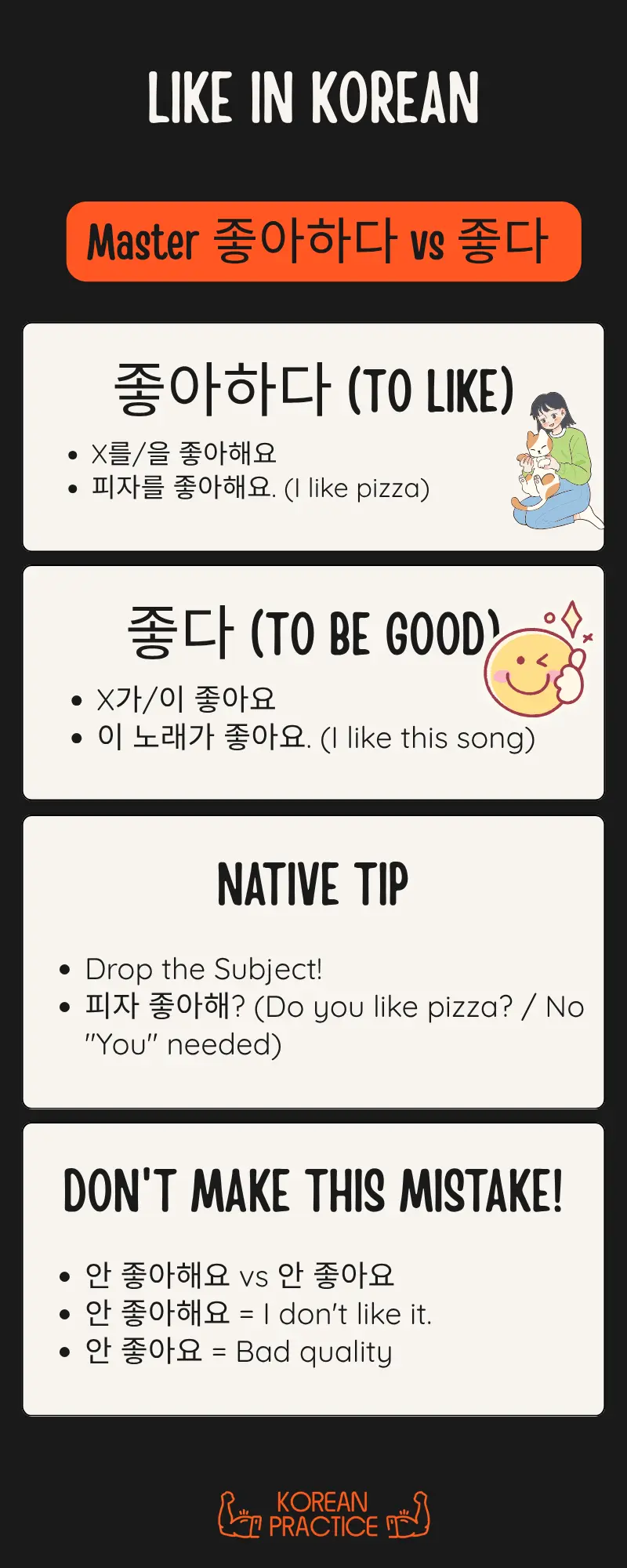
- 좋다 = to be good, to be nice, to please someone
- 좋아하다 = to like something or someone
The tricky part is that Korean often uses 좋다 where English speakers would naturally say “I like it.”
1. 좋다 means “to be good” or “to please”
좋다 is an adjective. It describes something as good, pleasant, nice, or enjoyable.
Examples
- 이 카페가 좋아요.
This café is nice. / I like this café.
- 날씨가 좋아요.
The weather is nice.
- 이 노래가 좋아요.
This song is good. / I like this song.
In Korean, the thing you enjoy often becomes the subject.
이 노래가 좋아요.
This song is pleasing to me.
That is why you do not need to say “I” every time. The feeling is already understood from the situation.
This is one of those Korean grammar basics that feels unusual at first, but gets easier with practice, much like the patterns covered in our Korean grammar basics for real-life Korean guide.
2. 좋아하다 means “to like”
좋아하다 is a verb. Use it when you want to say that a person likes something, someone, or an activity.
Examples
- 저는 커피를 좋아해요.
I like coffee.
- 저는 한국 드라마를 좋아해요.
I like Korean dramas.
- 민지가 고양이를 좋아해요.
Minji likes cats.
Here, the person who likes something is the subject.
저는 커피를 좋아해요.
I like coffee.
This pattern is especially useful when you are talking about habits, preferences, or another person’s likes.
3. The biggest difference: what is the focus?
Here is an easy way to remember it:
| Word | Focus | Example |
|---|---|---|
| **좋다** | The thing is good or pleasing | 이 영화가 좋아요. |
| **좋아하다** | A person likes something | 저는 이 영화를 좋아해요. |
Both sentences can translate to “I like this movie.”
But they feel slightly different:
- 이 영화가 좋아요.
This movie is good. I enjoy it.
- 저는 이 영화를 좋아해요.
I like this movie.
In everyday conversation, people often use 좋아요 when reacting naturally to something in front of them.
4. Talking about people: be careful with 좋아요
This is where things can get a little tricky.
- 민지 씨가 좋아요.
I like Minji. / Minji is good.
- 민지 씨를 좋아해요.
I like Minji.
Both can be correct. But the feeling can change depending on context.
민지 씨가 좋아요 can sound softer and more emotional. It may suggest romantic interest, especially when you are choosing between people or talking about someone you are drawn to.
민지 씨를 좋아해요 clearly means “I like Minji,” but it can still be romantic depending on the conversation.
For friends, hobbies, food, and everyday preferences, 좋아하다 is often clearer.
- 저는 친구들과 카페 가는 것을 좋아해요.
I like going to cafés with friends.
- 저는 매운 음식을 좋아해요.
I like spicy food.
5. A real-life café example
Imagine you are at a café in Seoul.
Your friend asks:
이 카페 어때요?
How is this café?
You can say:
좋아요! 분위기가 편해요.
It’s nice! The atmosphere is relaxing.
Here, 좋아요 sounds natural because you are giving your opinion about the café.
Now your friend asks:
커피 좋아해요?
Do you like coffee?
You can say:
네, 커피를 좋아해요.
Yes, I like coffee.
This is a preference, so 좋아하다 works best.
These small moments are what make basic Korean phrases feel useful in real life.
6. Common mistakes to avoid
Mistake 1: Using 좋아하다 for everything
You can say:
- 저는 이 카페를 좋아해요.
I like this café.
This is grammatically correct.
But when you are simply reacting to the café right now, this often sounds more natural:
- 이 카페가 좋아요.
This café is nice.
Mistake 2: Saying 저는 좋아요 for “I like it”
저는 좋아요 usually means:
I am okay with it.
It works for me.
For example:
A: 금요일에 만날까요?
Shall we meet on Friday?
B: 저는 좋아요.
That works for me.
To say “I like this,” say:
- 이거 좋아요.
I like this.
Mistake 3: Forgetting the object marker with 좋아하다
When using 좋아하다, use 을/를 for the thing someone likes.
- 저는 한국 음식을 좋아해요.
- 저는 축구를 좋아해요.
- 저는 여행하는 것을 좋아해요.
A helpful place to find more patterns like this is a Korean verbs list, because many Korean verbs use objects in a similar way, and our guide on Korean sentence connectors can help you link these ideas into longer sentences.
7. Practice with these everyday sentences
Try saying these out loud:
- 저는 한국어 공부가 좋아요.
I enjoy studying Korean.
- 저는 한국어 공부를 좋아해요.
I like studying Korean.
Both are possible. The first sounds more like “Studying Korean feels good/enjoyable to me.” The second is a direct statement of preference.
- 이 드라마가 좋아요.
This drama is good.
- 저는 이 드라마를 좋아해요.
I like this drama.
- 저는 한국 음식을 좋아해요.
I like Korean food.
- 오늘 날씨가 좋아요.
The weather is nice today.
You are doing great. The more you notice whether you are describing something as good or describing someone’s preference, the more natural this will feel.
Final tip
Use 좋다 when something feels good, looks good, sounds good, or is pleasing.
Use 좋아하다 when you want to say that someone likes a person, thing, activity, or idea.
You will hear both constantly in Korean real-life dialogues, from ordering food to talking with friends. Once you start listening for the pattern, you will notice it everywhere, just as you will with other tricky pairs like the one in our Korean future tense guide.


