
Go behind the scenes of a Teuida French shoot: the call sheet, props, scripts, and real actors that turn café and small-talk scenes into speaking practice.
You open the French course, tap into a scene, and a person on screen looks right at you and says, "Bonjour, ça va?" You answer out loud. They react. It feels human because it is human.
But have you ever wondered who that person is, where they were standing, and how that two-line exchange actually got made? This is that story — one full day on a Teuida French shoot, from the 11am call to the moment the cameras finally powered down.
Why we're pulling back the curtain
We say "real humans" a lot around here. Every conversation scene in Teuida is filmed with real actors, real scripts, and a real crew. It's one of the things that makes practicing French with us feel less like a textbook and more like actually talking to someone in Lyon or Montréal.
The thing is, "real humans" is easy to claim and hard to prove. So we followed Jay, one of our shoot leads, through a seven-hour production day for the FREN 7/8 block — the next stretch of French conversation scenes you'll role-play inside the app.
This post is photo-led on purpose. We want you to see the work behind the lines you repeat, because it changes how you practice. When you know a real person said that sentence to a real camera, you start answering it like a real person too.
The call sheet: what a 7-hour shoot day looks like
A call sheet is the production document that tells everyone — actors, crew, Jay — where to be and when. It's the skeleton of the whole day. Jay's FREN 7/8 call sheet ran a tight seven hours, and almost none of it was random.
Here's how the day broke down:
| Time | What's happening |
|---|---|
| 11:00 | Call time — crew arrives, set opens |
| 11:00–11:45 | Lighting, camera setup, sound check |
| 11:45–12:15 | Props laid out, scripts printed and distributed |
| 12:15–12:45 | Actor arrivals, wardrobe, quick read-through |
| 12:45–13:15 | Break + first blocking rehearsal |
| 13:15–18:15 | 5 hours of virtual-conversation filming |
| 18:15–18:45 | Wrap, equipment pack-down, footage backup |
That middle block — five straight hours of filming — is where your future French lessons are born.
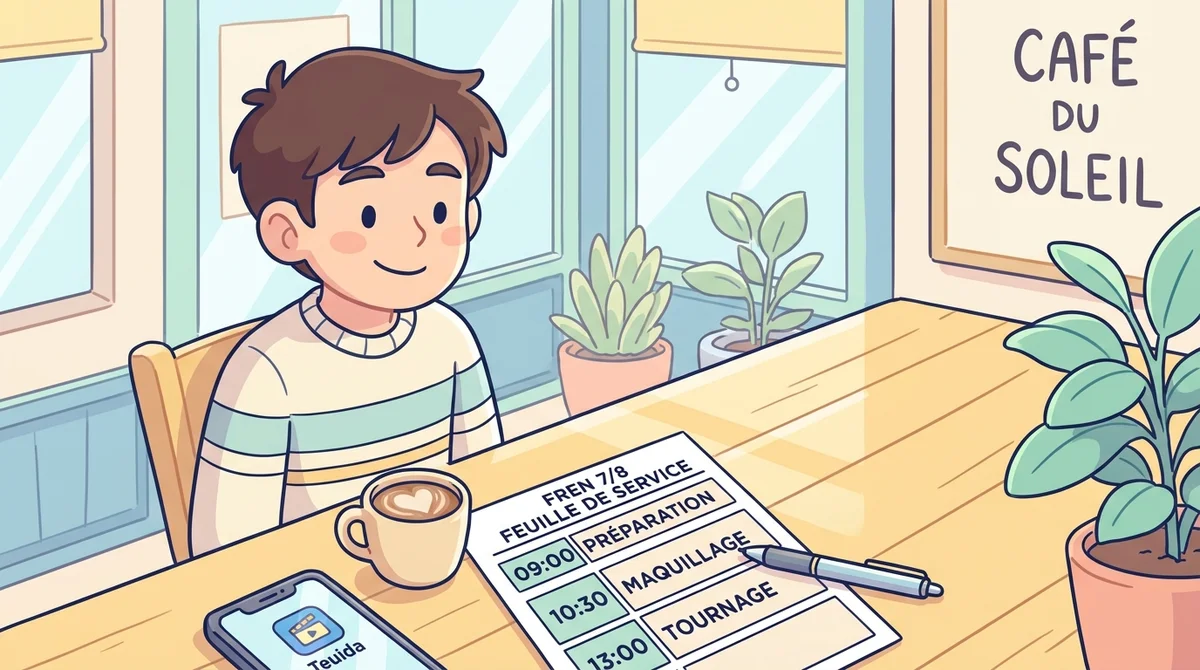
Notice how much happens before the first line is ever spoken. By the time an actor says "Bonjour," roughly two hours of setup have already gone into making that single word land clearly on camera.
Props, scripts, and the little details that sell a scene
The reason a Teuida scene feels like a slice of real life is that it's dressed like one. When Jay films a café conversation, there's an actual cup on the table. When it's a scene about asking directions, there's a real map in someone's hands.
For the FREN 7/8 block, the prop table held exactly what you'd expect from the scenarios: a café menu, a few shopping bags, a phone, a train ticket. Small things. But they give the actors something to do with their hands and give you context clues for the vocabulary.
The scripts matter even more. Every line is printed, reviewed, and checked by our bilingual tutors before anyone says it on camera. We're not writing textbook French — we're writing the French a real person would actually use.
Take a line from the café scene:
- Script: Je vais prendre un café, s'il vous plaît. (zhuh vay PRAHN-druh uh ka-FAY, seel voo PLEH) — "I'll have a coffee, please."
That's natural, spoken French. Not "I would like to purchase one coffee beverage." The printed script keeps the whole crew aligned so the actor delivers it the same clear way, take after take — which is exactly how you'll hear it in the app.
Common mistakes learners make — and why the shoot fixes them
Here's where the behind-the-scenes stuff loops straight back to your learning. A lot of beginner French mistakes come from learning the language in a vacuum — reading words without ever hearing a human say them in a real moment.
Three mistakes we specifically design the shoot to prevent:
1. Flat, textbook pronunciation. Learners often read French with the rhythm of their own language. Hearing a real actor say "ça va?" (sa VA), "how's it going?" — with the natural rising lilt — teaches your ear what to copy.
2. Ignoring liaison. In French, words link together. Vous avez sounds like "voo-za-VAY," not two separate words. On a textbook page you'd never guess that. On camera, you hear it instantly.
3. Freezing when someone replies. Most French courses teach you to produce sentences but never train you to respond to a live person. Filming real two-person exchanges means you practice the back-and-forth, not just the monologue.
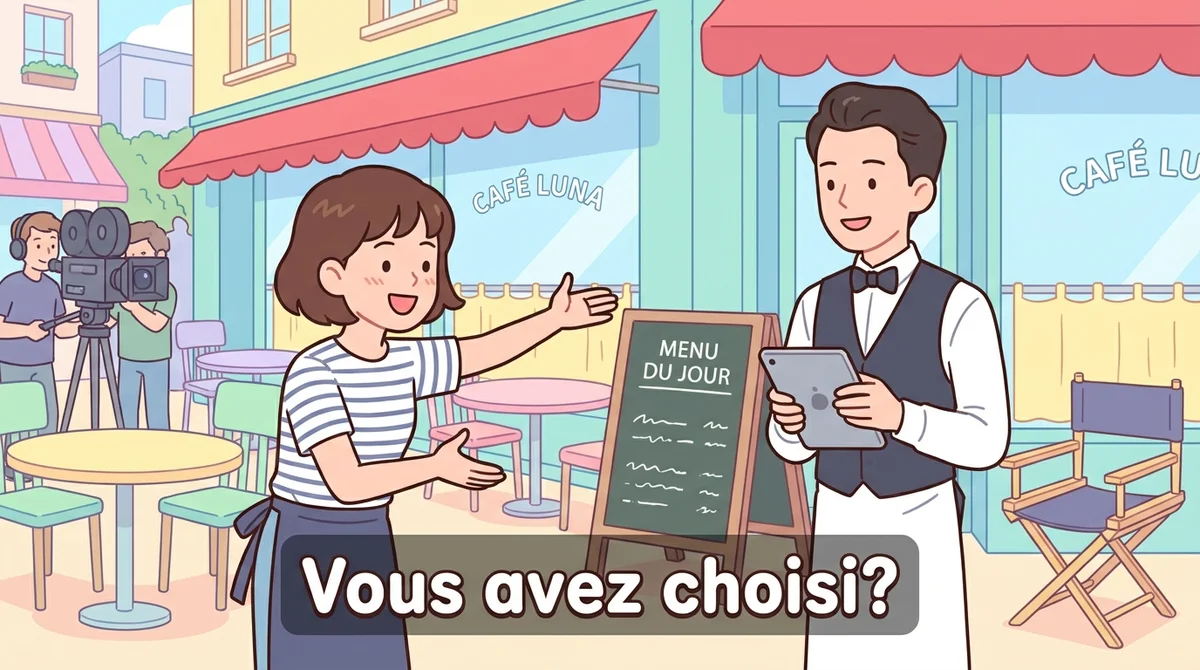
Every one of those problems gets quietly solved by the fact that a real person, on a real set, said the line to a real camera pointed where you will eventually be.
Step by step: how one conversation scene gets filmed
Those five hours of filming aren't one long take. Each short French exchange goes through the same repeatable cycle, and understanding it helps you understand how to practice it.
- Block it. Jay positions the actors and the camera. In a virtual-conversation scene, the actor often faces the lens directly — because in the app, that's you they're talking to.
- Rehearse the line. The actor runs the script a couple of times so the pronunciation is crisp and the pacing is natural.
- Roll camera + sound. Quiet on set. The line gets delivered.
- Get coverage. The same line is filmed a few times, and often with a deliberate pause — a gap where you will speak your answer in the app.
- Check and reset. Jay reviews the take, confirms the audio is clean, then moves to the next line.
That built-in pause in step 4 is the secret sauce. When you practice in Teuida, the scene stops and genuinely waits for your voice. That's not an accident — it was filmed that way on purpose.
Real French from the FREN 7/8 scenes
So what will you actually get to say? Here are a few exchanges straight from the kind of scripts filmed that day, with translations and pronunciation hints.
At the café:
- Actor: Bonjour ! Vous avez choisi ? (bon-ZHOOR, voo-za-VAY shwa-ZEE) — "Hello! Have you decided?"
- You: Oui, je vais prendre un croissant. (wee, zhuh vay PRAHN-druh uh krwa-SAHN) — "Yes, I'll have a croissant."
Asking for directions:
- You: Excusez-moi, où est la gare ? (ek-skew-zay-MWA, oo eh la GAR) — "Excuse me, where is the station?"
- Actor: C'est tout droit, puis à gauche. (seh too DRWA, pwee a GOASH) — "It's straight ahead, then on the left."
Small talk:
- Actor: Ça va aujourd'hui ? (sa VA oh-zhoor-DWEE) — "How are you today?"
- You: Ça va bien, merci ! Et vous ? (sa va bee-AN, mair-SEE, ay VOO) — "I'm well, thanks! And you?"
Read those out loud right now. Feel how the words link and bounce. That's the thing we spent five hours capturing so your ear has something true to imitate.
Practice tips: the only way this actually sticks
Here's the honest truth after watching a full shoot day: all that effort to film real people is wasted if you only listen. French sticks when you speak it out loud — when your own mouth makes the shapes and your ear hears whether you got it right.
That's exactly what Teuida's French course is built around. The scenes you just read about become role-play conversations where the actor talks to you, pauses, and genuinely waits for your reply. You answer out loud, and the app's AI pronunciation feedback scores how you said it — then shows you what to fix.
So you don't just memorize "Je vais prendre un café." You order the coffee, out loud, to a real person on screen, and find out if your "r" and your liaison landed. It's the closest thing to practicing with a French friend when you don't have one nearby.
A few ways to get the most out of it:
- Repeat each line until the rhythm matches the actor's, not just the words.
- Don't skip the response prompts — the pauses are where you grow.
- Do a little daily, even 10 minutes. A café scene a day builds real confidence fast.
- Re-shadow your worst score. The feedback tells you where to aim; chase the green.
Everything you saw being filmed today exists so you can do this one thing: speak French to a human and be understood.
Before you go
Next time you open a French scene and someone looks at you and says "Bonjour," you'll know what's behind it — a call sheet, a props table, printed scripts, real actors, and a crew who spent five hours making that moment feel real for you.
That's what "real humans" means here. It's not a slogan; it's Jay's seven-hour day. Now it's your turn to answer back.
Open Teuida's French course, step into the café scene, and say "Je vais prendre un café" out loud — then let the app score it and tell you how French you really sounded.


