
What is Teuida's Story Hall? Learn how stories, scenes, and lines work, the common mistakes to avoid, and a step-by-step routine to practise speaking daily.
You've downloaded Teuida, finished a couple of lessons, and now you're staring at the home screen wondering, "Okay… where do I actually practice talking?" You tap around, you see a few familiar faces and some scene-looking tiles, and you're not totally sure what's what.
That mystery usually has a name: the Story Hall. It's one of the most useful parts of the app, and also one of the most misunderstood. Let's clear it up.
What the Story Hall actually is
The Story Hall is the part of Teuida where the lessons stop feeling like lessons and start feeling like scenes from a drama you're in. Instead of drilling isolated words, you step into a story — a situation with characters, a place, and a reason to speak.
Think of it as the app's library of role-play episodes. Each "story" is a short, self-contained situation: meeting someone new, ordering food, asking for directions, running into a friend. You don't just read the dialogue — you say your lines out loud, and the app listens.
That's the heart of Teuida's whole philosophy: you speak the language from day one. The Story Hall is where that promise actually happens. It's not a grammar menu; it's a stage.
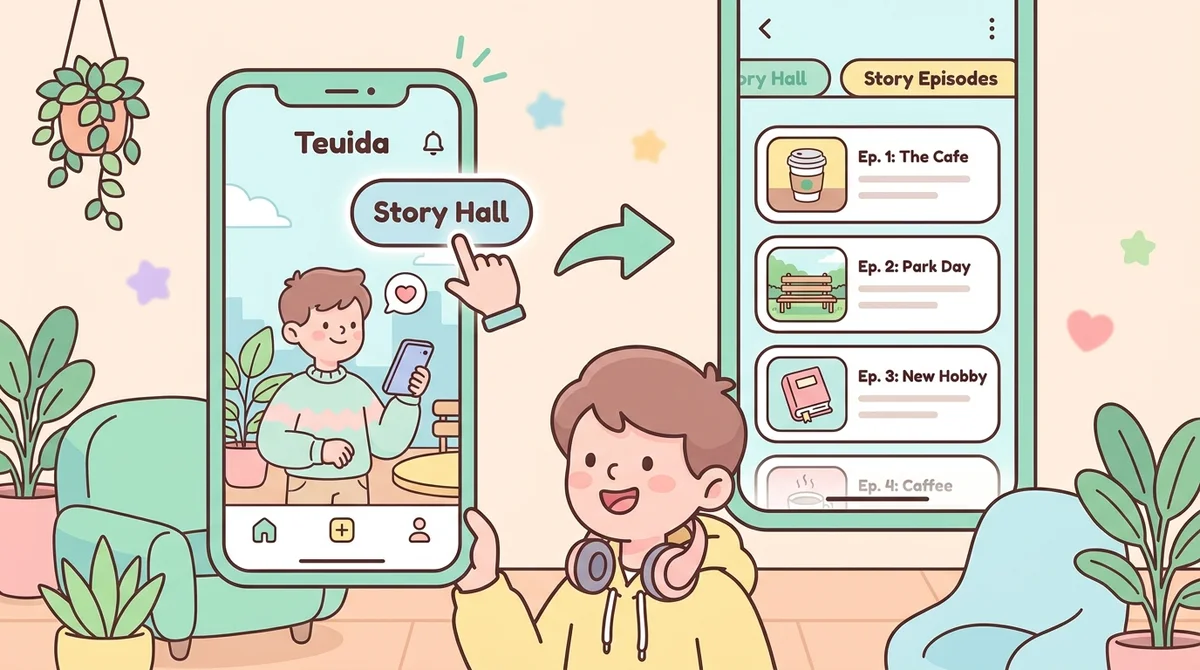
So if you've been treating Teuida like a flashcard app and skipping this section, you're skipping the best part — the part where you build the one skill most learners never get: the confidence to open your mouth.
How the Story Hall is built
Inside the Story Hall, everything is organized so you always know where you are and what's next. Here's the basic structure, no matter which course you're in — Korean, Japanese, Spanish, or French.
| Piece | What it is | Why it matters |
|---|---|---|
| Story | A themed episode (a café, a first meeting, a trip) | Gives your sentences a real context |
| Scene | A chunk of one story — one conversation | Keeps each practice session short |
| Line | A single thing your character says | This is where you speak and get scored |
| Characters | The people you talk to in the scene | They reply, so it feels like a real chat |
| Pronunciation feedback | A score on how you said your line | Tells you what to fix, instantly |
The key thing to understand: a story is the big picture, a scene is one sitting, and a line is where you do the work. You tap a line, you hear how it should sound, then you say it yourself and the app scores your pronunciation.
Because everything is broken into scenes, you're never trapped in a 40-minute block. You can finish one scene on your lunch break and pick up the next one tomorrow. That's deliberate — it's built for a daily habit, not a cram session.
Common mistakes learners make in the Story Hall
The Story Hall is simple, but a few habits quietly stop people from getting the most out of it.
Mistake 1: Reading instead of speaking. It's tempting to read the line silently, nod, and move on. But the whole point is the speaking. If you skip the out-loud part, you've turned a role-play into a reading exercise.
Mistake 2: Ignoring the pronunciation score. When the app flags a word, that's not a punishment — it's the most useful second of your whole session. Learners who glance at a low score and immediately move on miss the exact feedback a textbook can never give them.
Mistake 3: Rushing through for completion. Finishing every story as fast as possible feels productive, but you remember far more from repeating one scene three times than from blasting through ten scenes once.
Mistake 4: Only doing "new" content. Replaying a scene you already "finished" is not wasted time. The second and third times are when the words stop living on the screen and start living in your mouth.
Step-by-step: how to use the Story Hall
Here's the simple flow that works best, whether you're learning Korean, Japanese, Spanish, or French.
- Open the Story Hall and pick a story that matches something you'll actually do — ordering coffee, introducing yourself, small talk.
- Tap into the first scene. Read who the characters are and where the scene takes place so your lines have context.
- Listen first. Play the model audio for your line and really hear the rhythm before you try.
- Say it out loud — not a whisper, a real speaking voice. The microphone needs to hear you clearly.
- Check your pronunciation score. Notice which word or syllable got marked down.
- Repeat the flagged word slowly, then say the whole line again.
- Continue the conversation. The characters respond, so you move through the scene like a real chat.
- Replay the full scene once before you leave. This is the step most people skip and the one that makes it stick.
That's the entire loop. Pick a story, speak the lines, fix what the score flags, replay once. Do that daily and you'll feel the difference within a couple of weeks.
Real-life example: a scene in action
Let's walk through what a Story Hall scene feels like, using a café scene. Here's a Korean example (the same kind of scene exists in the Japanese, Spanish, and French courses too).
You walk into a café. The staff greets you.
- Staff: 어서 오세요! (eoseo oseyo!) — "Welcome!"
- You: 아메리카노 한 잔 주세요. (amerikano han jan juseyo.) — "One Americano, please."
- Staff: 따뜻한 거요, 차가운 거요? (ttatteutan geoyo, chagaun geoyo?) — "Hot or iced?"
- You: 차가운 거로 주세요. (chagaun georo juseyo.) — "Iced, please."
- Staff: 네, 잠시만요. (ne, jamsimanyo.) — "Sure, one moment."
You don't just read that — you speak your lines, and the staff character actually replies to each one. If your 주세요 (juseyo), "please give me," comes out shaky, the score tells you, and you try again.
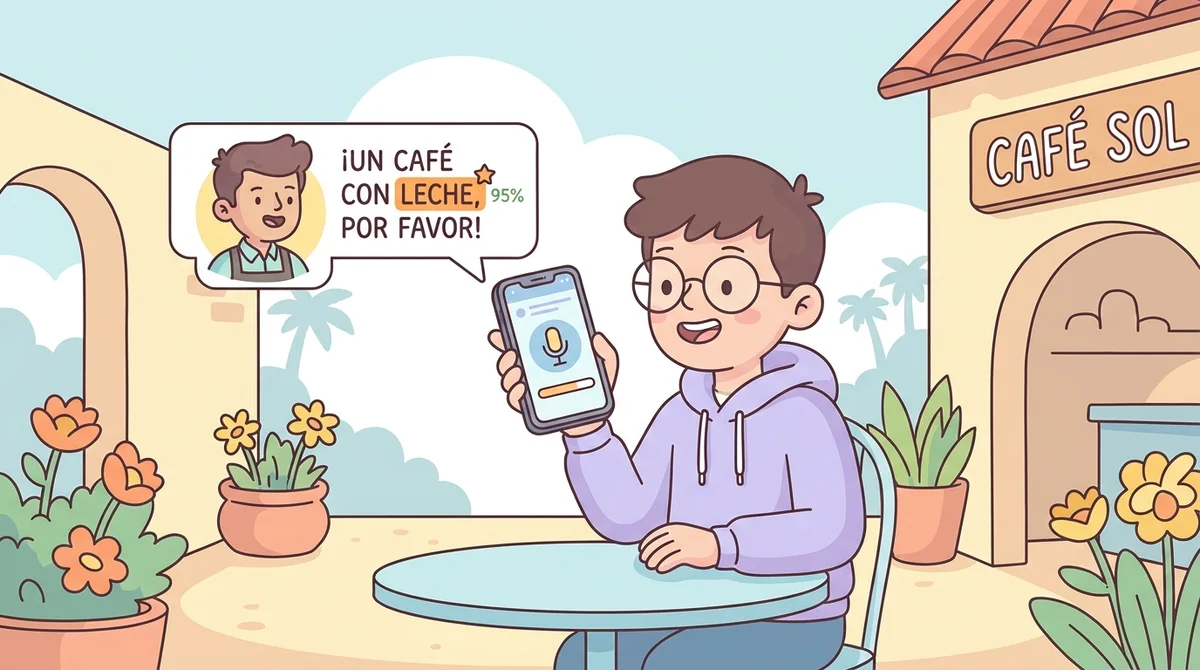
And if you're a Korean speaker learning Spanish, the same café scene lives in the Spanish course:
- Camarero: ¡Hola! ¿Qué desea? (OH-la, keh deh-SEH-ah) — "Hi! What would you like?"
- Tú: Un café, por favor. (oon kah-FEH, por fah-VOR) — "A coffee, please."
Notice how the Spanish r in por favor rolls differently from anything in Korean — that's exactly the kind of sound the pronunciation score helps you catch and smooth out.
Practice tips to get the most out of it
Here's the honest truth: the only way speaking sticks is by speaking. Not recognizing, not translating in your head — producing the sounds yourself, out loud, over and over. The Story Hall is built for exactly that, so lean into it.
Speak at full volume. Mumbling trains you to mumble. Say your lines like you mean them so the pronunciation feedback has something real to score.
Chase the low scores. Treat every flagged word as your to-do list. Repeat just that word five times, then re-say the line. This is where Teuida's AI pronunciation feedback earns its keep — it's the next best thing to a tutor sitting next to you, pointing at the one syllable you keep missing.
Shadow the characters. When a character replies, try saying their line too. You're not graded on it, but it doubles your speaking reps and trains your ear.
Pick scenes you'll actually use. Going to Korea? Drill the café, taxi, and shopping stories. Learning French for a trip? Do the greeting and restaurant scenes first. Because the Story Hall is full of real-life, K-drama-style situations, the lines you practice are the lines you'll genuinely say.
Build a tiny daily streak. One scene a day beats one marathon a month. The Story Hall is split into short scenes precisely so you can keep a habit without burning out.
Whatever course you're in — Korean, Japanese, Spanish, or French — the Story Hall is where you turn "I studied this" into "I can say this." Open a scene today and talk your way through it out loud.
Wrap-up
The Story Hall isn't a mystery tab to skip past — it's the heart of how Teuida works. Stories give your words a world, scenes keep each session short, and the pronunciation score turns every line into real practice. Read less, speak more, replay once, and let the feedback do its job.
You already have everything you need. Open the Story Hall, pick the one scene you'll use this week, and practice it out loud in Teuida until the words feel like yours.


