
Korean military words explained — 군대, 입대, 전역, 제대 and 고무신 — plus how Korea's mandatory service works and natural phrases to ask about it in conversation.
You're watching a K-drama and your favorite idol suddenly disappears from variety shows for almost two years. Fans post tearful goodbyes, there's a buzzcut photo, and everyone keeps saying 입대 (ipdae). You smile along, but honestly — you have no idea what half of these words mean.
If you've ever felt lost whenever Koreans start talking about 군대 (gundae), "the military," you're not alone. It comes up constantly — in dramas, in conversations, in dating apps, even in small talk — and it carries a whole vocabulary of its own. Let's fix that today.
Why military words matter in Korean
In Korea, military service isn't a niche topic. It's a shared experience that shapes a huge part of the culture, especially for men. Nearly every Korean man you meet has either served, is serving, or is about to serve.
That means the vocabulary leaks into everyday life. Guys bond over army stories. Couples count down to a boyfriend's discharge. Celebrities put careers on pause. If you want to really understand Korean conversations — not just café orders — these words are essential.
And here's the good news: you don't need to be an expert in military ranks to follow along. You just need a handful of key terms and a basic idea of how the system works.
What Korea's mandatory military service actually is
Korea has mandatory military service, called 병역 (byeongyeok), "military service duty." By law, almost all able-bodied Korean men must serve for a set period — currently around 18 to 21 months depending on the branch.
The core word you'll hear everywhere is 군대 (gundae), "the army" or "the military" in general. When someone says they're "going to 군대," they mean they're starting their service.
Here's a quick overview of how it generally flows:
| Korean | Pronunciation | Meaning |
|---|---|---|
| 병역 | byeongyeok | mandatory military service (the duty) |
| 입대 | ipdae | entering the military / enlisting |
| 훈련소 | hullyeonso | boot camp / training center |
| 이등병 | i-deungbyeong | private (lowest rank) |
| 휴가 | hyuga | leave / vacation from service |
| 전역 | jeonyeok | discharge (completing service) |
| 제대 | jedae | discharge (older, everyday word) |
Most men serve between the ages of 18 and 28. University students often take a break mid-degree to serve, then return to finish. This is why you'll meet Korean men in their mid-20s who are still undergraduates — it's completely normal.
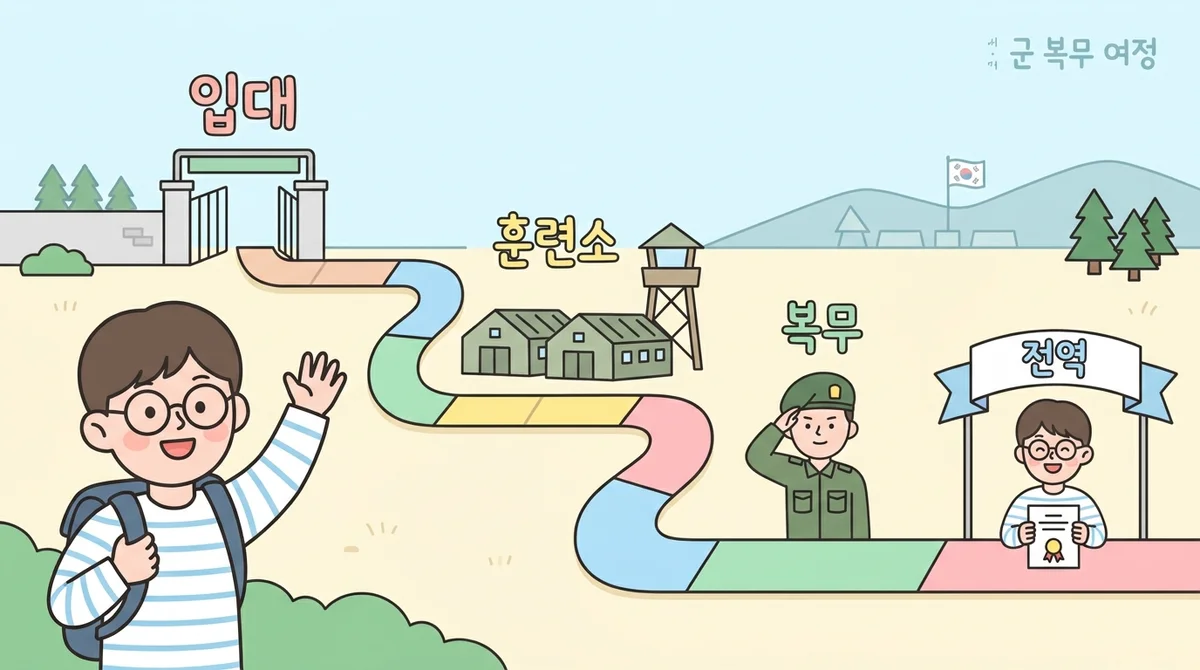
The core vocabulary, broken down
Let's go deeper into the words you'll actually hear and need to recognize. I'll group them so they're easier to remember.
Starting and finishing service
- 입대 (ipdae), "enlisting" — the day someone enters the military.
- 전역 (jeonyeok) and 제대 (jedae), both meaning "discharge." 전역 is the more official term; 제대 is the casual, everyday one people use when chatting.
- 복무 (bongmu), "serving duty" — the actual period of service.
Where they go
- 훈련소 (hullyeonso), "training camp" — the intense boot camp everyone starts with.
- 부대 (budae), "military unit / base" — where a soldier is stationed after training.
People and ranks
- 군인 (gunin), "soldier."
- 이등병 (i-deungbyeong), "private" — the newest, lowest rank.
- 병장 (byeongjang), "sergeant" — the highest enlisted rank, usually reached near the end of service.
- 선임 (seonim), "senior soldier," and 후임 (huim), "junior soldier." These relationships matter a lot inside the military.
Daily life words
- 휴가 (hyuga), "leave" — precious days off when soldiers can go home.
- 면회 (myeonhoe), "a visit" — when family or a partner visits the base.
- 고무신 (gomusin), literally "rubber shoes," is slang for a girlfriend waiting faithfully. If she leaves, people joke she 고무신 거꾸로 신었다 (gomusin geokkuro sinatda), "wore her rubber shoes backward" — meaning she broke up with him.
That last one is the kind of word you'll never find in a textbook but will absolutely hear in a drama.
Common mistakes learners make
Mixing up 입대 and 전역. These are opposites — one is entering, one is leaving. A quick memory trick: 입 (ip) relates to "entering/going in," while 전역 (jeonyeok) signals the end. Confusing them in conversation changes the whole meaning.
Using 군대 to mean a specific base. 군대 is the military as a whole concept. The actual base or unit is 부대 (budae). Saying "I'm going to 군대 tomorrow for a visit" sounds odd — you'd visit a 부대.
Assuming everyone serves in the "army." Korea has multiple branches: 육군 (yukgun), "army"; 해군 (haegun), "navy"; and 공군 (gonggun), "air force." 군대 is the umbrella word, not only the ground army.
Over-formalizing casual talk. With friends, people say 제대 (jedae) for discharge and speak casually. Dropping overly stiff vocabulary into a friendly chat can feel strange. Match the tone.
Forgetting the emotional weight. These aren't just neutral words. 입대 can be sad — people cry at send-offs. 전역 is celebrated. Knowing the feeling behind the word helps you respond naturally.
How to use these words naturally — step by step
1. Start with the three anchor words. Lock in 군대 (gundae), 입대 (ipdae), and 전역 (jeonyeok). With just these, you can follow 80% of casual military talk.
2. Learn the question forms. You'll often hear 군대 갔다 왔어요? (gundae gatda wasseoyo?), "Have you done your military service?" It's a very common question when getting to know a Korean man.
3. Add the "time" words. People constantly talk about how much time is left. 전역 언제예요? (jeonyeok eonjeyeyo?), "When's your discharge?" is a kind, natural thing to ask.
4. Recognize the slang before you use it. Words like 고무신 (gomusin) are fun to understand but tricky to deploy correctly. Understand first, speak later.
5. Match formality to the person. With a new acquaintance, keep it polite. With close friends, casual forms feel warmer and more natural.
Real-life example sentences and a mini-dialogue
Let's see these words in action. Read them out loud — that's how they stick.
Everyday sentences:
- 저는 다음 달에 입대해요.
(jeoneun daeum dare ipdaehaeyo.)
"I'm enlisting next month." - 오빠가 드디어 전역했어요!
(oppaga deudieo jeonyeokhaesseoyo!)
"My boyfriend/older guy friend finally got discharged!" - 군대에서 선임이 정말 좋았어요.
(gundaeeseo seonimi jeongmal joassseoyo.)
"My senior soldier in the army was really nice." - 이번 주말에 휴가 나와요.
(ibeon jumare hyuga nawayo.)
"He's coming out on leave this weekend."
Mini-dialogue — meeting someone new:
A: 혹시 군대 갔다 왔어요?
(hoksi gundae gatda wasseoyo?)
"By any chance, have you done your military service?"
B: 네, 작년에 전역했어요.
(ne, jangnyeone jeonyeokhaesseoyo.)
"Yes, I was discharged last year."
A: 와, 고생 많았겠어요.
(wa, gosaeng manatgesseoyo.)
"Wow, that must have been tough."
B: 괜찮았어요. 이제 복학 준비해요.
(gwaenchanasseoyo. ije bokhak junbihaeyo.)
"It was fine. Now I'm getting ready to go back to school."
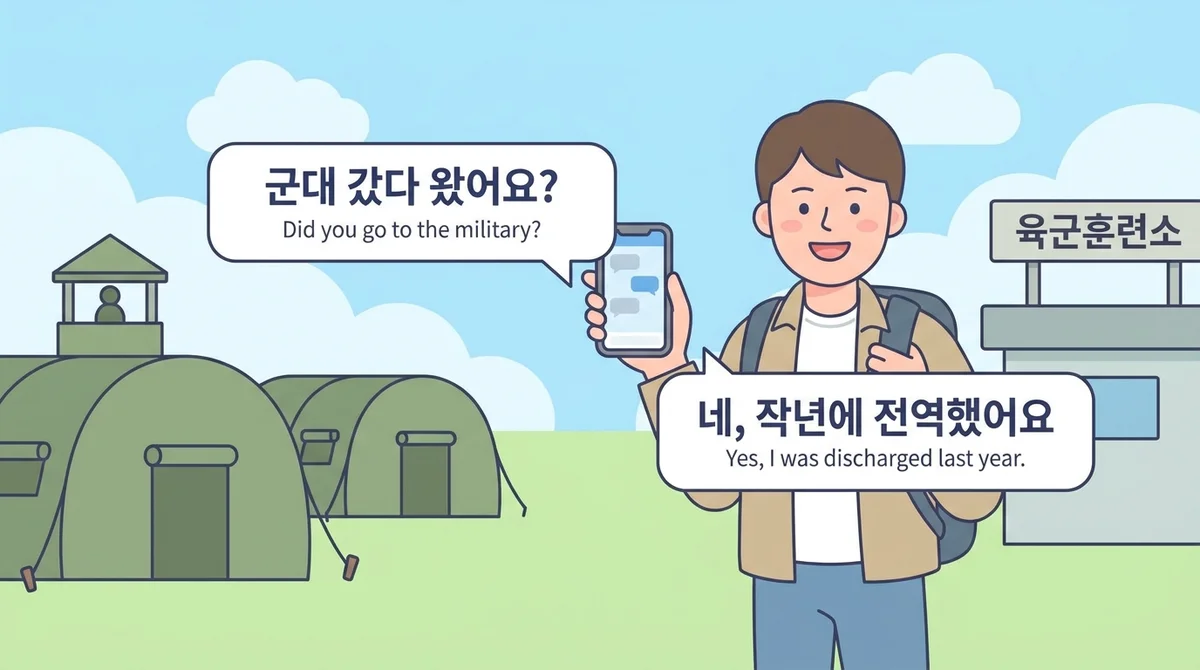
Notice 고생 많았겠어요 (gosaeng manatgesseoyo), "that must have been hard" — it's the warm, natural thing Koreans say in response. Learning the reaction is just as important as the question.
Practice tips — say it out loud
Here's the honest truth: you can memorize all these words and still freeze when a real conversation starts. The gap between recognizing 전역 on a page and actually asking 군대 갔다 왔어요? smoothly to a new friend is huge — and the only way to close it is to speak it out loud, over and over, until it feels automatic.
That's exactly what Teuida is built for. It's a speaking-first Korean app where you role-play real-life conversations — including the kind of casual "getting to know you" chats where military service naturally comes up. Instead of silently reviewing flashcards, you actually say the lines, and the AI pronunciation feedback scores how you sound and shows you what to fix.
So you can practice asking 군대 갔다 왔어요? in a realistic scenario, hear how it should flow, and build the confidence to say it to a real Korean person. It's the next best thing to having a patient native friend sitting beside you.
A few practical tips while you drill:
- Say the whole sentence, not single words. Practice 다음 달에 입대해요, not just 입대.
- Record yourself and compare your rhythm to a native speaker.
- Group opposites together — 입대 and 전역 — and say them back to back so you stop mixing them up.
- React, don't just ask. Practice 고생 많았겠어요 so you can keep the conversation alive.
Keep going — you've got this
Military vocabulary might feel heavy at first, but it's really a doorway into understanding Korean life on a deeper level. The moment you can follow a conversation about someone's 군대 days — or ask kindly about a friend's 전역 — you stop being a tourist in the language and start being a real participant.
Take it one word at a time. Start with 군대, 입대, and 전역, add the question forms, and practice them until they roll off your tongue. Then open Teuida's Korean course, role-play a real conversation about military service out loud, and get your pronunciation scored until it sounds natural.


