
What is 아샷추? Learn Korean café slang like 아아, 뜨아 and 얼죽아, how to order size, extra shots and less sweet, plus real café dialogues to practice out loud.
You walk into a café in Seoul, feeling pretty good about your Korean. Then the person in front of you rattles off "아샷추 톨 사이즈로 주세요" and the barista just nods like it's the most normal thing in the world.
You have no idea what they just ordered. You didn't hear "coffee" or "latte" — just some short, punchy word you've never seen in a textbook. Welcome to the world of Korean café slang, where regulars build their own drinks and give them nicknames that everyone somehow already knows.
What 아샷추 actually is (and why café slang matters)
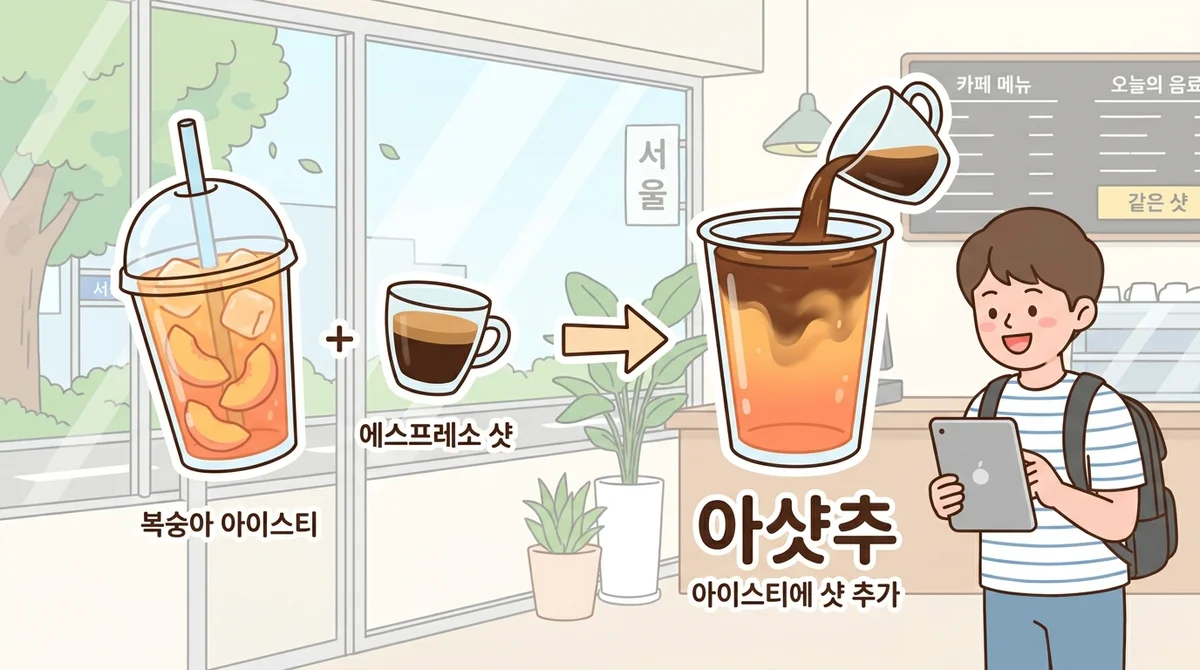
아샷추 (a-shat-chu) is a shortened, mashed-together nickname for a specific drink combo. Break it down and it comes from 아이스티에 샷 추가 (aisiti-e syat chuga), "iced tea with an added espresso shot."
So 아샷추 = iced peach tea + a shot of espresso. It sounds strange the first time, but it's genuinely one of the most ordered drinks among young Koreans. The tea is sweet and fruity, the espresso cuts through it, and you get caffeine plus flavor in one cup.
Here's why this matters for you as a learner: Korean café culture runs on these little combo words. If you only study "textbook" drink names, you'll understand the menu but miss half of what real people actually order. Learning a handful of these makes you sound natural instantly — and lets you order the drinks locals actually love.
Breaking down the most popular café combos
Most of these nicknames follow the same logic: take the base drink, add a modifier, then squish the words into a short form. Once you see the pattern, you can decode almost any of them.
Here's a quick reference table of the combos you'll hear most:
| Slang | Full form | Pronunciation | What it is |
|---|---|---|---|
| 아샷추 | 아이스티에 샷 추가 | a-shat-chu | Iced peach tea + espresso shot |
| 얼죽아 | 얼어 죽어도 아이스 아메리카노 | eol-juk-a | "Iced americano even if I freeze to death" |
| 뜨아 | 뜨거운 아메리카노 | tteu-a | Hot americano |
| 아아 | 아이스 아메리카노 | a-a | Iced americano |
| 바닐라 라떼 | 바닐라 라떼 | banilla ladde | Vanilla latte |
| 연아 | 연하게 아메리카노 | yeon-a | Weak/light americano |
| 샷추 | 샷 추가 | syat chu | "Add a shot" (to anything) |
A few of these deserve a closer look.
얼죽아 (eol-juk-a) is less a drink and more a personality. It literally packs the phrase 얼어 죽어도 (eol-eo jugeodo), "even if I freeze to death," in front of 아메리카노. It means someone drinks iced americano year-round, even in winter. You can call yourself one: "저 얼죽아예요 (jeo eol-juk-a-yeyo)," "I'm an ice-americano-forever person."
아아 (a-a) and 뜨아 (tteu-a) are the everyday shortcuts. 아아 is iced americano, 뜨아 is hot americano. You'll hear these constantly, so lock them in early.
Common mistakes learners make
The combos are fun, but they trip people up in predictable ways. Here are the ones to watch for.
Mistake 1: Trying to say the full phrase every time. You don't need to say 아이스티에 샷 추가 out loud — the whole point is the short form. Baristas at chains like Mega Coffee or Compose will understand 아샷추 immediately. Saying the long version is fine too, just less natural.
Mistake 2: Forgetting the size and cup words. After naming your drink, you still need to specify size and hot/iced if it's not obvious. Practice pairing the drink with 아이스 (aiseu), "iced," or 핫 (hat) / 뜨거운 (tteugeoun), "hot."
Mistake 3: Mixing up 샷 추가 and 연하게. 샷 추가 (syat chuga) means "add a shot" — stronger coffee. 연하게 (yeonhage) means "make it weak/light" — less coffee. These are opposites, so don't swap them by accident.
Mistake 4: Mispronouncing 아이스티. English speakers want to say "iced tea" with a hard T. In Korean it's 아이스티 (aiseuti), four syllables, each vowel clear. Rushing it makes 아샷추 come out wrong.
Step-by-step: how to order like a regular
Ordering in a Korean café follows a reliable little script. Once you know the shape of it, you can slot any drink in.
Step 1 — Greet and open. A simple 안녕하세요 (annyeonghaseyo), "hello," then state your drink. You don't need a long sentence.
Step 2 — Name the drink. Use the slang or the full name: 아샷추 주세요 (a-shat-chu juseyo), "one 아샷추, please."
Step 3 — Add size. Sizes are usually borrowed from English: 톨 (tol) "tall," 그란데 (geurande) "grande," or just 작은 거 (jageun geo) "small one" / 큰 거 (keun geo) "big one" at smaller cafés.
Step 4 — Confirm hot or iced. If it's not built into the name, add 아이스로 (aiseu-ro), "make it iced," or 뜨거운 걸로 (tteugeoun geollo), "make it hot."
Step 5 — Any extras. Want it stronger? 샷 추가해 주세요 (syat chuga-hae juseyo), "please add a shot." Less sweet? 덜 달게 해 주세요 (deol dalge hae juseyo), "make it less sweet."
Step 6 — For here or to go. They'll ask 드시고 가세요? (deusigo gaseyo?), "for here?" Answer 여기서 마실게요 (yeogiseo masilgeyo), "I'll drink here," or 테이크아웃이요 (teikeu-aut-iyo), "to go."
That's the whole flow. Notice how little grammar you actually need — mostly it's naming things and adding 주세요, "please give me."
Real café dialogues to practice
Let's put the pieces together. Read these out loud — that's the only way they'll feel natural in your mouth.
Dialogue 1 — Ordering 아샷추
- You: 안녕하세요, 아샷추 하나 주세요. (annyeonghaseyo, a-shat-chu hana juseyo.) — "Hello, one 아샷추, please."
- Barista: 사이즈는요? (saijeu-neunyo?) — "What size?"
- You: 큰 거로 주세요. (keun geo-ro juseyo.) — "The big one, please."
- Barista: 드시고 가세요? (deusigo gaseyo?) — "For here?"
- You: 테이크아웃이요. (teikeu-aut-iyo.) — "To go."
Dialogue 2 — Customizing your drink
- You: 아이스 아메리카노 하나요. 샷 추가해 주세요. (aiseu amerikano hanayo. syat chuga-hae juseyo.) — "One iced americano. Please add a shot."
- Barista: 네, 샷 하나 추가요. (ne, syat hana chuga-yo.) — "Sure, one extra shot."
- You: 그리고 덜 달게요. (geurigo deol dalge-yo.) — "And less sweet, please."
Dialogue 3 — Declaring yourself a 얼죽아
- Friend: 겨울인데 아이스 마셔? (gyeoul-inde aiseu masyeo?) — "It's winter and you're drinking iced?"
- You: 응, 나 얼죽아잖아. (eung, na eol-juk-a-janha.) — "Yeah, I'm an ice-americano-forever person, remember?"
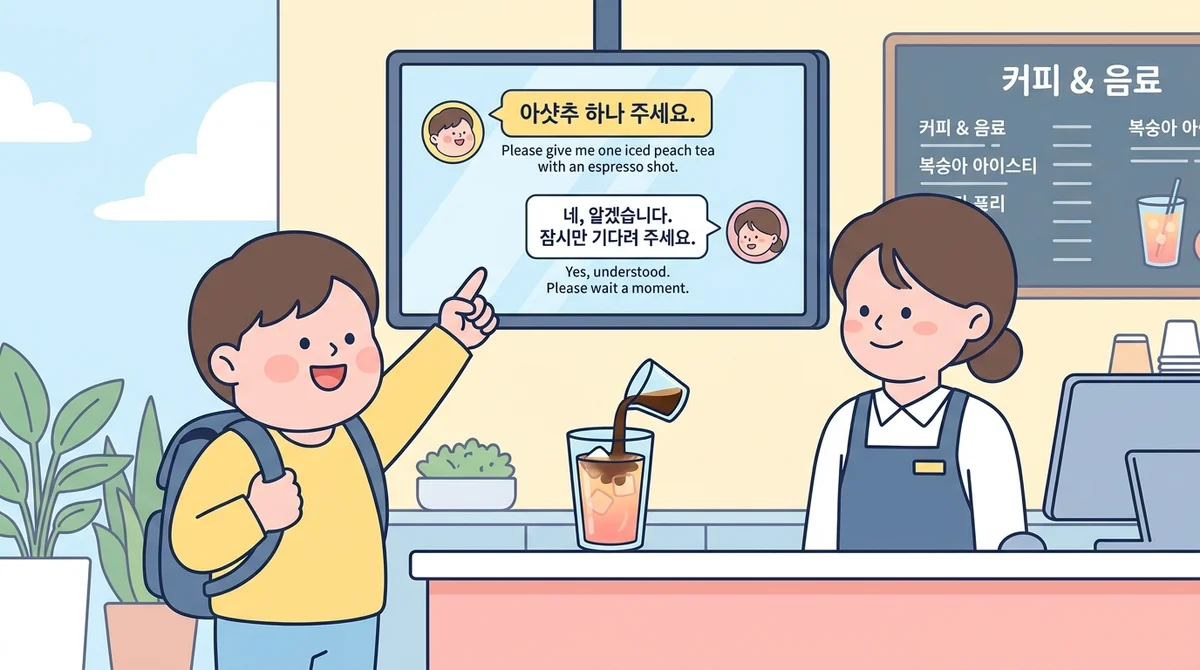
Notice how casual these are. Café talk is friendly and fast, so short phrases win. You almost never need full formal sentences.
Practice tips: say it before you sip it
Here's the honest truth about café slang — you can memorize 아샷추 on paper and still freeze when the barista looks at you. The words only stick when they've been in your mouth, out loud, a few times.
So start there. Say 아샷추 하나 주세요 at normal café speed, not slow textbook speed. Then run the whole order top to bottom: greeting, drink, size, hot or iced, for here or to go. Do it until it flows without stopping to think.
This is exactly what Teuida is built for. Instead of grinding flashcards, you role-play a real café scene out loud — you're the customer, the barista responds, and you order your 아샷추 in context, just like the dialogues above. Teuida's AI pronunciation feedback scores how you say each line and shows you what to fix, so 아이스티 stops coming out like English "iced tea." It's the next best thing to standing at a real counter in Seoul.
You'll find these café scenarios inside Teuida's Korean course, alongside other everyday situations — ordering food, asking for directions, small talk. Practice the café one on repeat and by the time you're actually in Korea, ordering won't feel like a test. It'll feel like something you've already done a dozen times.
The learners who get fluent aren't the ones who recognize 아샷추. They're the ones who can say it without hesitating.
Wrap-up: your café order is waiting
Korean café slang looks intimidating from the outside — all those squished-up nicknames nobody explains. But underneath, it's just a simple pattern: base drink, modifier, short form. Learn 아샷추, 아아, 뜨아, and 얼죽아, add 주세요, and you're already ordering like a local.
The next step is making it automatic, and that only happens by speaking. Order your first 아샷추 out loud in Teuida's Korean café scenario and get your pronunciation scored before you ever set foot in Seoul.


