
Why Teuida rejected AI-generated lesson videos: what learners told us, why real human models teach better pronunciation, and where AI feedback still helps.
You open a language app, tap into a lesson, and something feels slightly off. The teacher's mouth doesn't quite match the sound. The voice is smooth but strangely hollow. You can't say why, but you don't trust it — and within a minute you've closed the app.
If you've felt that, you're not imagining it. We felt it too, and more importantly, our learners told us about it to our faces. This is the story of why we decided not to use AI-generated video in our lessons or our marketing — and what we chose to do instead.
What this decision actually was
Let's be precise, because "we don't use AI" can mean a hundred different things.
The decision we made is narrow and specific: Teuida does not use AI-generated lesson video, and we don't use AI-generated people in our marketing. No synthetic "teacher" talking at you from the screen. No cloned voices reading your example sentences. No AI faces in our ads pretending to be real learners.
This isn't a slogan we printed on a landing page. It came out of actually sitting down with the people who use our app — travellers heading to Seoul, K-drama fans, Korean speakers picking up Spanish and French — and listening to how they reacted to AI content. What we heard was clear enough that it changed what we build.
We want to be honest that this is a choice, with trade-offs, not a claim of moral superiority. AI tools are fast and cheap. Choosing not to use them for the human-facing parts of a learning product costs us time and money. We did it anyway, and the rest of this post explains why — and what it means for you as a learner.
Why real learners reacted the way they did
When our team met users directly, we weren't fishing for compliments. We showed people different kinds of lesson content and watched what happened.
The pattern was strikingly consistent. The moment something looked or sounded AI-generated, trust dropped. People used words like "fake," "creepy," and "I don't believe this person actually speaks Korean." For a product whose entire job is to help you speak, that reaction is fatal.
Here's the thing about learning a language: you are copying a human. When you repeat a phrase, you're not just memorizing symbols — you're imitating a real mouth, real breath, real rhythm. Learners could feel, even without naming it, when that human reference was missing.
There's a second reason that matters just as much. When you're learning pronunciation, you need a correct and natural model to imitate. AI-generated speech often sounds plausible but gets the small things wrong — the length of a vowel, the drop at the end of a sentence, the gentle stress that makes a phrase sound polite instead of flat. Copy a flawed model and you learn the flaw. That's the opposite of what we're here to do.
The two things learners were actually telling us
It helps to separate the feedback into what people said versus what was underneath it.
| What learners said | What they actually meant |
|---|---|
| "This feels fake." | I can't trust this as a model to copy. |
| "The voice is weird." | The pronunciation and rhythm aren't natural, so I'll pick up mistakes. |
| "Is this person even real?" | I bond with and learn from humans, not avatars. |
| "It feels cheap." | If you cut corners here, where else did you cut them? |
| "I zoned out." | There's no warmth, so there's no reason to keep going. |
The last row is the quiet killer. Language learning only works if you come back tomorrow, and the day after. Warmth, personality, a real human you feel like you're talking with — that's what makes a daily habit stick. AI-generated presenters, however polished, were giving people a reason to leave, not a reason to return.
So the decision wasn't really about technology. It was about habit, trust, and getting pronunciation right. AI video failed on all three.
Common mistakes learners make when they trust AI content
If you're learning on your own, it's worth knowing where AI-generated material can quietly steer you wrong. These are the traps we kept seeing.
Copying a model that sounds "close enough." AI voices are good at almost right. In language, almost right is a mistake you'll have to unlearn later. The flat intonation on a Korean sentence, or a Spanish vowel that's a hair too long — small now, stubborn later.
Assuming fluency equals accuracy. A synthetic voice reads smoothly, so beginners assume it's correct. Smoothness and correctness are not the same thing. A real teacher stumbling slightly is still more trustworthy than a flawless-sounding error.
Losing the human cues. So much of speaking is non-verbal — the slight bow in the voice when you're being polite, the smile you can hear. AI strips those cues out. You end up technically understandable but socially off.
Practising recognition instead of production. It's easy to watch AI content passively and feel like you're learning. You're not speaking. And speaking is the only thing that turns knowledge into ability.
How we decide what stays human — our rules
We're not anti-technology. We use software every day. The line we drew is about who you're learning to be like. Here's the simple rule set we now follow.
- If you're meant to copy it, it's human. Every voice you imitate, every model phrase, comes from a real speaker. No cloned voices for pronunciation.
- If it's a face you're meant to trust, it's real. No AI-generated people in lessons or ads. The humans you see are humans.
- AI can assist behind the scenes, never impersonate. Tools that help you — like scoring your own pronunciation — are fine, because they're not pretending to be a person. They're a mirror, not a mask.
- When in doubt, we ask learners. The whole reason we changed course was listening. We keep doing it.
That third point is the nuance people miss. "No AI" doesn't mean refusing all technology. It means AI never plays the role of a human you're supposed to learn from or believe. It can quietly help you check your work. That distinction is the entire philosophy.
Real example: what a human model gives you
Let's make this concrete with the kind of phrase you'd actually practise. Say you're learning Korean for a trip and you want to order politely at a café.
손님: 아이스 아메리카노 한 잔 주세요.
(son-nim: a-i-seu a-me-ri-ka-no han jan ju-se-yo.)
"One iced americano, please."
직원: 네, 사이즈는 어떻게 하시겠어요?
(jigwon: ne, sa-i-jeu-neun eo-tteo-ke ha-si-ge-sseo-yo?)
"Sure, which size would you like?"
Read like that, it's just text. But listen to a real person say 주세요 (ju-se-yo), "please give me," and you hear the soft, slightly rising ending that makes it warm rather than demanding. An AI model often flattens that ending — and suddenly your perfectly correct words sound curt to a native ear.
Now a Spanish example, because Teuida teaches Spanish too, and plenty of our learners are Korean speakers. Imagine asking for the bill:
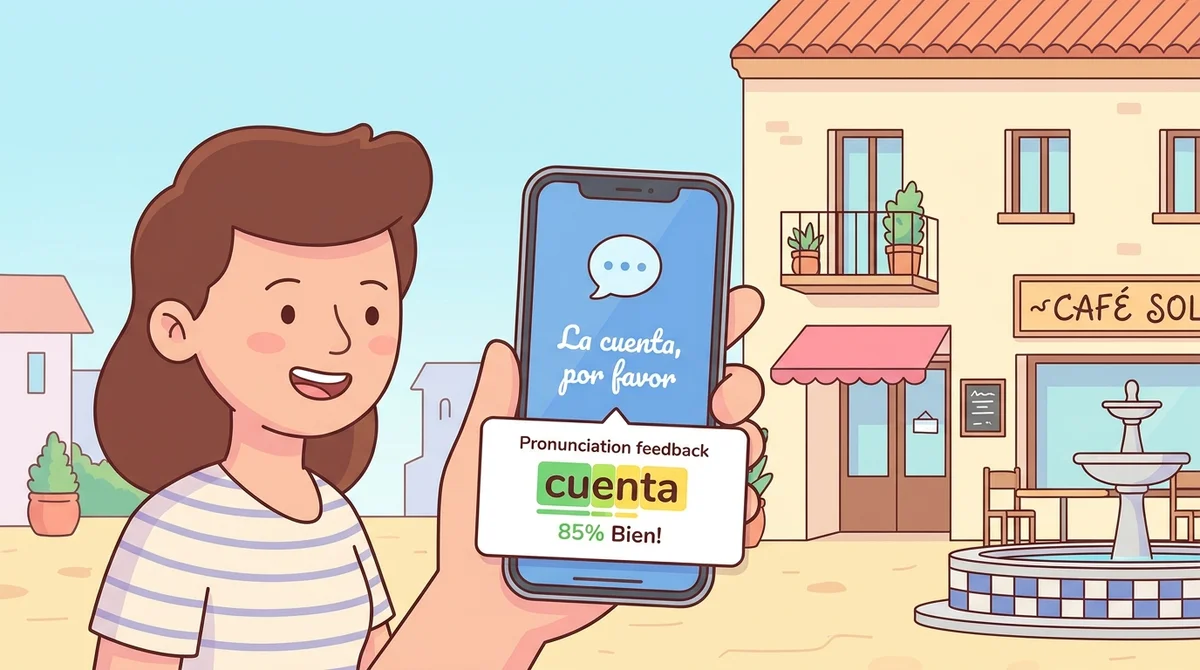
Cliente: La cuenta, por favor. (la KWEN-ta, por fa-VOR.) "The bill, please."
Camarero: Enseguida se la traigo. (en-se-GHEE-da se la TRA-ee-go.) "I'll bring it right away."
For a Korean speaker, the trap in cuenta is the ue cluster — Korean doesn't glide two vowels like that inside one syllable, so learners tend to split it. Hearing a real Spanish speaker do it in one smooth motion is worth a hundred written explanations. That's exactly the kind of thing a flawed AI voice won't reliably teach you.
How to practise this so it actually sticks
Here's the uncomfortable truth we built everything around: reading and listening feel like progress, but you don't own a phrase until you've said it out loud, heard yourself, and fixed what was off.
So practise in that order. First, listen to a real human say the phrase and copy the melody, not just the words. Second, say it out loud yourself — full voice, not a mumble. Third, get feedback on how you sounded, because you can't hear your own mistakes well.
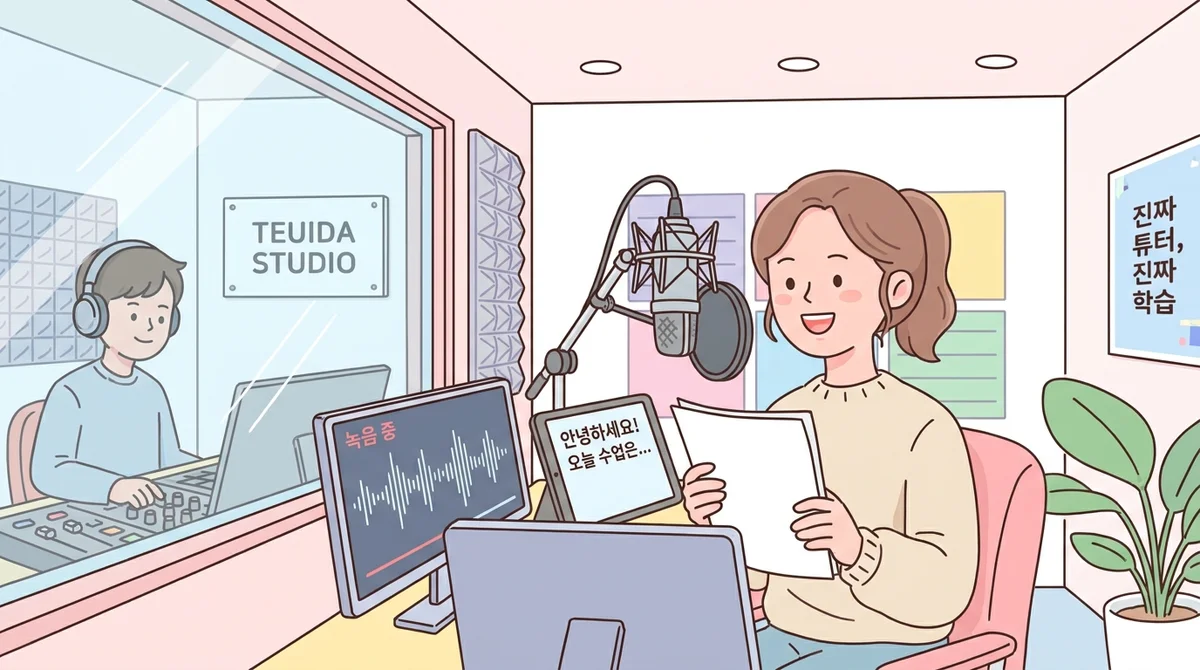
That last step is where most solo learners get stuck, and it's exactly what Teuida is built for. In our scenarios you role-play real situations — ordering that iced americano, asking for the bill, checking into a hostel — and you speak the lines out loud instead of tapping multiple-choice answers. The models you copy are real speakers, recorded by bilingual tutors, so you're imitating natural rhythm from day one.
Then our AI pronunciation feedback scores how you said it and shows you what to fix. Notice the difference from everything above: the AI never pretends to be a teacher talking at you. It's a mirror held up to your own voice — the next best thing when you can't practise with a real person. That's the one place AI genuinely helps a learner, and it's the only place we use it in front of you.
If you're learning Korean, you'll run these drills in our Korean course; if you're a Korean speaker picking up Spanish or French, the same speak-first scenarios live in those courses too. The topic of this post — real human models plus feedback on your own speaking — is the method Teuida runs on.
The takeaway
We didn't drop AI-generated lesson video to sound principled. We dropped it because we sat with real learners, watched trust evaporate the moment something felt synthetic, and realised that fake models teach fake pronunciation and kill the habit before it starts.
So we kept the humans where humans matter — the voices you copy, the faces you trust — and let technology do the one job it does well: showing you how your own speaking is coming along.
That's the story behind the choice. Now it's your turn to use it. Open a scenario, say the line out loud to a real human model, and let Teuida score your pronunciation — practise this in your course today and feel the difference between recognising a phrase and actually being able to say it.


