
Teuida vs Duolingo, Babbel and Rosetta Stone compared: speaking practice, AI pronunciation feedback, free tiers, and which app fits your real language goal.
You've been on a streak for three weeks. You can tap the right answer, match the picture to the word, and your little owl is proud of you. Then a real person asks you a simple question out loud — and your mind goes completely blank.
If that's you, you're not broken and you didn't waste your time. You've just been training the wrong muscle. Recognizing a word and saying it in a live conversation are two different skills, and most apps only ever build the first one. Let's talk honestly about how Teuida stacks up against Duolingo, Babbel and Rosetta Stone — so you can pick the tool that actually gets you talking.
Why comparing these apps even matters
All four apps promise the same happy ending: you, speaking a new language. But they take very different roads to get there, and the road you choose decides what you can actually do at the end.
Duolingo, Babbel and Rosetta Stone are all excellent at parts of the journey. Duolingo is the king of daily habit. Babbel is strong on structured grammar. Rosetta Stone built its name on immersion. Teuida is built around one thing above all: opening your mouth and speaking from day one.
This isn't a "one app to rule them all" article. It's a look at what each one is genuinely good at, so you can match the tool to your goal — whether that's ordering food in Seoul, chatting with a Spanish coworker, or finally understanding your favorite drama without subtitles.
The core comparison
Here's the honest breakdown. No app is bad — they're just built for different outcomes.
| Feature | Teuida | Duolingo | Babbel | Rosetta Stone |
|---|---|---|---|---|
| Main method | Speaking-first, real conversation role-play | Gamified tap-and-match drills | Structured lessons + grammar | Immersion, image association |
| Languages (relevant here) | Korean, Japanese, Spanish, French | 40+ | 14 | 25 |
| Speak out loud from day 1 | Yes, core of every lesson | Occasional, optional | Some speaking exercises | Yes, but scripted words |
| AI pronunciation feedback | Yes, scores how you say each line | Limited | Some | Yes (TruAccent) |
| Real-life dialogue scenarios | K-drama-style situations you act out | Sentences, less situational | Dialogue-based lessons | Contextual but not story-driven |
| Grammar depth | Learn-as-you-speak | Light, implicit | Strong, explicit | Light, implicit |
| Free tier | Yes | Yes (ad-supported) | No (paid) | No (paid) |
| Best for | Actually speaking in real situations | Building a daily habit | Understanding grammar rules | Passive immersion |
Read that table one more time with your own goal in mind. If your goal is "recognize vocabulary," several of these work. If your goal is "hold a conversation without freezing," the speaking-first column is the one to watch.
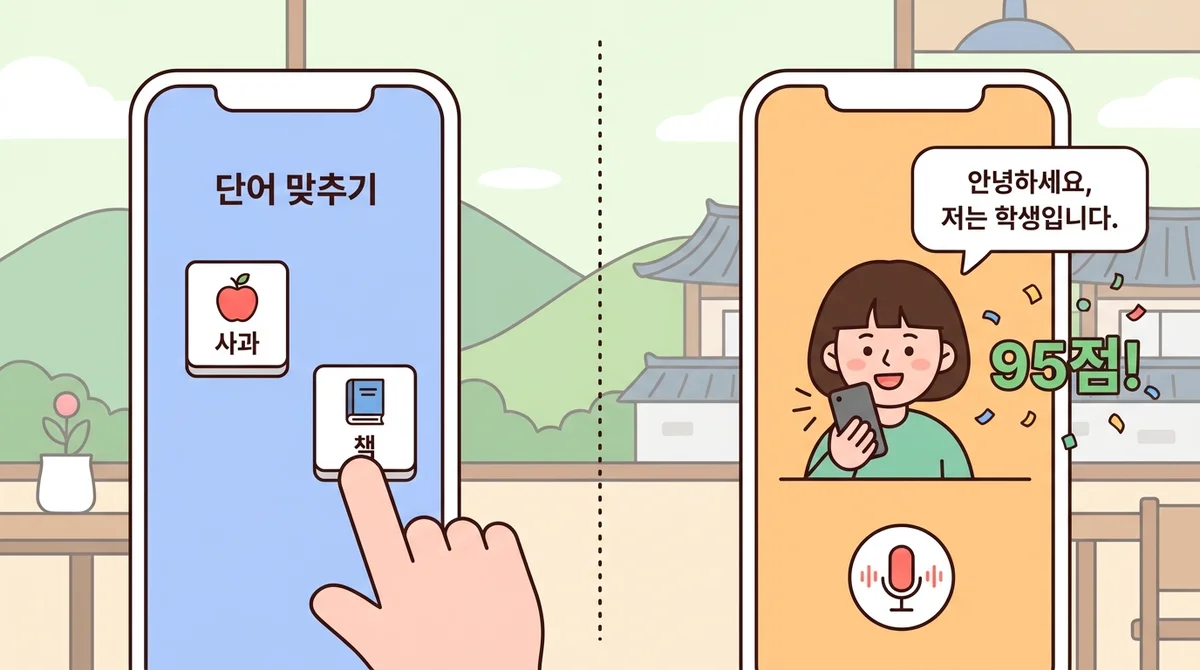
Common mistakes learners make when choosing an app
Mistaking a streak for progress. A 200-day streak feels amazing. But if all 200 days were tapping tiles, you've trained your eyes, not your mouth. Ask yourself: could I actually say what I learned to a real person today?
Thinking grammar first, speaking later. Plenty of learners spend months on rules, waiting to feel "ready" to speak. That day never quite arrives. You get ready to speak by speaking — badly at first, then a little better every time.
Choosing by language count. "This app has 40 languages!" is impressive, but you only need one done well. Depth in your language beats a huge menu you'll never touch.
Ignoring pronunciation feedback. You can practice a phrase 100 times and cement the wrong sound if nobody corrects you. This is the single most important feature for travelers and anyone who wants to be understood.
Assuming one app must do everything. Honestly? Many learners pair a habit app with a speaking app. There's no rule against using Duolingo on the bus and Teuida when you want to practice a real conversation.
How to actually choose — a step-by-step guide
Step 1: Name your real goal. Be specific. "Order coffee and small-talk in Korea in three months" is a goal. "Learn Korean" is a wish. Your goal points straight at the method you need.
Step 2: Decide how much you'll speak. If you want to converse, put speaking practice at the center, not as a bonus feature. Choose an app where you talk out loud in every lesson.
Step 3: Check your target language is done well. Teuida focuses on four — Korean, Japanese, Spanish and French — and builds each around real conversations. A smaller menu often means deeper lessons.
Step 4: Test the free tier. Duolingo and Teuida both let you start free. Do a few lessons and notice one thing: at the end, did you say anything, or just tap?
Step 5: Match the vibe to your life. Love gamification and gentle nudges? Duolingo. Want grammar explained clearly? Babbel. Want quiet immersion? Rosetta Stone. Want to walk away actually able to speak in real situations? Teuida.
Real-life example: the same moment, two skills
Let's see the difference with a simple café scene. First, the kind of line a tap-and-match app trains you to recognize:
- Korean: 물 (mul), "water"
- Japanese: 水 (mizu), "water"
- Spanish: agua (AH-gwa), "water"
- French: eau (oh), "water"
Great — you know the word. But recognizing a word on a screen isn't the same as using it. Now here's what a speaking-first lesson has you actually do, out loud, in a scene:
Korean
- 저기요, 물 좀 주세요. (jeogiyo, mul jom juseyo.) — "Excuse me, water please."
- 네, 여기 있습니다. (ne, yeogi itseumnida.) — "Yes, here you go."
Spanish
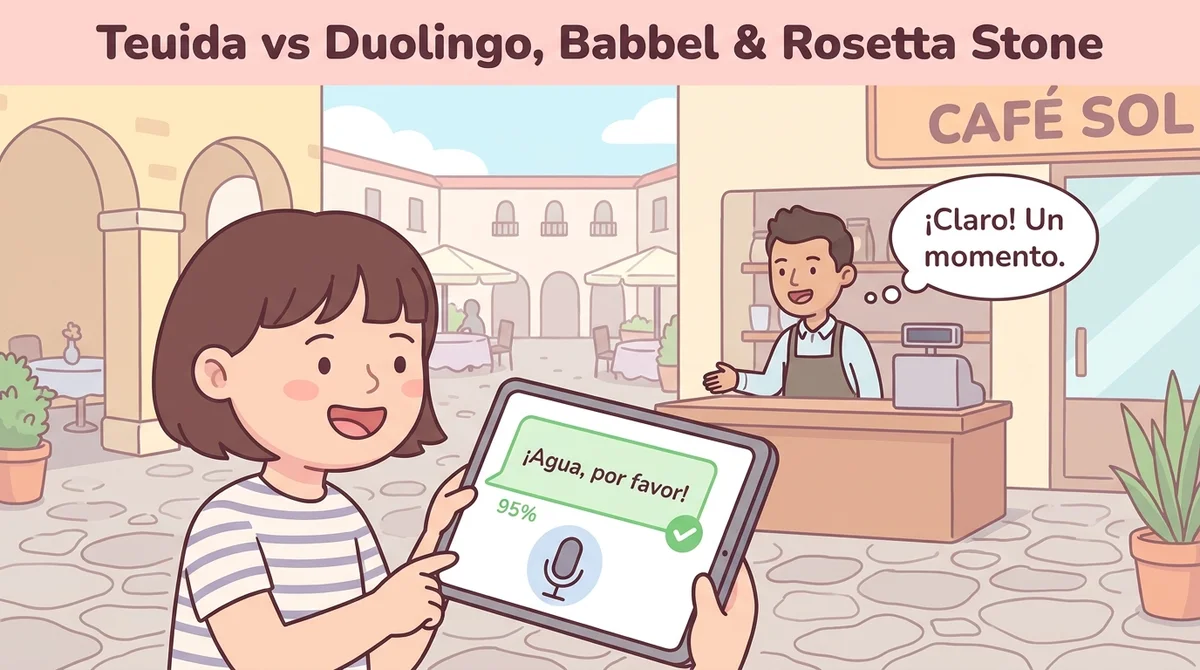
- Perdona, ¿me pones un agua, por favor? (per-DOH-na, meh POH-nes oon AH-gwa) — "Excuse me, can I get a water, please?"
- Claro, ahora mismo. (KLAH-roh, ah-OH-ra MEES-moh) — "Sure, right away."
Japanese
- すみません、お水をください。(sumimasen, omizu o kudasai.) — "Excuse me, water please."
- はい、どうぞ。(hai, dōzo.) — "Yes, here you are."
See the gap? One skill lets you point at "water" on a flashcard. The other lets you walk into a café and be understood. That gap is exactly what a speaking-first app is designed to close.
Practice tips that actually make it stick
Here's the truth every language teacher knows: you learn to speak by speaking. Reading and tapping build a passive base, but fluency comes from your mouth doing the work, over and over, until the words stop feeling foreign.
The problem for most people is obvious — you don't have a patient native speaker on call to rehearse with. That's the exact gap Teuida was built to fill. Instead of tapping tiles, you step into K-drama-style scenes and speak your lines out loud, in context, from your very first lesson. The café order above? You'd actually role-play it, respond to the character, and hear how a real exchange flows.
And you're not talking into the void. Teuida's AI pronunciation feedback scores how you say each line and shows you what to fix — the next best thing to a tutor sitting beside you. That's the piece Duolingo mostly skips and the reason so many streak-holders still freeze in real life.
A few tips to get the most out of any speaking practice:
- Say it, don't just read it. Every new phrase, speak out loud at least three times.
- Shadow the audio. Copy the rhythm and melody, not just the words.
- Repeat scenes until they're automatic. Ordering, greeting, asking directions — drill the ones you'll actually use.
- Chase the feedback score. Redo a line until your pronunciation lands. That green checkmark means a real person will understand you.
Whether you're learning Korean, Japanese, Spanish or French, pick the scene that matches your goal and run it out loud in Teuida's course for that language until it feels like second nature.
The bottom line
There's no single "best" app — there's the best app for your goal. If you want a fun daily habit, Duolingo delivers. If you crave grammar structure, Babbel is your friend. If you like quiet immersion, Rosetta Stone earns its reputation.
But if your real dream is to open your mouth and talk — to order that coffee, chat with a host family, understand a drama, or just not freeze when someone speaks to you — then speaking has to be the center of your practice, not a side feature. That's the whole reason Teuida exists.
You already know more than you can say. It's time to close that gap. Open Teuida, pick your language's course, and practice this café scene out loud today — your first real conversation is one spoken line away.


