
Teuida vs LingoDeer compared honestly: grammar-first drills or speaking-first role-play. See which Korean app actually closes the gap between knowing Korean and saying it out loud.
You've been studying Korean for three months. You can read 한글 (hangeul), you know your particles, you can conjugate 하다 (hada), "to do," in your sleep. Then a Korean speaker asks you a simple question at a café — and your mouth just… freezes.
That gap between knowing Korean and speaking Korean is the single most frustrating thing about learning this language. And the app you choose has a huge say in whether you close it. So let's honestly compare two popular options — Teuida and LingoDeer — through one lens that matters most: which one actually gets you talking?
Why "which app" is the wrong first question
Before we compare, it helps to know what you're really choosing between. Every Korean app is built around one core assumption about how you learn best.
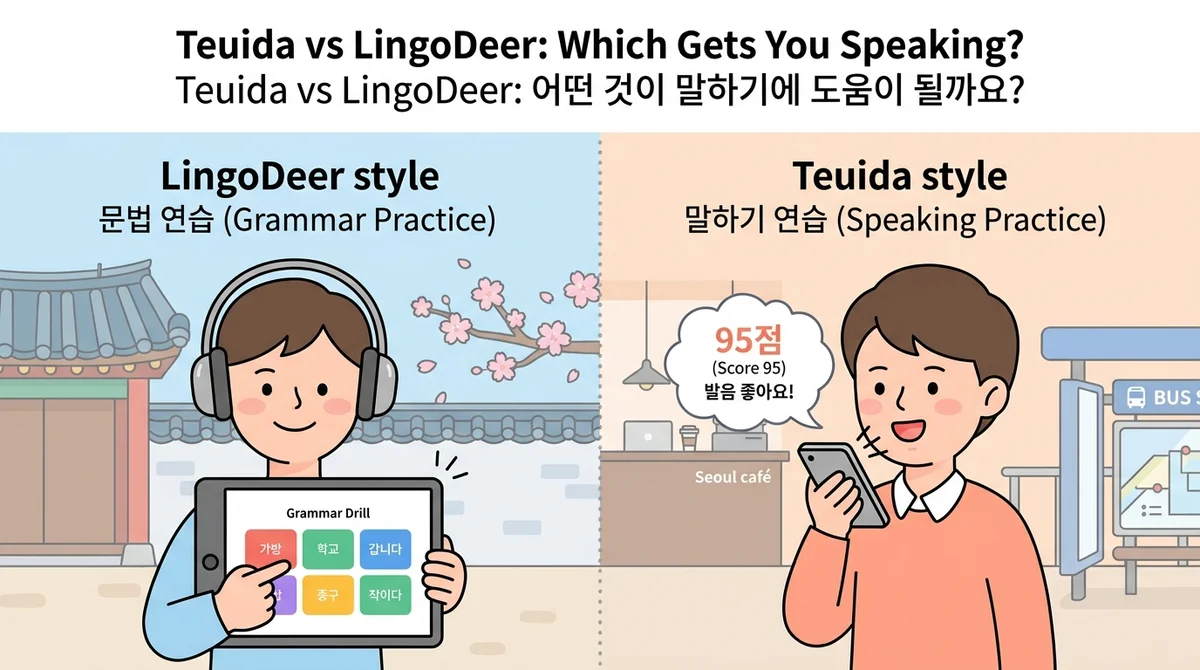
LingoDeer assumes you learn by understanding the system first — grammar rules, sentence structure, vocabulary drills — and speaking comes later, once the foundation is solid. It's structured, thorough, and very good at explaining why Korean works the way it does.
Teuida assumes you learn by speaking from day one — you open your mouth, say real sentences out loud in real situations, and the grammar sinks in because you used it. Different philosophy, different results.
Neither is "wrong." But if your goal is to survive a real conversation in Seoul — or finally understand your favorite drama without subtitles and respond to it — the philosophy you pick changes everything.
The core difference, side by side
Here's the honest breakdown. Both apps teach Korean well; they just aim at different finish lines.
| Feature | Teuida | LingoDeer |
|---|---|---|
| Core method | Speak out loud from lesson 1 | Grammar + structured drills first |
| Speaking practice | Full spoken conversations, scored | Some speaking, mostly typing/tapping |
| Pronunciation feedback | AI scores how you say it | Limited / listen-and-repeat |
| Lesson style | K-drama-style role-play scenarios | Textbook-style units |
| Grammar depth | Learned through use | Very detailed explanations |
| Best for | Speaking confidence, travel, real talk | Reading, writing, grammar mastery |
| Feels like | Talking to a person | Working through a smart workbook |
The short version: LingoDeer builds your Korean knowledge. Teuida builds your Korean mouth. If you already know a lot of grammar but can't get words out, that second one is your missing piece.
The common mistake: confusing recognition with speaking
Here's the trap almost every Korean learner falls into, and it's worth naming.
When you tap the right answer in a drill, or match 안녕하세요 (annyeonghaseyo), "hello," to its meaning, your brain feels like it knows it. That's recognition — you can identify the right answer when it's shown to you.
But production — pulling that sentence out of your own head and saying it out loud, correctly, in real time — is a totally different skill. And it only grows when you actually practice producing.
This is why so many learners who grind grammar apps for months still freeze in conversation. They trained recognition. They never trained their mouth. You can conjugate perfectly on paper and still be unable to order 김치찌개 (kimchi-jjigae), "kimchi stew," out loud because you've literally never said the sentence.
The fix isn't more grammar. It's more speaking. So when you compare apps, ask the blunt question: how many minutes of this app is me actually talking?
How to choose the right app for your goal
Instead of "which is better," decide based on where you are and where you want to go.
Step 1 — Name your real goal.
Do you want to read webtoons and understand grammar deeply? Or do you want to speak — order food, make small talk, respond in a conversation? Be honest, because it points to different tools.
Step 2 — Check your current weak spot.
If you can already read 한글 and know basic grammar but panic when asked to speak, your weak spot is production. No amount of extra grammar fixes that.
Step 3 — Match the tool to the gap.
For grammar-heavy foundations, a structured app like LingoDeer does the job. For the speaking gap specifically — pronunciation, fluency, confidence — you need an app built around your voice.
Step 4 — Count the speaking.
Open each app and do one lesson. Track how long you spent actually saying Korean out loud. That number tells you which app trains the skill you're missing.
Step 5 — Combine, if you want.
There's no rule that says one app. Many learners use a grammar app for structure and a speaking-first app to actually talk. But if you had to pick the one that closes the "can't speak" gap, pick the one that makes you speak.
Real Korean you'd practice out loud
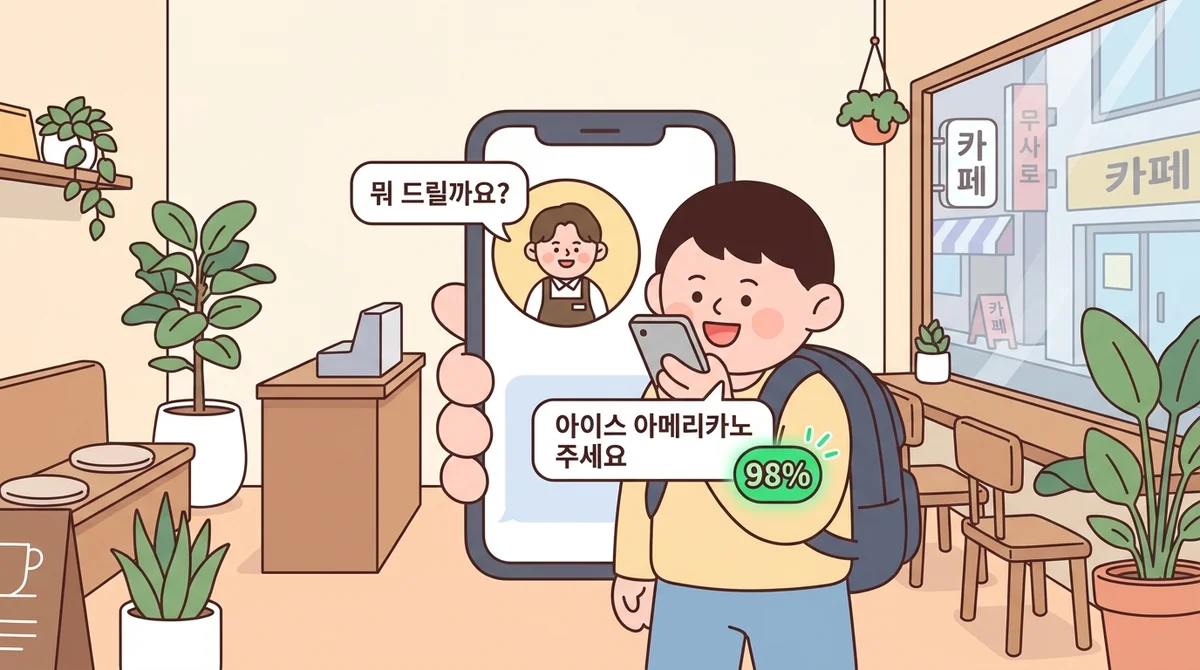
The whole point of a speaking-first approach is that you rehearse full, natural exchanges — not isolated words. Here's the kind of café scene you'd role-play out loud rather than just tap through.
- Staff: 어서 오세요. 뭐 드릴까요? (eoseo oseyo. mwo deurilkkayo?) — "Welcome. What can I get you?"
- You: 아이스 아메리카노 한 잔 주세요. (aiseu amerikano han jan juseyo.) — "One iced americano, please."
- Staff: 사이즈는요? (saijeuneunyo?) — "What size?"
- You: 큰 걸로 주세요. (keun geollo juseyo.) — "The large one, please."
- Staff: 네, 삼천오백 원입니다. (ne, samcheon-obaek won-imnida.) — "Okay, that's 3,500 won."
Notice what just happened. You didn't learn "juseyo" as a vocabulary card — you used it twice in a real situation, heard the follow-up question, and answered. That's how it locks in.
A quick everyday exchange:
- A: 한국어 잘하시네요! (hangugeo jalhasineyo!) — "Your Korean is really good!"
- B: 아니에요, 아직 배우고 있어요. (anieyo, ajik baeugo isseoyo.) — "No no, I'm still learning."
Say that "anieyo" out loud a few times and it becomes automatic — the exact reflex you want when a real compliment catches you off guard.
Practice tips that actually close the speaking gap
If there's one thing to take from this whole comparison, it's this: the only way speaking sticks is by speaking. Reading about it, tapping tiles, watching explanation videos — none of it trains your mouth. Your mouth needs reps.
Here's how to build those reps:
- Say every sentence out loud. Never let a phrase stay silent in your head. If your app lets you tap through without talking, talk anyway.
- Repeat until it's smooth, not just correct. Getting 주세요 right once isn't enough. Say it until it flows without thinking.
- Practice full exchanges, not single words. Real conversations are back-and-forth. Rehearse the question and your answer.
- Get feedback on your pronunciation. You can't hear your own mistakes reliably. You need something — or someone — telling you when your 어 and 오 vowels are off.
This is exactly where Teuida is built to help. Its Korean course drops you into K-drama-style scenarios — ordering coffee, meeting someone, shopping — and you actually speak your lines out loud. The AI pronunciation feedback scores how you say each sentence and shows you what to fix, which is the next best thing to having a Korean friend correcting you in real time.
So instead of learning "juseyo" as a flashcard, you role-play that whole café order in Teuida's Korean course and get your pronunciation scored line by line. That's the difference between recognizing Korean and speaking it — and it's the gap grammar-first apps tend to leave open.
Even fifteen minutes a day of real spoken practice beats an hour of silent tapping. Speaking is a physical habit, and Teuida is designed to make that habit stick daily.
The bottom line
If you want a deep, structured grammar reference, LingoDeer is a genuinely strong app and worth respecting for what it does. But if you've been studying Korean and you still can't get the words out — if your real goal is to speak, travel, and hold your own in a conversation — then a grammar-first app was never going to fix that. Only speaking fixes speaking.
That's the whole reason Teuida exists: to get you talking from day one, in real situations, with feedback on how you sound. Knowing Korean and speaking Korean are two different skills, and you deserve the one that actually shows up when a real person is standing in front of you.
Ready to stop freezing and start talking? Open Teuida's Korean course, role-play that café order out loud, and hear your pronunciation score for yourself.


