
Which anime teach Japanese? Slice-of-life shows hand you repeatable everyday lines; fantasy epics bury you in archaic grammar. Pick right and shadow it.
You finish an episode feeling like you understood everything — then you try to repeat one line out loud and realize you can't reproduce a single word of it. Sound familiar?
Anime is one of the most fun ways to fall in love with Japanese, but not every show teaches you the same thing. Some are basically free everyday conversation practice. Others are gorgeous, thrilling, and almost useless for a beginner. Let's sort out which is which so you spend your watch time wisely.
Why anime choice matters for learning Japanese
Anime is real Japanese, spoken at natural speed, with real emotion behind it. That's exactly why it works — and exactly why the wrong pick can crush your confidence.
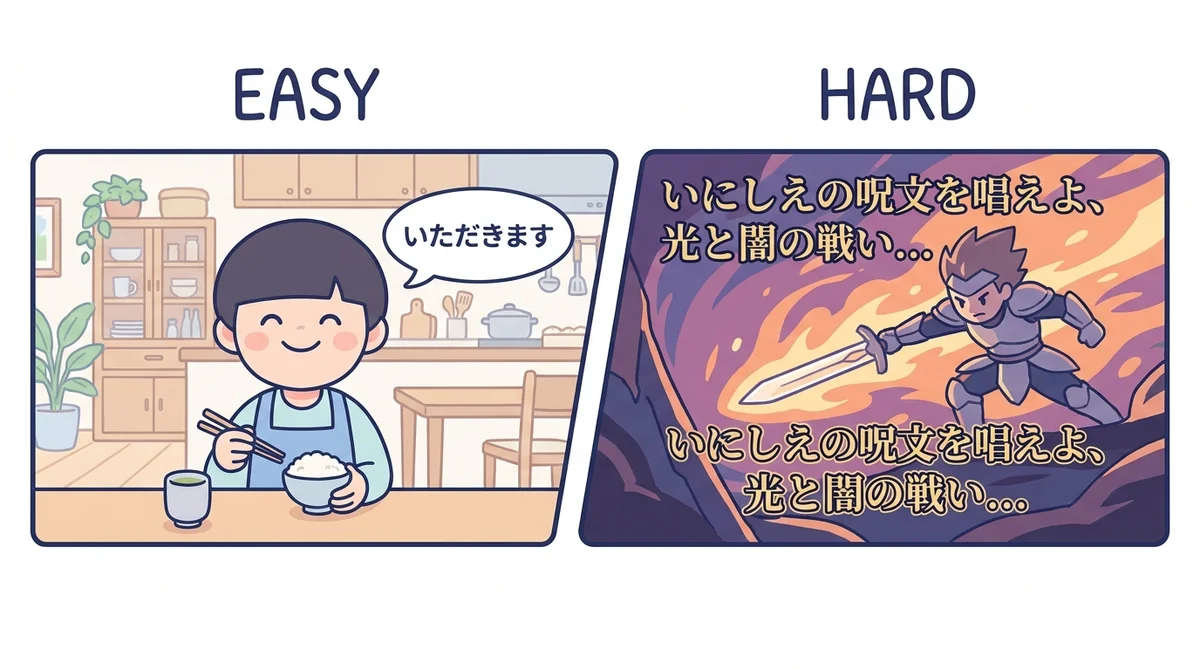
The trap is thinking all anime is "practice." A slice-of-life show set in a normal high school gives you sentences you could actually use tomorrow. A fantasy war epic gives you archaic verb forms, invented vocabulary, and shouting you'll never say to a shop clerk.
The goal isn't to understand cool lines. It's to pick up language you can speak back. A good learning anime feeds you natural, repeatable Japanese — greetings, feelings, everyday questions — in situations close to your own life.
So before you queue up the most epic thing on your list, ask one question: would I ever actually say this out loud?
What makes an anime easy or hard to learn from
A few concrete features decide whether a show helps you or overwhelms you.
| Feature | Easier to learn from | Harder to learn from |
|---|---|---|
| Setting | Everyday life, school, home | Fantasy, war, historical, sci-fi |
| Speech speed | Calm, clear, spaced out | Rapid-fire, overlapping |
| Vocabulary | Common daily words | Invented terms, slang, jargon |
| Politeness level | Standard です/ます (desu/masu) forms | Rough, archaic, or hyper-casual |
| Sentence length | Short, complete | Long, interrupted, poetic |
| Emotion | Natural, conversational | Screaming, whispering, dramatic |
Notice the pattern: the closer a show is to ordinary daily life, the more useful its Japanese. A character asking おはよう (ohayō), "morning," and どこ行くの? (doko iku no?), "where are you going?" is teaching you language you'll reuse constantly.
Compare that to a warlord bellowing 我が名において (waga na ni oite), "in my name" — beautiful, but it will never help you order lunch.
Common mistakes learners make with anime
Mistake 1: Copying rough male speech. Many action heroes drop the polite endings and use blunt forms like お前 (omae), "you," or だ (da) sentence endings. If you speak like that to a stranger in Japan, you'll sound aggressive. Learn the polite version first.
Mistake 2: Watching with your native subtitles and calling it study. Reading a translation the whole time trains your eyes, not your ears. You feel like you learned, but you didn't hold any Japanese in your head.
Mistake 3: Trying to learn from fantasy first. Beginners often start with their favorite epic series because it's what got them into anime. Then they're baffled that "normal Japanese" sounds nothing like it. That's because it isn't normal Japanese.
Mistake 4: Never repeating anything out loud. This is the big one. Recognition is not production. You can watch 200 hours and still freeze when you have to actually speak.
Mistake 5: Ignoring how women and men speak differently. A lot of anime exaggerates gendered speech. Copying a character of another gender word-for-word can sound off. Notice who is speaking before you borrow their lines.
The best anime for learning Japanese (and why)
You don't need a specific title list to make good choices — you need the right type of show. Here's how to pick winners.
Slice-of-life is king. Shows set in everyday homes, schools, and cafés use exactly the Japanese you want. Characters greet each other, eat meals, complain about homework, and make plans. That's your daily conversation toolkit.
Kids' and family anime are gold for beginners. They speak slowly, repeat key phrases, and keep grammar simple because their audience is learning too. Long-running family shows about ordinary households are packed with reusable lines.
Romance and school comedies are great intermediate picks. The stakes are small and human — confessions, misunderstandings, asking someone out. You'll hear natural feelings vocabulary and casual-but-not-rude speech.
Look for these green flags in any show:
- Modern, real-world setting
- Characters your own age doing normal things
- Standard polite speech mixed with friendly casual speech
- Clear, unhurried delivery
If a show has those, it's teaching you Japanese you can actually use.
The hardest anime to learn from (save these for later)
These aren't "bad" — they're just the wrong tool for building everyday speech.
Fantasy and isekai (another-world) series. They invent vocabulary — skill names, magic systems, made-up ranks. You'll memorize words that don't exist in real Japan.
Historical and samurai anime. These use archaic grammar and old politeness levels. でござる (de gozaru), "it is" (an old-fashioned copula), is charming but nobody talks like that today.
Fast, dense dialogue shows. Some mystery, political, or sci-fi series pack long, technical sentences into rapid delivery. Even advanced learners rewind constantly.
Heavy-slang comedies. Rapid-fire jokes rely on wordplay, regional dialects, and pop-culture references. Funny, but very hard to decode as a learner.
Here's a simple ladder:
| Level | Watch this type |
|---|---|
| Absolute beginner | Kids' / family slice-of-life |
| Beginner | Everyday school slice-of-life |
| Intermediate | Romance & school comedy |
| Advanced | Fantasy, historical, mystery, sci-fi |
Start low, climb slowly. Your favorite epic will still be there when you're ready.
Real Japanese you'll actually pick up from good anime
Here's the kind of everyday language a beginner-friendly slice-of-life show hands you — lines worth learning by heart and saying out loud.
Greetings and daily life:
- おはよう (ohayō) — "morning" (casual)
- おはようございます (ohayō gozaimasu) — "good morning" (polite)
- いってきます (ittekimasu) — "I'm heading out" (said when leaving home)
- ただいま (tadaima) — "I'm home"
- おかえり (okaeri) — "welcome back"
A tiny mealtime scene:
A: いただきます!(itadakimasu!) — "Thanks for the food!" (said before eating)
B: どうぞ、たくさん食べてね。(dōzo, takusan tabete ne.) — "Go ahead, eat lots."
A: おいしい!(oishii!) — "Delicious!"
A friend making plans:
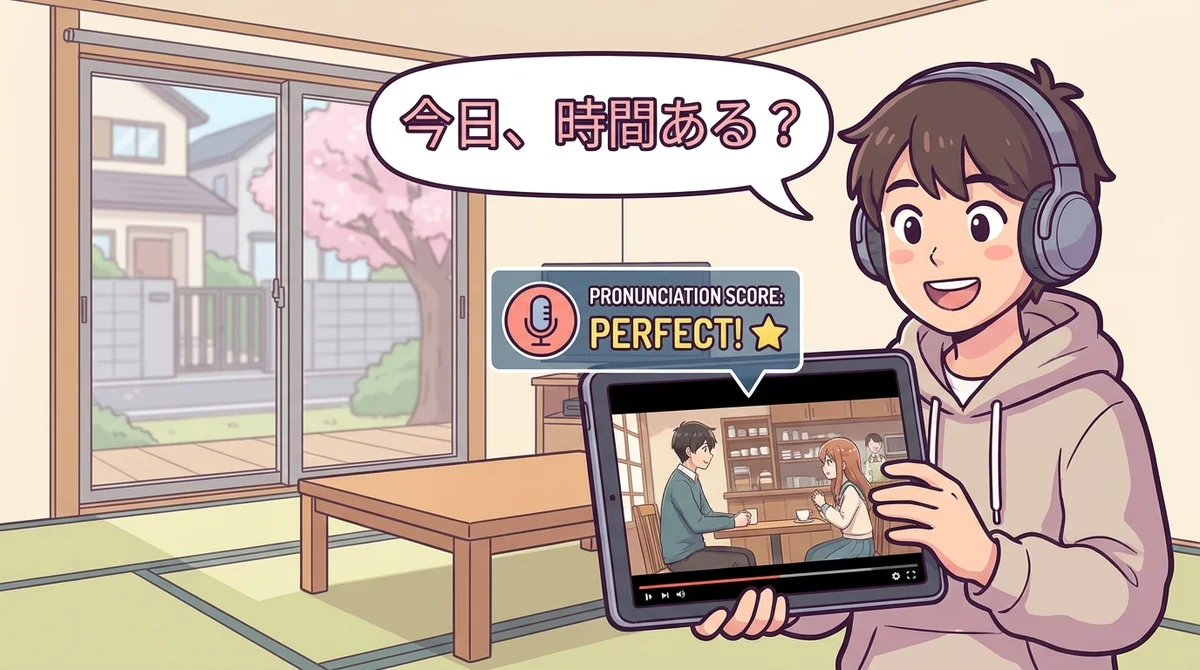
A: 今日、時間ある?(kyō, jikan aru?) — "Do you have time today?"
B: うん、大丈夫だよ。(un, daijōbu da yo.) — "Yeah, I'm free."
A: じゃあ、一緒にカフェ行こう。(jā, issho ni kafe ikō.) — "Then let's go to a café together."
Notice how short and clean these are. Every single line is something you could use this week. That's the sign you picked the right show.
How to practice so anime actually sticks
Watching is input. Speaking is where it becomes yours. Here's a routine that turns episodes into real ability.
1. Watch once for fun. Enjoy it. Don't study yet.
2. Rewatch a short scene and shadow it. Pause after each line and say it out loud, copying the rhythm and intonation exactly. This is called shadowing, and it's the fastest way to make Japanese come out of your mouth naturally.
3. Steal 3 lines per episode. Not 30. Pick three short, useful sentences and drill them until you can say them without the screen.
4. Use them in a real conversation. This is the step almost everyone skips — and it's the one that makes the language permanent.
That last step is exactly what an anime can't give you. A show never talks back, never checks your pronunciation, never puts you on the spot to actually respond. That's where speaking practice comes in.
This is why Teuida's Japanese course pairs so well with anime. Instead of just recognizing lines, you role-play real conversations out loud — greetings, ordering food, making plans, the same slice-of-life situations your favorite shows are full of. Teuida is speaking-first, so you're producing Japanese from day one, not just collecting it.
Even better, its AI pronunciation feedback scores how you say each line and shows you what to fix — the next best thing to a patient tutor sitting beside you. So when you shadow おはようございます (ohayō gozaimasu) from an episode, you can immediately check whether you actually nailed it.
Watch to fall in love with the sound. Practice in Teuida to make it yours.
Keep watching — but start speaking
Anime is a fantastic doorway into Japanese, as long as you pick shows that match where you are. Start with slice-of-life and everyday settings, save the epic fantasy and samurai worlds for later, and always aim for language you'd actually say.
But remember: no amount of watching replaces opening your mouth. The learners who get fluent are the ones who repeat, respond, and speak — not the ones who only recognize.
Pick one easy, everyday scene tonight, learn three lines, and practice them out loud in Teuida's Japanese course until they feel like your own words.


