
What is Chuseok? Korea's autumn harvest holiday explained — songpyeon, charye rites, travel chaos, and the Korean phrases you will actually hear during 추석.
You're scrolling through a K-drama and suddenly everyone's on the road, packed into cars, carrying stacks of gifts and wearing traditional clothes. Someone bows deeply on the floor. There's a table absolutely loaded with food. And a character sighs, "벌써 추석이네 (beolsseo chuseogine)," "It's already Chuseok."
If you've ever paused and wondered what exactly is going on here — you're in the right place. 추석 (Chuseok) is one of the biggest holidays in Korea, and once you understand it, a whole layer of Korean life and drama suddenly makes sense.
What 추석 Actually Is
추석 (Chuseok) is often called "Korean Thanksgiving," and that's a helpful shortcut — but it's not the whole story.
At its heart, 추석 is a harvest festival. It happens on the 15th day of the 8th month of the lunar calendar, which usually falls in September or early October. Because it follows the lunar calendar, the exact date shifts every year.
The word itself gives you a clue. 추 (chu) relates to autumn, and the day is tied to the full harvest moon. Another old name for it is 한가위 (hangawi), which roughly means "the great middle of autumn."
So while American Thanksgiving is about gratitude around a turkey, 추석 is about thanking your ancestors for the harvest, honoring family, and gathering everyone together. It's less about one big dinner and more about roots, memory, and togetherness.
Why 추석 Matters So Much
If you're learning Korean to travel, watch dramas, or connect with Korean friends, understanding 추석 is a real cultural key.
For one, it's a national holiday that usually spans three days, and many people take even more time off. The whole country basically moves. Highways clog for hours as millions travel back to their hometowns — this mass migration even has a name feel to it in the news every year.
It's also deeply emotional. In dramas, 추석 is often when family tension bubbles up, when a character finally goes home, or when someone feels lonely because they can't go home. That's not just plot convenience — it mirrors how heavy and meaningful this holiday is in real life.
And practically speaking, if you're in Korea during 추석, shops and restaurants may close, transport is packed, and prices for gifts and tickets spike. Knowing the holiday helps you plan — and helps you not accidentally show up to a locked-down city expecting business as usual.
The Core Traditions, Broken Down
Let's walk through what actually happens during 추석. Here's a clean overview:
| Korean term | Pronunciation | What it means |
|---|---|---|
| 차례 | cha-rye | A memorial rite to honor ancestors with a food-laden table |
| 성묘 | seong-myo | Visiting and tending ancestors' graves |
| 송편 | song-pyeon | Half-moon shaped rice cakes, the signature 추석 food |
| 한복 | han-bok | Traditional Korean clothing, often worn on the day |
| 벌초 | beol-cho | Clearing weeds around family graves before the holiday |
| 보름달 | bo-reum-dal | The full harvest moon everyone admires |
The morning of 추석 often begins with 차례 (charye), a ceremony where families set out a carefully arranged table of food for their ancestors and bow to show respect and gratitude.
Then many families do 성묘 (seongmyo), visiting ancestral graves. Afterward comes the part everyone actually looks forward to: eating together, catching up, and making 송편 (songpyeon) by hand.
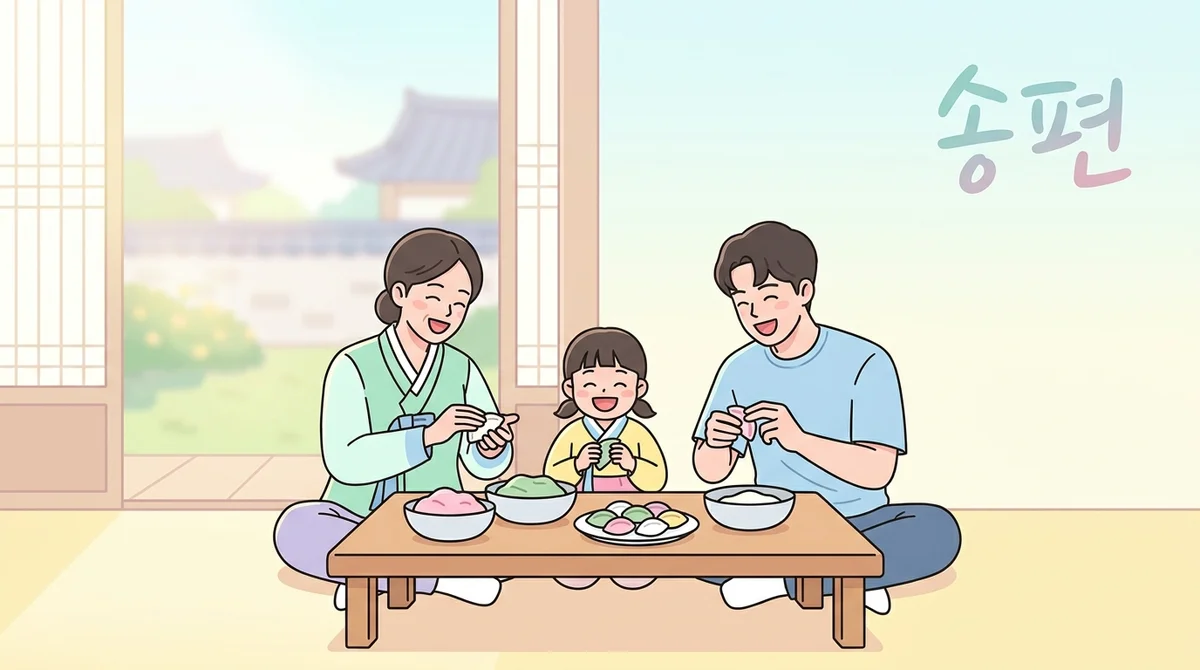
In the evening, people look up at the 보름달 (boreumdal), the big full moon, and make a wish. It's a quiet, lovely tradition — a moment of calm after a busy, food-filled day.
Common Mistakes Learners Make
Because "Korean Thanksgiving" is such an easy label, a few misunderstandings pop up constantly. Let's clear them.
Assuming it's the same as American Thanksgiving. It's not on a fixed date, there's no turkey, and the focus is ancestors and harvest, not the Pilgrims. Using the shortcut is fine — just don't expect the details to match.
Thinking it's a religious holiday. 차례 (charye) honors ancestors, but for many families today it's more about cultural tradition and family bonding than strict religious belief. Don't assume everyone practices it the same way.
Mispronouncing 추석. Learners often say it like "chu-SEK." The 석 (seok) part has a soft "uh"-ish vowel — think "suhk," not "sek." Say it slowly: 추 (chu) + 석 (seok).
Confusing 추석 with 설날 (seollal). 설날 (seollal) is Lunar New Year — a different big holiday in winter. Both involve family, travel, bowing, and traditional food, so they blur together easily. Just remember: 추석 = autumn harvest moon; 설날 = new year.
Forgetting to greet people. During the holiday, Koreans exchange specific 추석 greetings. Showing up with none feels a little flat — and saying the right one earns you instant warmth.
How to Talk About 추석 Like a Local
Here's a simple, practical set of things to say and do around the holiday, step by step.
1. Learn the core greeting.
The classic 추석 greeting is:
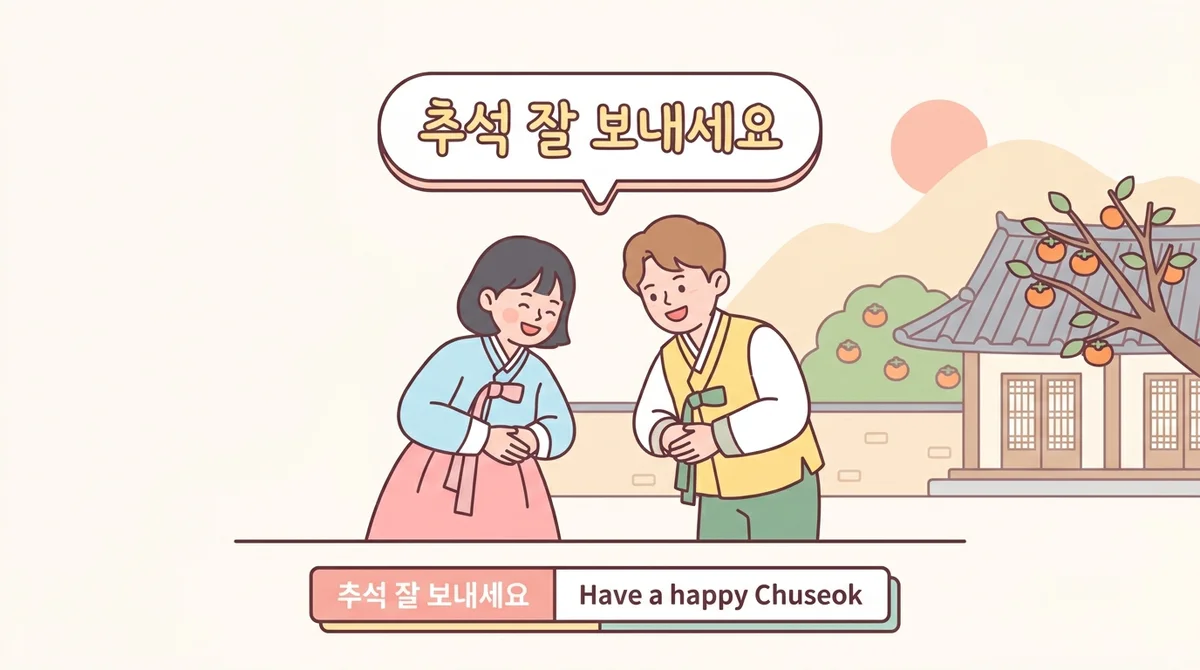
추석 잘 보내세요 (Chuseok jal bonaeseyo) — "Have a good Chuseok."
2. Have a slightly warmer version ready.
행복한 추석 되세요 (haengbokan Chuseok doeseyo) — "Have a happy Chuseok."
3. Know how to respond.
If someone greets you first, you can echo it back:
네, 감사합니다. 추석 잘 보내세요 (ne, gamsahamnida. Chuseok jal bonaeseyo) — "Thank you, and have a good Chuseok too."
4. Ask about someone's plans.
추석 때 뭐 하세요? (Chuseok ttae mwo haseyo?) — "What are you doing for Chuseok?"
5. Mention going home.
Going to your hometown is called 귀향 (gwihyang) or more casually people just say they're going to their 고향 (gohyang), "hometown."
저는 고향에 가요 (jeoneun gohyang-e gayo) — "I'm going to my hometown."
These few lines cover almost every 추석 conversation you'll have as a beginner or intermediate learner.
Real-Life Example Dialogues
Let's put it together with some natural exchanges you might hear — or say — around 추석.
Dialogue 1 — Greeting a coworker before the holiday
A: 추석 잘 보내세요! (Chuseok jal bonaeseyo!)
→ "Have a good Chuseok!"
B: 네, 감사합니다. 민수 씨도 잘 보내세요. (Ne, gamsahamnida. Minsu ssi-do jal bonaeseyo.)
→ "Thank you. You have a good one too, Minsu."
Dialogue 2 — Talking about plans
A: 추석 때 뭐 하세요? (Chuseok ttae mwo haseyo?)
→ "What are you doing for Chuseok?"
B: 저는 고향에 가요. 가족들 만나요. (Jeoneun gohyang-e gayo. Gajokdeul mannayo.)
→ "I'm going to my hometown. I'll see my family."
A: 좋겠다! 송편 많이 드세요. (Jokket-da! Songpyeon manhi deuseyo.)
→ "That sounds nice! Eat lots of songpyeon."
Dialogue 3 — At a family gathering
A: 오랜만이에요! 잘 지냈어요? (Oraenmani-eyo! Jal jinaesseoyo?)
→ "Long time no see! Have you been well?"
B: 네, 덕분에요. 보름달 보러 나갈까요? (Ne, deokbune-yo. Boreumdal boreo nagalkkayo?)
→ "Yes, thanks to you. Shall we go out to see the full moon?"
Notice how gentle and warm these lines are. 추석 language leans into kindness, respect, and reconnecting — which is exactly the mood of the holiday.
Practice Tips: Say It Out Loud
Here's the honest truth: you can read every 추석 phrase above and still freeze the moment a real person says "추석 잘 보내세요" to your face.
That's because recognizing a phrase and producing it are two completely different skills. The only way these greetings become automatic is to say them out loud, over and over, until your mouth knows them without your brain scrambling.
A few things that genuinely help:
- Shadow the dialogues. Play each line, pause, and repeat it aloud immediately — matching the rhythm and intonation, not just the words.
- Practice the tricky sounds. Drill 추석 (Chuseok) and 송편 (songpyeon) slowly. That 송 (song) → 편 (pyeon) transition trips a lot of learners up.
- Rehearse full exchanges, not single words. In real life you'll need to greet and respond, so practice both sides.
This is exactly where Teuida fits in. Teuida is a speaking-first app — instead of drowning in flashcards, you actually talk from day one. In the Korean course, you can role-play real-life scenarios, including holiday and everyday conversations, and say lines like "추석 잘 보내세요" out loud.
The best part is the AI pronunciation feedback — it scores how you say each phrase and shows you where to fix it, which is the next best thing to having a Korean friend patiently correcting you. So instead of just hoping your 송편 sounds right, you find out and improve it.
You're Ready for 추석
추석 isn't just a vocabulary word — it's a window into what Koreans care about most: family, gratitude, roots, and gathering under the same full moon.
Now you know what the holiday is, what happens during it, how to greet people, and how to avoid the classic mix-up with 설날 (seollal). That's more than enough to feel confident whether you're watching a drama, visiting Korea, or messaging a Korean friend in September.
The next step is to make those phrases yours by speaking them. Open Teuida's Korean course, role-play the 추석 greetings out loud, and let the app score your pronunciation until "추석 잘 보내세요" rolls off your tongue.


