
Essential French phrases for your trip — greetings, cafés, shopping and directions, with pronunciation, mini-dialogues and the mistakes travelers make most.
You've just landed in Paris. You walk up to a café counter, ready for your first real French coffee, and suddenly every word you practiced on the plane vanishes. You point. You smile awkwardly. The barista waits.
We've all been there. The good news is you don't need to be fluent to travel confidently in France — you need maybe forty well-chosen phrases and the courage to say them out loud. This guide gives you exactly those, with pronunciation you can actually use.
Why a Few French Phrases Change Everything in France
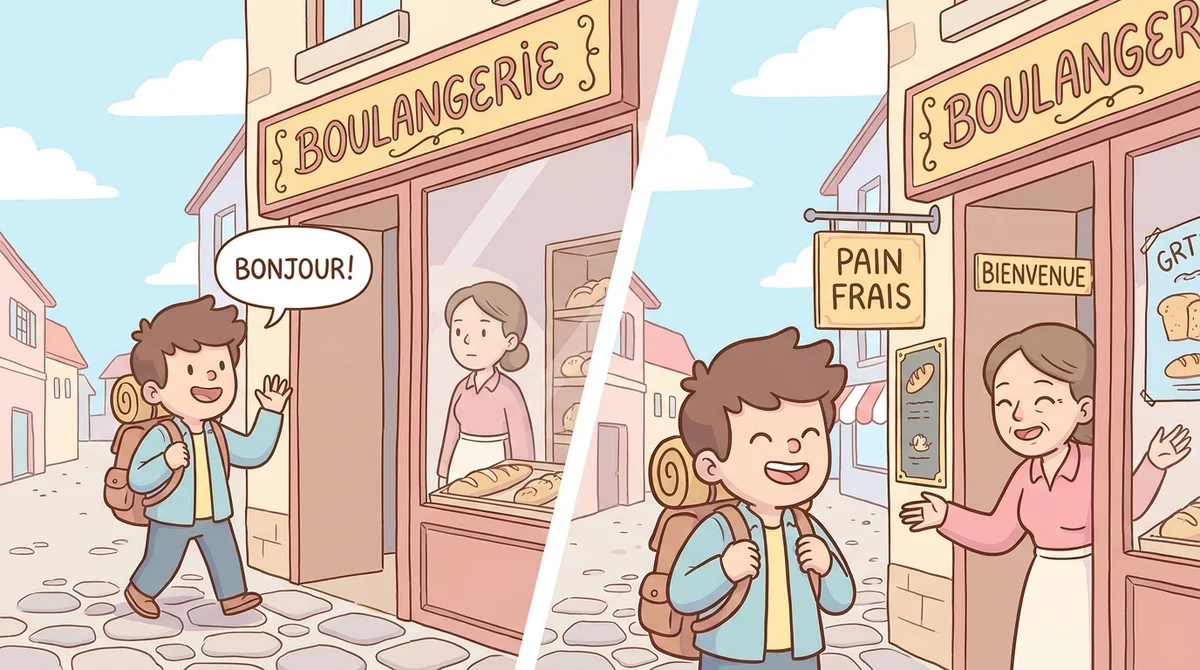
There's a common myth that French people are cold to tourists. The truth is simpler: in France, greetings are a social contract. Walking into a shop and immediately speaking English can feel abrupt, but starting with bonjour (bon-ZHOOR), "hello," instantly softens the whole interaction.
You'll notice it right away. Say a warm bonjour and the same person who seemed distant will suddenly be patient and helpful. That one word does more work than any grammar rule you'll ever memorize.
So this post isn't about perfect sentences. It's about the handful of phrases that open doors — literally and socially — when you travel to France.
The Core Travel Phrases, Grouped by Moment
Let's build your toolkit around the moments you'll actually live: greeting people, ordering food, finding your way, shopping, and handling small emergencies.
Here's a quick-reference table of the absolute essentials. Read the pronunciation out loud as you go.
| French | Pronunciation | Meaning |
|---|---|---|
| Bonjour | bon-ZHOOR | Hello (daytime) |
| Bonsoir | bon-SWAHR | Good evening |
| S'il vous plaît | seel-voo-PLEH | Please |
| Merci | mair-SEE | Thank you |
| Merci beaucoup | mair-SEE boh-KOO | Thank you very much |
| Excusez-moi | ex-kew-zay-MWAH | Excuse me |
| Pardon | par-DON | Sorry / pardon |
| Oui / Non | WEE / NOHN | Yes / No |
| Au revoir | oh-ruh-VWAHR | Goodbye |
| Parlez-vous anglais ? | par-lay-voo-on-GLEH | Do you speak English? |
Notice a few sound patterns. The French r is made in the back of the throat, softer than an English or Spanish r. And final consonants are often silent — the t in s'il vous plaît and the s in anglais simply disappear.
One more thing: French uses a space before ? and !. That's not a typo — it's just how French punctuation works.
The Mistakes Travelers Make Most Often
Even eager learners trip over the same few things. Knowing them in advance saves you real embarrassment.
Skipping the greeting. The biggest one. Never open with your question. Always lead with bonjour before you ask anything — "Bonjour, un café s'il vous plaît."
Using bonjour at night. After roughly 6 p.m., switch to bonsoir (bon-SWAHR). Saying bonjour in the evening marks you instantly as a tourist. It's not a disaster, but bonsoir feels natural and polite.
Pronouncing every letter. French loves silent endings. Comment (koh-MON), "how," has a silent t. Beaucoup (boh-KOO), "a lot," ends in a silent p. When in doubt, let the final consonant fade.
Forgetting the polite forms. French is more formal than English with strangers. Use vous (voo), the polite "you," not tu (tew), the casual "you," with people you don't know. Parlez-vous anglais ? uses the polite form — perfect for travel.
Confusing merci with a yes. If someone offers you more of something and you say merci while shaking your head, it can be read as "no thank you." To accept, say oui, merci (WEE, mair-SEE), "yes, thank you." To decline, non merci (NOHN mair-SEE).
Step-by-Step: How to Handle Any Interaction
Here's a simple, reliable pattern that works at a bakery, a ticket window, or a hotel desk. Follow these four steps every time.
Step 1 — Greet. Start with bonjour or bonsoir. Always. This is non-negotiable.
Step 2 — Soften your request. Add excusez-moi (ex-kew-zay-MWAH), "excuse me," if you're interrupting or asking for help.
Step 3 — Make your request with s'il vous plaît. Ending a request with s'il vous plaît makes almost anything polite. "Un café, s'il vous plaît" — "A coffee, please."
Step 4 — Thank and close. Finish with merci and au revoir (oh-ruh-VWAHR), "goodbye," as you leave.
That's the whole rhythm: greet → soften → ask → thank. Master this loop and you can travel anywhere in France with dignity, even with a tiny vocabulary.
If you don't understand the answer, you have easy escape phrases:
- Je ne comprends pas. (zhuh nuh kom-PRON pah) — "I don't understand."
- Pouvez-vous répéter ? (poo-vay-voo ray-pay-TAY) — "Can you repeat?"
- Plus lentement, s'il vous plaît. (ploo lon-tuh-MON) — "More slowly, please."
Real Mini-Dialogues You'll Actually Use
Reading phrases in isolation is one thing; hearing them in context is where they stick. Here are three short exchanges for the situations you'll meet on day one.
At the café:
You: Bonjour ! Un café et un croissant, s'il vous plaît.
(bon-ZHOOR, uhn kah-FAY ay uhn krwah-SON, seel-voo-PLEH)
"Hello! A coffee and a croissant, please."
Server: Voilà. Ça fait cinq euros.
(vwah-LAH. sah feh sank uh-ROH)
"Here you go. That's five euros."
You: Merci beaucoup. Au revoir !
"Thank you very much. Goodbye!"
Asking for directions:
You: Excusez-moi, où est la gare, s'il vous plaît ?
(ex-kew-zay-MWAH, oo eh lah GAHR, seel-voo-PLEH)
"Excuse me, where is the train station, please?"
Local: C'est tout droit, puis à gauche.
(seh too DRWAH, pwee ah GOHSH)
"It's straight ahead, then on the left."
You: Merci ! Bonne journée.
(mair-SEE, bun zhoor-NAY)
"Thank you! Have a good day."
Shopping at a market:
You: Bonjour, je voudrais une baguette, s'il vous plaît.
(zhuh voo-DREH ewn bah-GET)
"Hello, I would like a baguette, please."
Vendor: Bien sûr. Avec ceci ?
(bee-en SEWR. ah-vek suh-SEE)
"Of course. Anything else?"
You: Non merci, c'est tout. Combien ?
(NOHN mair-SEE, seh TOO. kom-bee-EN)
"No thanks, that's all. How much?"
Notice how je voudrais (zhuh voo-DREH), "I would like," pops up again and again. It's the single most useful phrase for ordering and buying — polite, flexible, and it works with any noun. Je voudrais un ticket (a ticket), je voudrais l'addition (the bill). Learn it once, reuse it everywhere.
How to Make These Phrases Actually Stick
Here's the honest part: reading this list won't prepare you. You can recognize s'il vous plaît perfectly on paper and still freeze at the counter. The only thing that builds real travel confidence is saying these phrases out loud, over and over, until your mouth knows them without your brain checking first.
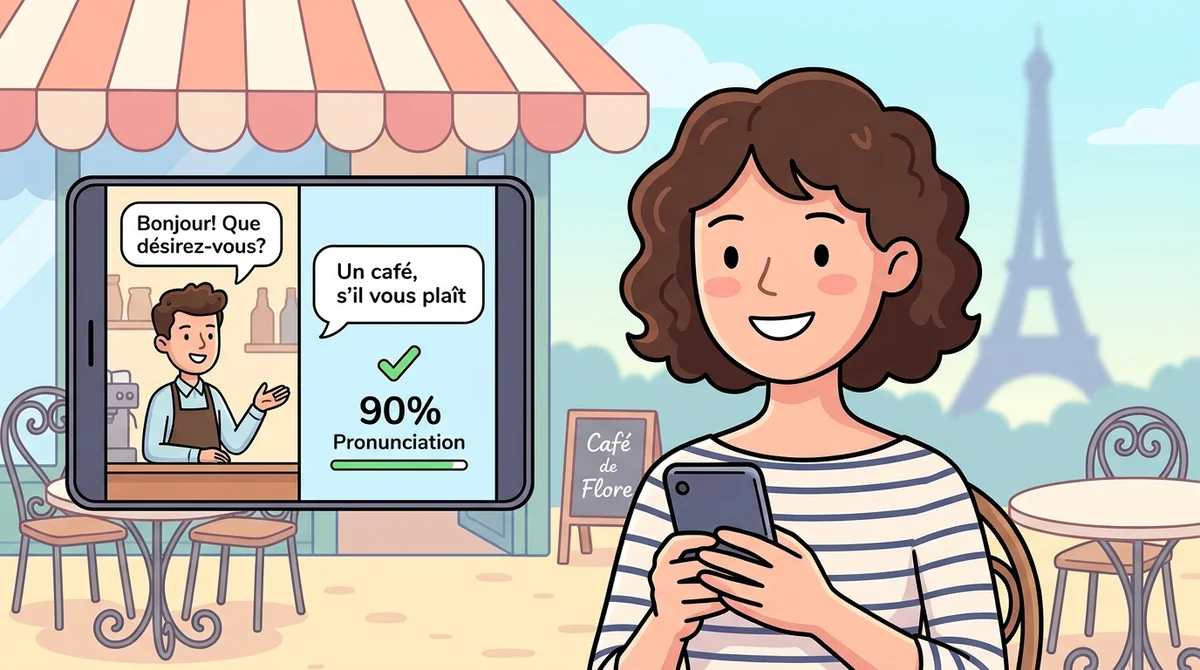
That's exactly what Teuida's French course is built for. Instead of grinding flashcards, you role-play the real situations from this post — ordering at a café, asking for directions, buying your baguette — by actually speaking, out loud, from day one. The scenarios feel like scenes from real life, so you practice the exact rhythm of greet → ask → thank in context.
And because your accent matters more in French than almost any other language, Teuida gives you AI pronunciation feedback that scores how you say each phrase and shows you what to fix. It's the next best thing to a patient French friend correcting you — you'll nail that back-of-the-throat r and those silent endings before you ever board the plane.
A simple practice routine: pick one dialogue above, say it aloud five times, then run the matching scenario in Teuida and try to beat your pronunciation score. Ten minutes a day for a week and these phrases stop being a list — they become reflexes.
You're More Ready Than You Think
You don't need perfect grammar to have a wonderful trip to France. You need bonjour, a warm smile, s'il vous plaît, and the willingness to try. French people overwhelmingly appreciate the effort — that single greeting changes how they treat you.
Start with the four-step loop, learn je voudrais, and practice out loud until it feels natural. The rest you'll pick up on the ground, one café at a time.
Practice these travel phrases out loud in Teuida's French course today, get your pronunciation scored, and land in France already sounding like you belong.


