
Essential Japanese phrases for travel — greetings, ordering food, shopping, directions and emergencies, with pronunciation, real dialogues and practice tips.
You've booked the flights, saved the ramen spots, and pinned every convenience store you want to raid at 2 a.m. Then the plane lands, someone at the counter says something fast and polite, and your brain goes completely blank.
It happens to almost everyone. The good news? You don't need to be fluent to have an amazing trip. A handful of well-chosen phrases — said with a smile — will carry you through airports, restaurants, train stations, and those tiny moments that make travel feel human.
Why a Few Japanese Phrases Change Everything
Japan is famously easy to travel in. Trains run on time, signs often have English, and staff are patient. So do you really need Japanese?
You'll survive without it. But surviving and connecting are two different trips. When you greet a shop owner in their language or thank a stranger who helped you find your platform, faces light up. You stop being just another tourist and become a guest making an effort.
There's also the practical side. Not every taxi driver, ryokan host, or tiny izakaya cook speaks English. In those moments, ten memorized phrases are worth more than any translation app buffering on weak station Wi-Fi.
This post walks you through the phrases that actually come up — greetings, politeness, ordering food, shopping, directions, and small emergencies — with pronunciation and real sentences you can use the day you land.
The Core Phrases, Grouped by Situation
Let's start with the absolute must-knows. These are the words you'll use dozens of times a day. Read the pronunciation out loud as you go — don't just skim.
| Japanese | Pronunciation | Meaning |
|---|---|---|
| こんにちは | konnichiwa | Hello (daytime) |
| ありがとうございます | arigatō gozaimasu | Thank you (polite) |
| すみません | sumimasen | Excuse me / Sorry |
| はい / いいえ | hai / iie | Yes / No |
| お願いします | onegaishimasu | Please (making a request) |
| 大丈夫です | daijōbu desu | I'm okay / It's fine / No thanks |
| わかりません | wakarimasen | I don't understand |
| 英語 話せますか? | eigo hanasemasu ka? | Do you speak English? |
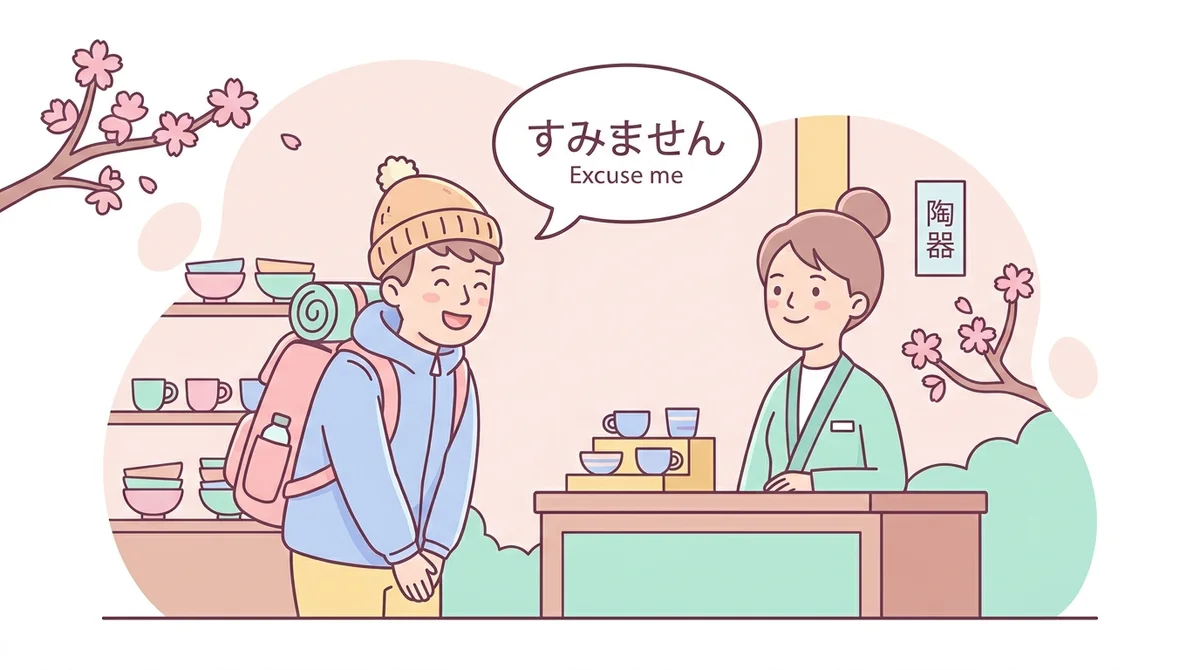
If you only memorize one word from this whole article, make it すみません (sumimasen). It works to get attention ("excuse me"), to apologize ("sorry"), and even as a soft "thank you" when someone goes out of their way for you. It's the Swiss Army knife of Japanese travel.
Common Mistakes Travelers Make
Before we build sentences, let's clear up the slip-ups that trip up almost every first-timer.
Mixing up こんにちは with the wrong time of day. こんにちは (konnichiwa) is a daytime hello. In the morning, use おはようございます (ohayō gozaimasu), "good morning," and in the evening こんばんは (konbanwa), "good evening." Using the daytime greeting at 8 a.m. isn't a disaster, but the right one earns a warmer response.
Forgetting the ございます (gozaimasu) ending. Saying just ありがとう (arigatō) to strangers or staff can sound a little casual. Adding ございます makes it polite and appropriate for shops, hotels, and anyone you don't know. When in doubt, be more polite.
Over-relying on はい (hai). はい means "yes," but Japanese speakers also use it as a general "I'm listening" or "okay." Nodding and saying はい to a question you didn't understand can lead to confusion. If you're lost, it's much better to say すみません、わかりません (sumimasen, wakarimasen), "sorry, I don't understand."
Speaking too quietly. Many learners mumble because they're nervous about pronunciation. But Japanese has clean, steady vowels — a, i, u, e, o — that sound almost exactly the same every time. Say them clearly and evenly and you'll be understood, even if your accent isn't perfect.
Step-by-Step: How to Use These in Real Order
Real interactions follow a rhythm. Here's the pattern that fits almost any shop, restaurant, or counter in Japan.
1. Greet first. Walk in and you'll often hear いらっしゃいませ (irasshaimase), "welcome." You don't reply to it — just a small nod or こんにちは is plenty.
2. Get attention politely. When you're ready, say すみません (sumimasen) to call staff over.
3. Make your request with お願いします. Point at what you want and add お願いします (onegaishimasu). "This, please" becomes これ、お願いします (kore, onegaishimasu).
4. Confirm or decline. If they ask something you don't need, 大丈夫です (daijōbu desu) is a gentle "no thanks."
5. Thank them. End with ありがとうございます (arigatō gozaimasu) as you leave.
That five-step flow covers convenience stores, cafés, souvenir shops, and ticket counters. Learn the rhythm once and you'll reuse it constantly.
Real-Life Example Dialogues
Let's put the phrases together the way you'll actually use them.
At a restaurant:
You: すみません、メニューをお願いします。
(Sumimasen, menyū o onegaishimasu.)
"Excuse me, the menu please."
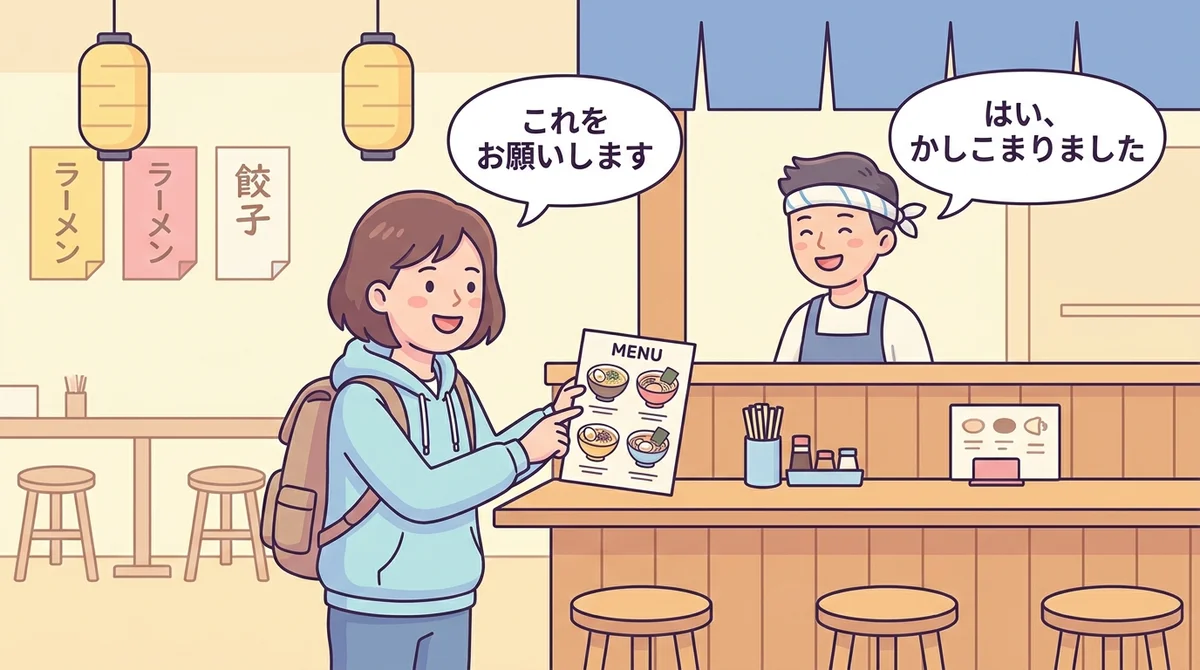
You: これをお願いします。
(Kore o onegaishimasu.)
"I'll have this, please." (while pointing)
Staff: お飲み物は?
(Onomimono wa?)
"Anything to drink?"
You: 大丈夫です。ありがとうございます。
(Daijōbu desu. Arigatō gozaimasu.)
"I'm fine, thank you."
Asking for directions:
You: すみません、駅はどこですか?
(Sumimasen, eki wa doko desu ka?)
"Excuse me, where is the station?"
You: ありがとうございます!
(Arigatō gozaimasu!)
"Thank you!"
Notice どこですか (doko desu ka), "where is it?" You can swap in almost any place name: トイレはどこですか (toire wa doko desu ka?), "where is the toilet?" — arguably the most valuable question in the entire language.
Shopping and paying:
You: いくらですか?
(Ikura desu ka?)
"How much is it?"
You: カードは使えますか?
(Kādo wa tsukaemasu ka?)
"Can I use a card?"
A small emergency:
You: すみません、道に迷いました。
(Sumimasen, michi ni mayoimashita.)
"Excuse me, I'm lost."
You: 助けてください。
(Tasukete kudasai.)
"Please help me."
Keep these last two in your back pocket. You'll probably never need them — but if you do, you'll be very glad they're already in your mouth and not buried in an app.
Practice Tips: Make It Stick Before You Fly
Here's the honest truth: reading these phrases isn't the same as being able to say them when a real person is looking at you, waiting. The gap between recognizing a phrase and actually producing it out loud is where most travelers freeze.
So the number one rule is simple — say everything out loud, right now, repeatedly. Don't whisper. Order imaginary ramen in your kitchen. Ask your bathroom mirror どこですか. It feels silly, and that silliness is exactly what burns the phrase into your muscle memory so it's ready under pressure.
A few more tips:
- Learn in chunks, not word by word. Memorize これをお願いします as one unit, the way you'd learn a song lyric.
- Practice the exact scenario. Rehearse ordering, asking directions, and paying — the three things you'll do most.
- Get feedback on your pronunciation. You can't hear your own mistakes, and Japanese vowels need to be crisp to be understood.
This last point is where Teuida comes in. Teuida is a speaking-first app, so instead of drilling flashcards you actually speak Japanese from day one. In Teuida's Japanese course you role-play the same real situations from this post — walking into a shop, ordering at a restaurant, asking where the station is — in K-drama-style scenarios you talk through out loud.
The AI pronunciation feedback then scores how you said each phrase and shows you what to fix, so by the time you land you're not guessing whether your すみません sounds right — you already know it does. It's the closest thing to rehearsing with a patient local before your trip.
You're More Ready Than You Think
You don't need hundreds of words to travel well in Japan. You need a small set of phrases you can say with confidence and a smile — and now you have them.
Pick five from this post today. Say them out loud until they feel natural, then add five more tomorrow. By the time your plane touches down, ordering ramen and thanking the kind stranger who points you to your platform will feel like second nature.
Practice these exact travel phrases out loud in Teuida's Japanese course and get your pronunciation scored before you fly — so your first konnichiwa in Japan sounds like you mean it.


