
Teuida lessons are 100% made by real human tutors, filmed in real places — AI only scores your pronunciation. Why human-made content helps you speak naturally.
You open a language app and a robotic voice reads a sentence at you. It's flat, a little too perfect, and somehow nothing like the way anyone actually talks. You repeat it, but you already know you'd freeze the moment a real person said it back to you.
That gap — between "the app" and "a real human standing in front of you" — is exactly what Teuida was built to close. And the way we close it is simple, if a little old-fashioned: we make everything with real people.
What "100% made by humans" actually means
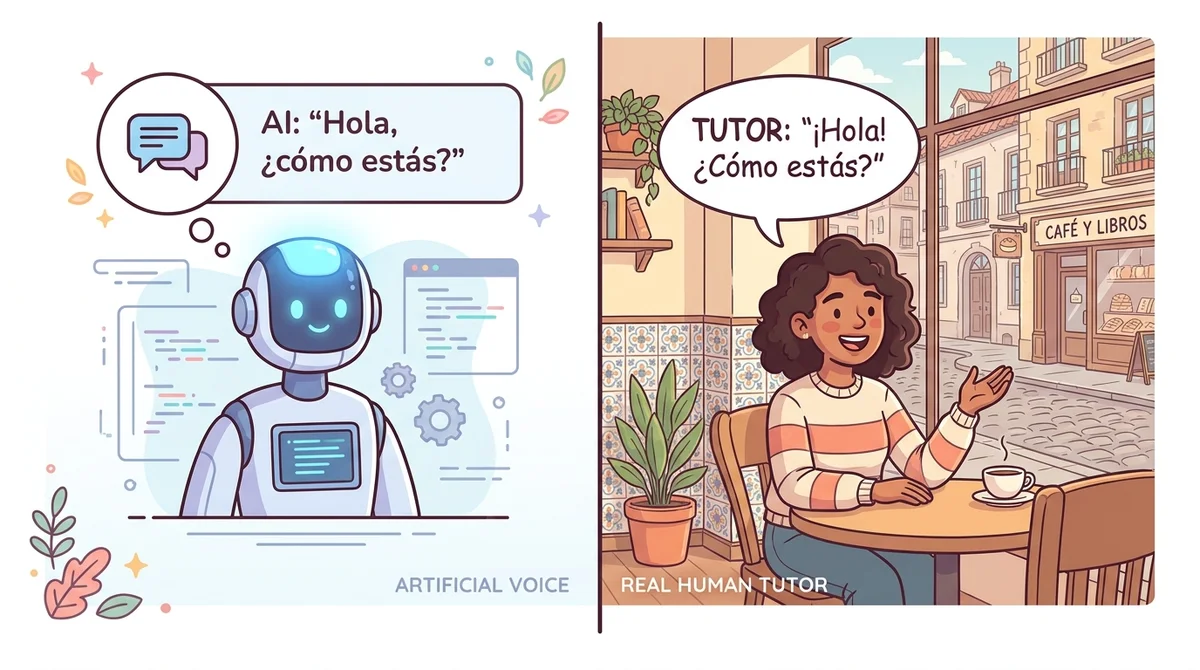
A lot of apps today lean hard on AI to generate their lessons, their voices, even the faces you see on screen. It's fast and it's cheap, and it usually sounds like it.
Teuida takes the slower road on purpose. Every scenario you practice was written, acted, and filmed by real human tutors — people who actually speak the language, in real places, with real expressions and real timing.
So when you're learning to order at a café, you're not watching a synthetic avatar. You're watching a real person in a real café, saying the words the way a real person says them. That difference is small on paper and huge in your ear.
Why the human touch matters for speaking
Language isn't just words — it's rhythm, tone, and the little human things a machine tends to flatten out. When someone is genuinely happy to see you, their 안녕하세요 (annyeonghaseyo), "hello," rises differently than a robot's does. When they're apologizing, ごめんなさい (gomen nasai), "I'm sorry," carries a softness no text-to-speech captures well.
Here's a side-by-side of what changes when a human makes the content instead of an AI:
| What you get | AI-generated | Real human tutors (Teuida) |
|---|---|---|
| Pronunciation model | Averaged, robotic timing | Natural rhythm and stress |
| Emotion in the voice | Flat, uniform | Real warmth, surprise, apology |
| Body language | None or uncanny | Genuine gestures and eye contact |
| Setting | Blank or generated | Real cafés, streets, shops |
| Cultural nuance | Guessed from data | Lived and understood |
You learn to speak by copying real speech. If the thing you're copying was never spoken by a person, you're copying a copy of a guess.
Common mistakes learners make when they learn from AI-only content
Learning from purely synthetic material creates habits that are hard to unlearn later. Here are the ones we see most.
Copying robotic intonation. If the model voice is flat, you'll sound flat too — and to a native ear, flat can read as cold or rude, even when you're being polite.
Missing the natural pauses. Real people breathe, hesitate, and stress certain syllables. AI often smooths all of that away, so learners speak in one long unbroken line that native speakers find hard to follow.
Never seeing the context. A phrase like 괜찮아요 (gwaenchanayo) can mean "it's okay," "I'm fine," or a polite "no thanks," depending entirely on the situation and the face saying it. Without a real scene, you learn the words but not the when.
Assuming perfect audio is normal. Real conversations have background noise, overlapping voices, and speed. Learners raised on clean AI audio often panic the first time a real waiter talks fast.
How Teuida makes each lesson — step by step
Because people always ask, here's roughly how a Teuida scenario comes to life. No robots involved.
- Bilingual tutors write the script. People who speak both your language and the target language decide what phrases you actually need, in the order you'll actually meet them.
- They choose a real situation. Ordering coffee, asking for directions, meeting a friend — the kind of moment you'll genuinely have.
- We film on location with real tutors. Real cafés, real streets, real shops — not a green screen.
- The tutors act it naturally. Real timing, real expressions, real emotion, so you hear the language as it's truly spoken.
- You step into the scene and speak. You're not a spectator — you play a role in the conversation and say the lines out loud.
- AI checks your pronunciation. This is the one place technology helps: it scores how you said it, so you can fix it. The teaching is human; the feedback on your voice is the tool.
Notice the split there. The content is 100% human. The AI only exists to listen to you and help — it never replaces the tutor.
Real-life example lines from real filmed scenes
Here are the kinds of natural lines you'll hear from real tutors in Teuida scenarios — the way people actually say them, not the textbook version.
In a Korean café:
- 아이스 아메리카노 한 잔 주세요. (aiseu amerikano han jan juseyo) — "One iced americano, please."
- 여기서 드시나요, 가져가시나요? (yeogiseo deusinayo, gajyeogasinayo?) — "For here or to go?"
- 테이크아웃이요. (teikeuausiyo) — "To go, please."
Meeting a friend in Japanese:
- 久しぶり!元気だった? (hisashiburi! genki datta?) — "Long time no see! How've you been?"
- うん、おかげさまで。 (un, okagesama de) — "Yeah, doing great, thanks."
Asking for help in Spanish:
- Perdona, ¿dónde está el baño? (per-DOH-na, DON-de es-TA el BA-nyo) — "Excuse me, where's the bathroom?"
- Está al fondo, a la derecha. (es-TA al FON-do, a la de-RE-cha) — "It's at the back, on the right."
A small kindness in French:
- Vous avez besoin d'aide ? (voo-za-vay buh-ZWAN ded) — "Do you need help?"
- Oui, merci beaucoup ! (wee, mair-SEE boh-KOO) — "Yes, thank you very much!"
Read those out loud right now. Notice how the rhythm wants to move — that movement is what a real tutor gives you and a robot voice can't.
Practice tips: the human way to make it stick
You can watch real tutors all day, but the language only becomes yours when it leaves your mouth. Here's how to make that happen.
Speak along, don't just listen. Pause the scene and copy the tutor's exact tone, including the rise and fall. You're not memorizing words — you're borrowing a real person's rhythm.
Shadow the emotion, not just the sound. If the tutor sounds warm, sound warm. If they sound apologetic, lean into it. Emotion is half of being understood.
Practice in the real scenario, out loud. This is exactly where Teuida is built to help. Instead of reading a list, you step into a filmed scene with a real tutor and play your part — you say your line back into the conversation, in context, the way you'd actually need it.
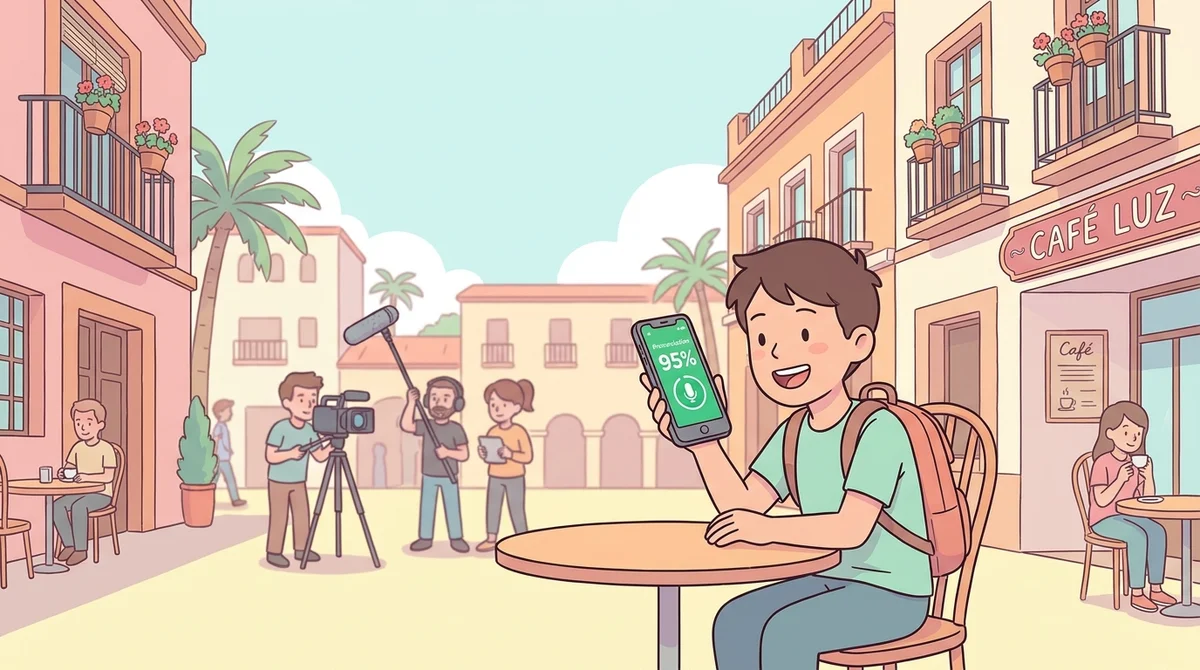
And because you can't always have a native speaker next to you, Teuida's AI pronunciation feedback listens to how you say each line and scores it, then shows you what to fix. Think of it as the next best thing to the tutor being in the room — human-made lessons, honest feedback on your voice.
Whether you're in the Korean, Japanese, Spanish, or French course, the pattern is the same: real humans give you the language, real scenes give you the context, and you practice by actually speaking. That's how it goes from "I recognize this" to "I can say this."
Wrap-up: real people, real practice, real confidence
There's a reason we film with real tutors in real places instead of letting a machine invent it all. Speaking a language is a deeply human thing — the warmth, the timing, the little smile before someone answers you. You can't fake that, and you shouldn't have to learn from something that does.
Teuida gives you the real thing: lessons made 100% by human tutors, filmed where life actually happens, plus feedback that helps your voice get there. So pick your course, step into a real filmed scene, and say your first line out loud in Teuida today.


