
K-dramas vs Spanish telenovelas for learners: politeness, speed, real lines like 괜찮아요 and ¿Estás bien?, plus a step-by-step routine to speak scenes back aloud.
You fell asleep watching a K-drama, woke up to the credits, and realized you'd understood maybe five words — but you felt every single one. A few weeks later a telenovela cliffhanger left you gasping, and again, you only caught scraps of the Spanish.
Here's the good news: both of those late-night binges can be some of the best language practice you'll ever get. The trick is knowing what each type of show is really teaching you, and how to turn "I watched it" into "I can say it."
Why soap operas are secretly great language teachers
When you study from a textbook, every sentence is clean, slow, and polite. Real life isn't like that — people interrupt, mumble, joke, and get emotional. Soap operas live in that messy, emotional space, which is exactly where real speech happens.
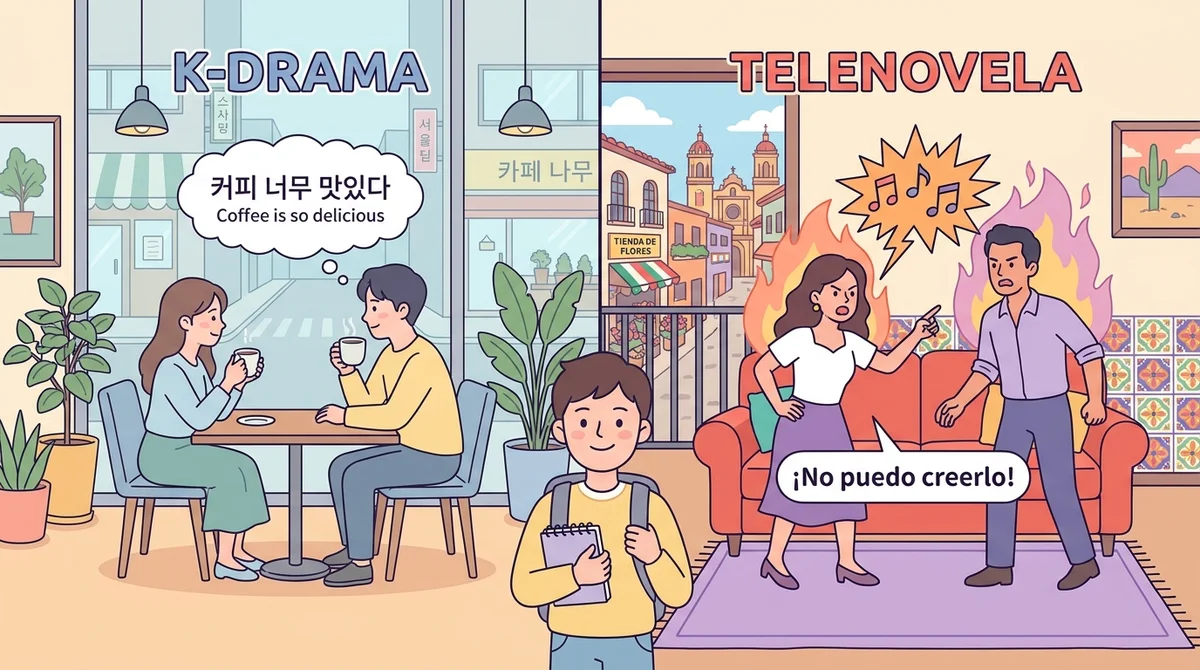
Korean dramas (K-dramas) and Spanish telenovelas are both built on big feelings: love, betrayal, family secrets, dramatic reunions. That emotional intensity is a gift for learners, because strong feelings make language stick. You remember a line better when someone screamed it across a rainy parking lot.
But Korean and Spanish shows don't teach the same way. They have different rhythms, different social rules baked into the dialogue, and different habits you'll pick up without noticing. Knowing the difference helps you choose the right show for the language you're learning — and avoid picking up the wrong habits.
K-dramas vs telenovelas: a side-by-side look
Let's compare the two as learning tools, not just entertainment. Both teach you real, spoken language — but they emphasize different things.
| Feature | Korean Dramas | Spanish Telenovelas |
|---|---|---|
| Episode length | ~60–70 min, usually 16 episodes | ~45 min, often 100+ episodes |
| Speaking speed | Moderate, lots of pauses | Often fast, very expressive |
| Politeness levels | Huge focus — formal vs casual speech | Mostly informal, some regional formality |
| Emotional range | Slow burn, subtle | Loud, immediate, melodramatic |
| Great for learning | Honorifics, everyday phrases, tone | Fast listening, emotion words, regional accents |
| Repetition | Moderate | Very high (plots repeat ideas a lot) |
Notice that long episode count on the telenovela side. Those 100+ episodes mean the same phrases come back again and again — which is fantastic for repetition. K-dramas are tighter and more cinematic, so you get polish and nuance instead.
The biggest learning difference is politeness levels. Korean constantly signals respect through verb endings. A K-drama will show you the exact same idea said three different ways depending on who's talking to whom — and that's a core part of actually speaking Korean.
Common mistakes learners make with soap operas
The shows are great, but learners tend to trip over the same few things. Here's what to watch for.
Mistake 1: Copying the drama without copying the register. In K-dramas, characters often use very casual or even rude speech because they're close friends, rivals, or lovers. If you repeat 야 (ya), "hey," to a stranger or your boss, it lands as disrespectful. Korean's politeness system is not optional.
Mistake 2: Thinking telenovela Spanish is one accent. Telenovelas come from Mexico, Colombia, Venezuela, Spain and more. A Mexican güey and a Spanish tío both mean roughly "dude," but they're not interchangeable everywhere. Pick a region and lean into it.
Mistake 3: Reading subtitles instead of listening. If your eyes are glued to English text, your ears aren't working. Subtitles are a starting tool, not a crutch for life.
Mistake 4: Memorizing drama lines that no one says in real life. Both genres love dramatic one-liners. "You are my destiny" is fun, but you won't need it at a café. Collect useful lines, not just cinematic ones.
Mistake 5: Watching passively. An hour of watching with your brain half off teaches you very little. We'll fix that next.
A step-by-step way to learn from any soap opera
Whether you're learning Korean from dramas or Spanish from telenovelas, this routine works. Do it with short scenes, not whole episodes.
- Pick one short scene (2–4 minutes). Dialogue-heavy, not an action chase.
- Watch once for the story — subtitles on, just enjoy it and get the gist.
- Watch again and listen only — hide the subtitles. Catch whatever words you can.
- Pick 3–5 phrases that sound useful and repeat often. Write them down with the script and pronunciation.
- Say each line out loud, copying the character's rhythm and emotion. Yes, be dramatic. The feeling helps you remember.
- Shadow the scene — play it and speak along a half-second behind the actor, matching their pace.
- Use one phrase that same day — in a message, out loud to yourself, or in a practice app.
That last step is what turns watching into speaking. Recognizing a phrase and producing it are two different skills, and only the second one lets you actually hold a conversation.
Real phrases you'll hear in each
Let's pull out lines you genuinely hear in these shows — and that you can actually use. First, some classic K-drama staples.
Korean:
- 괜찮아요? (gwaenchana-yo?) — "Are you okay?"
- 잠깐만요. (jamkkanman-yo.) — "Wait a moment."
- 보고 싶었어. (bogo sipeosseo.) — "I missed you." (casual — said to someone close)
- 진심이에요. (jinsim-ieyo.) — "I mean it / I'm serious."
Notice the 요 (yo) ending on most of these — that's the friendly-polite form you can safely use with most people. The one without it, 보고 싶었어, is casual and would only be used with close friends or a partner, which is exactly the kind of thing a drama teaches you to feel.
Now some telenovela favorites.
Spanish:
- ¿Estás bien? (es-TAHS bee-EN?) — "Are you okay?"
- Espérame. (es-PEH-rah-meh.) — "Wait for me."
- Te extrañé. (teh eks-trah-NYEH.) — "I missed you."
- Te lo juro. (teh loh HOO-roh.) — "I swear to you."
See how ¿Estás bien? and 괜찮아요? do the same job? Learning both languages through drama, you start to notice these emotional anchors show up in every episode. They're high-frequency, high-usefulness, and worth drilling.
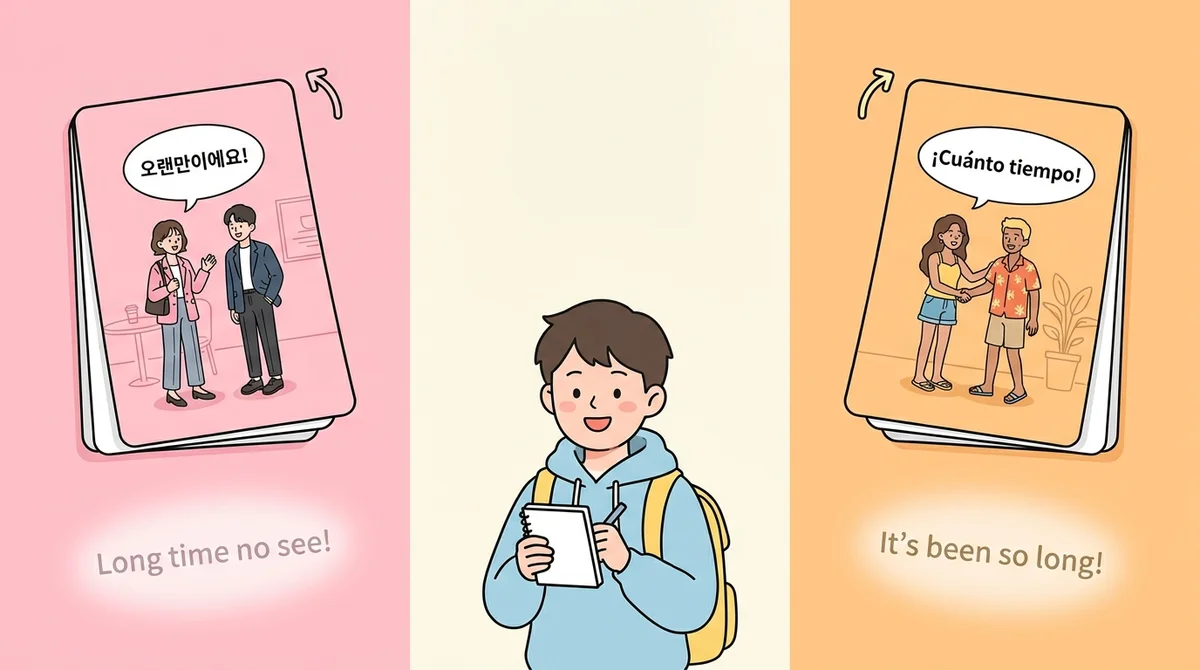
Here's a tiny mixed example of a dramatic reunion scene, the kind both genres love:
Korean:
- A: 왜 이제 왔어? (wae ije wasseo?) — "Why did you come only now?"
- B: 미안해. 보고 싶었어. (mianhae. bogo sipeosseo.) — "I'm sorry. I missed you."
Spanish:
- A: ¿Por qué tardaste tanto? (por KEH tar-DAHS-teh TAN-toh?) — "Why did you take so long?"
- B: Perdóname. Te extrañé. (per-DOH-nah-meh. teh eks-trah-NYEH.) — "Forgive me. I missed you."
Same emotional beat, two languages. If you learn the pattern once, you'll spot it everywhere.
Practice tips: don't just watch — speak it back
Here's the honest truth: you can watch a thousand episodes and still freeze when a real person talks to you. Watching builds recognition. Speaking builds ability. They're different muscles, and the second one only grows when you open your mouth.
So after every scene, say the lines out loud. Match the actor's emotion. If a character pleads "제발 (jebal)," "please," then plead too — the exaggeration drills the pronunciation deep. The same goes for a telenovela's "¡Te lo juro!" Feel it, don't mumble it.
The problem is most of us have no one to practice with at 1 a.m. after an episode. That's exactly where Teuida comes in. Teuida is a speaking-first app where you role-play real conversation scenarios out loud — the same K-drama-style situations you just watched, like a tense reunion or a café chat — and its AI scores your pronunciation and shows you how to fix it.
If K-dramas pulled you in, Teuida's Korean course lets you actually speak those lines back and practice the polite-versus-casual difference that dramas are built on. If it's telenovelas you love, the Spanish course drops you into real conversations so you can practice that fast, emotional dialogue without being afraid to say it wrong. Either way, you go from "I understood it" to "I said it" — which is the whole point.
Pair your binge with ten minutes of out-loud practice, and that drama becomes a real lesson instead of background noise.
Keep watching — but start talking
K-dramas and telenovelas are two beautifully different doors into two beautiful languages. Dramas teach you subtlety, respect, and tone. Telenovelas teach you speed, emotion, and the joy of a language that moves fast. Neither is "better" — the right one is the one in the language you're learning, watched the active way.
So tonight, pick one short scene. Grab three phrases. Say them out loud like you mean it. Then open Teuida and role-play that exact moment — speak your K-drama lines in the Korean course or your telenovela lines in the Spanish course, and let the pronunciation feedback turn tonight's episode into tomorrow's real conversation.


