
What is Culture Day (文化の日) in Japan? November 3rd explained — its history, how people celebrate, common learner mistakes, and Japanese phrases to say out loud.
You're scrolling through your Japanese friend's photos in early November and suddenly there's a flood of them — museum exhibits, people in handmade costumes, a quiet street lined with calligraphy displays. Someone's caption just says 文化の日 (bunka no hi), and you have no idea what that means or why it mattered enough to post about.
If that's you, you're in the right place. 文化の日 is one of Japan's loveliest national holidays, and once you know what it's about, you'll start noticing it everywhere — and you'll have the words to talk about it.
What Is Culture Day and Why It Matters
文化の日 (bunka no hi) literally means "Culture Day." It's a Japanese national holiday celebrated every year on November 3rd (11月3日, jūichi-gatsu mikka).
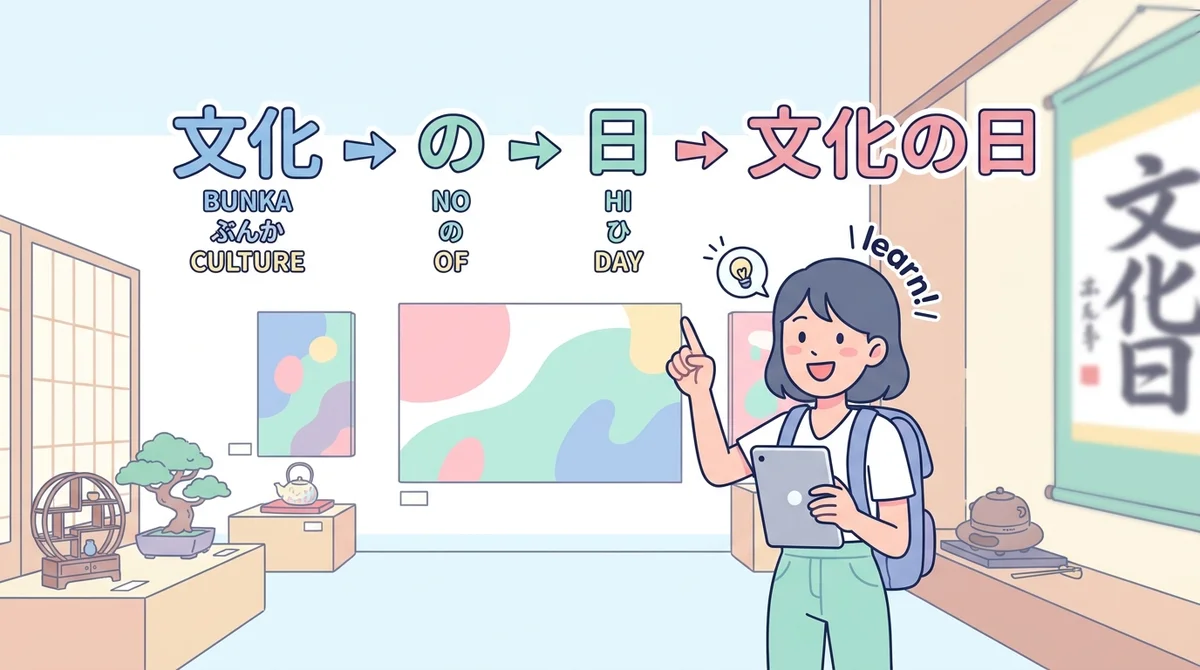
Let's break the name down, because it's made of words you'll use often:
- 文化 (bunka) — "culture"
- の (no) — a little connector, like "of" or an apostrophe-s
- 日 (hi) — "day"
So 文化の日 is simply "the day of culture." The holiday is dedicated to celebrating freedom, peace, and the arts — basically, everything that makes life richer beyond just work.
Why should a language learner care? Because holidays are where a language lives. If you're learning Japanese for travel, for J-culture, or just for the joy of it, understanding 文化の日 gives you real conversation material with native speakers — and a window into what Japan actually values.
The Core Explanation: Where Culture Day Comes From
Culture Day has a surprisingly deep history, and knowing it helps the vocabulary stick.
November 3rd was originally the birthday of the Meiji Emperor (明治天皇, meiji tennō), celebrated as a holiday called 明治節 (meiji-setsu). After World War II, the date took on new meaning: on November 3rd, 1946, Japan's postwar constitution (憲法, kenpō) was announced to the public. That constitution emphasized peace and freedom.
So in 1948, the government officially renamed the day 文化の日 and defined its purpose as a day to "love freedom and peace, and promote culture."
Here's a quick breakdown to keep it all straight:
| Japanese | Pronunciation | Meaning |
|---|---|---|
| 文化の日 | bunka no hi | Culture Day |
| 祝日 | shukujitsu | national holiday |
| 憲法 | kenpō | constitution |
| 平和 | heiwa | peace |
| 自由 | jiyū | freedom |
| 芸術 | geijutsu | art / the arts |
One more thing worth knowing: on this day, the government holds an awards ceremony for the Order of Culture (文化勲章, bunka kunshō), honoring people who've made outstanding contributions to science, the arts, and society. So it's not just a vibe — it's an official celebration of achievement, too.
Common Mistakes Learners Make
A few things trip up learners when they first meet this holiday. Let's clear them up now.
Mistake 1: Confusing 文化の日 with 文化祭.
These look almost identical but mean different things.
- 文化の日 (bunka no hi) — the national holiday on November 3rd.
- 文化祭 (bunka-sai) — a "culture festival," the school festival where students show off clubs, food stalls, and performances.
If you've watched anime, you've definitely seen a 文化祭. It's related in spirit but is a separate event, often held around autumn.
Mistake 2: Mispronouncing 文化.
Learners often say "boon-ka" with a heavy "oo." In Japanese, 文化 is closer to "boon-kah," short and even, with both syllables getting roughly equal weight. Don't drag out the vowel.
Mistake 3: Reading 日 the wrong way.
日 has several readings. In 文化の日 it's hi. But when you say the date, 3日 becomes mikka, not "san-hi." Dates in Japanese have their own special readings, and November 3rd is 11月3日 (jūichi-gatsu mikka).
Mistake 4: Assuming everything closes.
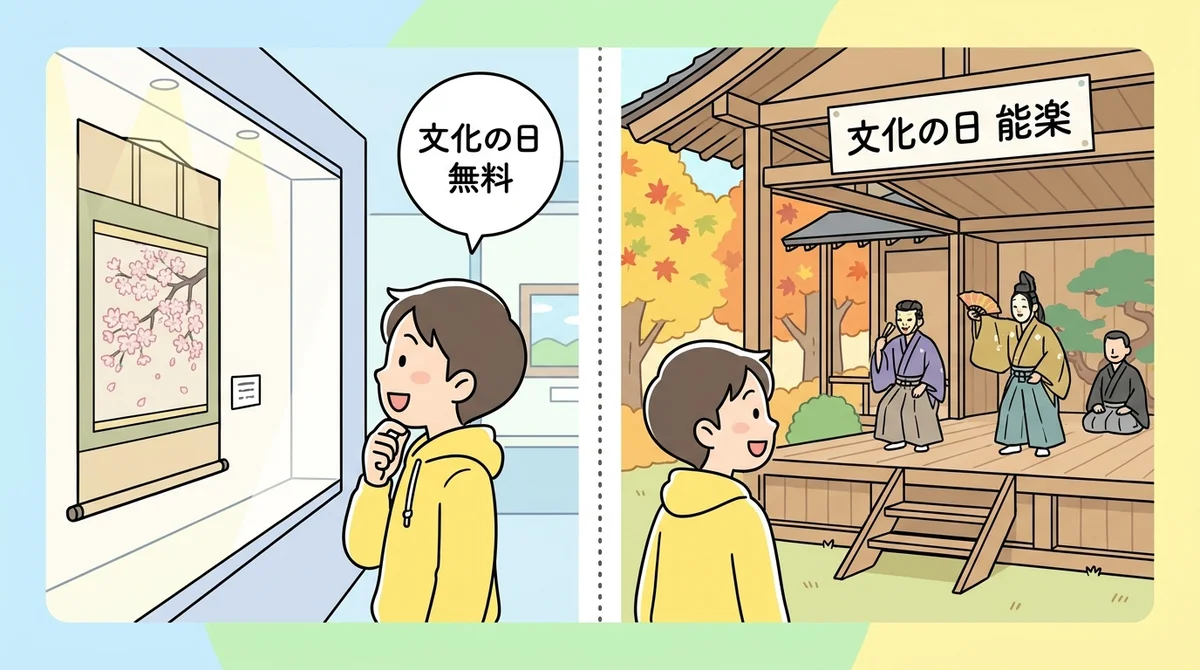
Because it's a holiday, you might expect shops to shut. In reality, museums and cultural sites are often free or discounted on 文化の日, so it's a great day to go out, not stay in.
How Culture Day Is Celebrated (Step by Step)
If you were in Japan on November 3rd, here's roughly what you could do — and the language that goes with each step.
Step 1: Visit a museum or gallery.
Many museums (美術館, bijutsukan) and art exhibits (展覧会, tenrankai) offer free entry. You might say:
今日は入場無料です (kyō wa nyūjō muryō desu) — "Admission is free today."
Step 2: Watch or join a cultural event.
Towns hold parades, tea ceremonies, and traditional performances. Look for the word イベント (ibento), "event."
Step 3: Catch the awards news.
The 文化勲章 (bunka kunshō) ceremony is covered on TV. It's a nice, low-pressure way to practice listening.
Step 4: Enjoy the autumn weather.
November 3rd is statistically one of the sunniest days of the year in Japan — people joke it's a 晴れの特異日 (hare no tokuijitsu), a "day that tends to be clear." Perfect for a walk.
Step 5: Talk about it.
The whole point of learning is to use the words. Tell a friend what you did, or ask what they did — which brings us to real sentences.
Real-Life Example Sentences and a Mini-Dialogue
Here are phrases you can actually use around Culture Day. Say each one out loud as you read.
Simple statements:
- 明日は文化の日です。
(ashita wa bunka no hi desu.)
"Tomorrow is Culture Day." - 文化の日は祝日です。
(bunka no hi wa shukujitsu desu.)
"Culture Day is a national holiday." - 美術館に行きたいです。
(bijutsukan ni ikitai desu.)
"I want to go to a museum."
A mini-dialogue between two friends:
A: 文化の日に何をしますか?
(bunka no hi ni nani o shimasu ka?)
"What are you doing on Culture Day?"
B: 美術館に行きます。入場無料ですから。
(bijutsukan ni ikimasu. nyūjō muryō desu kara.)
"I'm going to a museum. Because admission is free."
A: いいですね!一緒に行きましょう。
(ii desu ne! issho ni ikimashō.)
"Nice! Let's go together."
B: はい、楽しみです!
(hai, tanoshimi desu!)
"Yes, I'm looking forward to it!"
Notice how useful these building blocks are beyond this one holiday. 〜に行きます (~ni ikimasu), "I'll go to ~," and 〜が楽しみです (~ga tanoshimi desu), "I'm looking forward to ~," work in a hundred other conversations too.
One more natural phrase:
- 素敵なイベントでしたね。
(suteki na ibento deshita ne.)
"That was a lovely event, wasn't it?"
The 〜ね (ne) at the end softens it and invites agreement — very Japanese, and very friendly.
Practice Tips: Make It Stick by Speaking
Here's the honest truth: reading these phrases once won't make them yours. You'll forget 入場無料です (nyūjō muryō desu) by next week unless you say it out loud, several times, in context.
That's the whole reason speaking-first practice works. When you actually voice a sentence — mouth moving, sound coming out — your brain files it as something you can do, not just something you recognize. Recognition and production are two different skills, and travelers get stuck when they can only do the first one.
This is exactly what Teuida's Japanese course is built for. Instead of grinding flashcards, you step into real conversation scenarios — like asking a friend 文化の日に何をしますか (bunka no hi ni nani o shimasu ka), "What are you doing on Culture Day?" — and you say your lines out loud. The app's AI pronunciation feedback scores how you said それ (sore) and nudges you to fix that long "oo" in 文化 until it sounds natural. It's the next best thing to a patient friend sitting across from you.
Try this today: pick three sentences from the dialogue above and repeat each one five times. Then imagine a friend asking you about your plans and answer out loud. That tiny habit, done daily, is how speaking confidence is built.
Wrap-Up: Go Enjoy the Culture
文化の日 is more than a day off. It's Japan quietly celebrating art, peace, and freedom — and now you have both the backstory and the words to join in. Whether you're planning a November trip, chatting with a Japanese friend, or just loving the culture from afar, you're ready to talk about it.
Start small. Learn one phrase, say it until it feels easy, then add the next. Before long you won't just know about Culture Day — you'll be able to talk your way through it.
Practice these 文化の日 phrases out loud in Teuida's Japanese course and get your pronunciation scored, so the next time November 3rd rolls around, you'll say them like you mean them.


