
What is 한정선 찹쌀떡, the viral Korean rice cake? See why it is trending, learn words like 쫀득쫀득, 품절 and 포장, and how to order it in Korean step by step at the shop.
You're scrolling through Korean food videos late at night, and the same thing keeps popping up: a soft white rice cake being pulled apart to reveal a stretchy, melting middle. The comments are full of people begging for the location. The brand name on the box? 한정선 찹쌀떡.
If you've ever stood in front of a trending Korean snack with no idea what to say to buy it, this one's for you. Let's break down what 한정선 찹쌀떡 actually is, why it's everywhere right now, and exactly how to order it in Korean.
What 한정선 찹쌀떡 Actually Is
Let's start with the name, because it tells you almost everything.
한정선 (han-jeong-seon) is the brand name — it reads like a person's name, which is common for Korean dessert shops that want a handmade, personal feel.
찹쌀떡 (chap-ssal-tteok) is the real star. Break it apart:
- 찹쌀 (chap-ssal) means "glutinous rice" or "sweet rice" — the sticky kind.
- 떡 (tteok) means "rice cake."
So 찹쌀떡 is a chewy glutinous rice cake, usually round, dusted with a little powder, and stuffed with a filling. Traditionally that filling is 팥 (pat), "sweet red bean paste." If you've eaten Japanese daifuku (だいふく), 찹쌀떡 is Korea's close cousin — soft, stretchy, and barely sweet in a comforting way.
The 한정선 version went viral because it leans into that pull-apart, gooey texture and uses fillings people love photographing: red bean, cream, sometimes seasonal fruit. It looks dramatic on camera and tastes nostalgic. That combination is pure social-media fuel.
Why It's Blowing Up Right Now
Food trends in Korea move fast, and 한정선 찹쌀떡 hit several buttons at once.
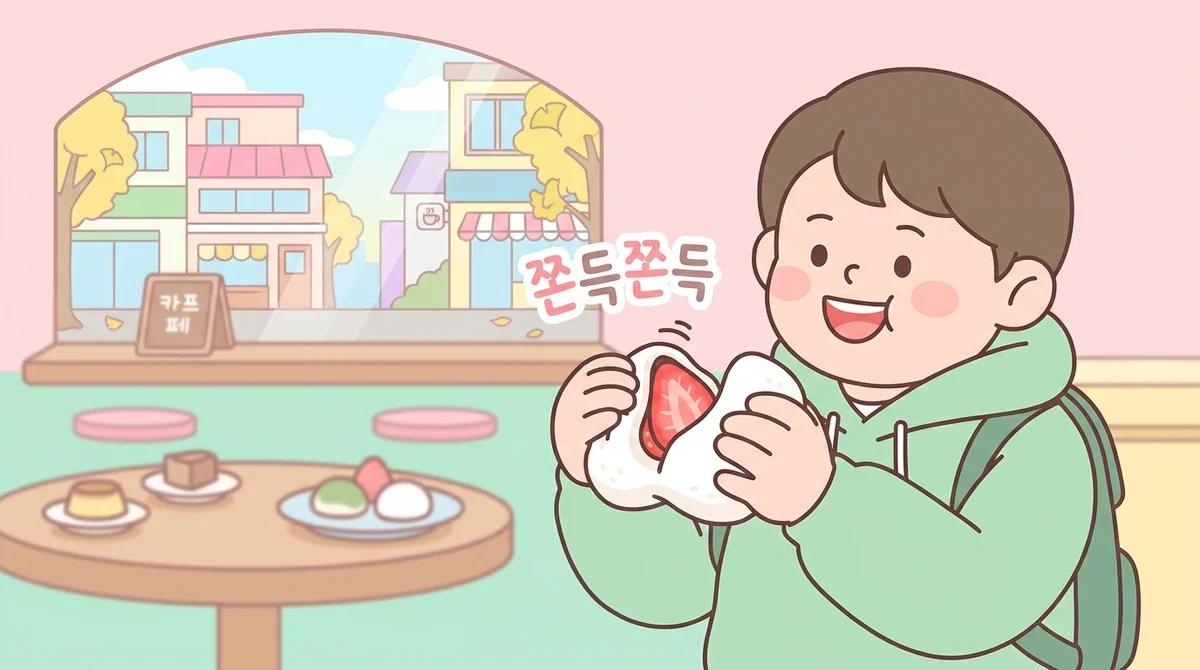
First, texture is a whole genre online. Koreans have a word for that satisfying chewy-stretchy mouthfeel: 쫀득쫀득 (jjon-deuk-jjon-deuk), "chewy and springy." A rice cake that stretches when you pull it is basically built for slow-motion video.
Second, it's affordable and giftable. 찹쌀떡 has always been a humble, everyday snack. Seeing a classic treat get a trendy, premium glow-up makes people feel like they're in on something both new and familiar.
Third, there's the nostalgia factor. Many Koreans grew up eating 찹쌀떡 from their grandmother or a neighborhood 떡집 (tteok-jip), "rice cake shop." A viral version brings back warm memories while giving younger fans a reason to line up.

So when you see the hype, you're not just seeing a dessert. You're seeing texture content, nostalgia, and good-value gifting all stacked into one little white ball.
The Core Vocabulary, Broken Down
If you want to talk about this trend — or actually go buy some — here are the words that matter most. Notice how each one gets you closer to sounding natural in a shop.
| Korean | Pronunciation | Meaning |
|---|---|---|
| 찹쌀떡 | chap-ssal-tteok | glutinous rice cake |
| 떡 | tteok | rice cake (general) |
| 팥 | pat | sweet red bean paste |
| 크림 | keu-rim | cream |
| 쫀득쫀득 | jjon-deuk-jjon-deuk | chewy, springy (texture) |
| 맛집 | mat-jip | a place famous for good food |
| 줄 서다 | jul seo-da | to stand in line |
| 품절 | pum-jeol | sold out |
| 포장 | po-jang | to-go / takeaway (packaging) |
| 하나 | ha-na | one |
Two of these will save you in real life. 품절 (pum-jeol), "sold out," is the sign you'll dread seeing on a viral snack. And 포장 (po-jang), "takeaway," is how you ask for it boxed up to carry home or gift.
Common Mistakes Learners Make
Even motivated learners trip on a few predictable things with this one. Let's fix them before you're standing at the counter.
1. Saying the 떡 part too softly. The 떡 in 찹쌀떡 has a tense, slightly "hard" start — that double-consonant tension. It's not "deok" with a gentle d; it's closer to a sharp tt. Say it a bit more forcefully than feels natural.
2. Pluralizing it like English. There's no "s." You don't ask for "two 찹쌀떡s." You just say the number plus a counter. For snacks like this, use 개 (gae), "items/pieces": 두 개 (du gae), "two pieces."
3. Confusing 떡 with 떡볶이. They share the 떡 but are totally different. 떡볶이 (tteok-bokki) is the spicy stir-fried rice cake dish. 찹쌀떡 is a soft sweet snack. Don't ask the dessert shop for the spicy one.
4. Over-translating "chewy." Beginners reach for a textbook word, but Koreans will light up if you say 쫀득쫀득해요 (jjon-deuk-jjon-deuk-hae-yo), "it's so chewy." It's casual, it's accurate, and it's exactly how people describe this snack.
How to Order It, Step by Step
Here's a simple flow you can follow at almost any 떡집 or trendy dessert counter. Keep it polite and short.
Step 1 — Greet. Walk in with 안녕하세요 (an-nyeong-ha-se-yo), "hello." One word, instant goodwill.
Step 2 — Ask if it's available. The viral stuff sells out, so start here:
찹쌀떡 있어요? (chap-ssal-tteok iss-eo-yo?) — "Do you have the rice cakes?"
If they say 품절이에요 (pum-jeol-i-e-yo), "it's sold out," you'll know to come earlier next time.
Step 3 — Say how many. Use a number plus 개 (gae):
두 개 주세요 (du gae ju-se-yo) — "Two, please."
Step 4 — Choose a filling, if asked. You might hear about 팥 (pat), "red bean," or 크림 (keu-rim), "cream." Point and say 이거 주세요 (i-geo ju-se-yo), "this one, please."
Step 5 — Ask for takeaway. To carry or gift it:
포장해 주세요 (po-jang-hae ju-se-yo) — "To go, please."
Step 6 — Pay and thank them. Close with 감사합니다 (gam-sa-ham-ni-da), "thank you."
That's the entire transaction. Six short lines and you've ordered a trending Korean snack like you've done it a hundred times.
Real-Life Example Dialogues
Let's put it together. Here are two mini-conversations you can practice out loud right now.
Dialogue 1 — Buying a few to take home
You: 안녕하세요! 찹쌀떡 있어요?
(an-nyeong-ha-se-yo! chap-ssal-tteok iss-eo-yo?)
"Hello! Do you have the rice cakes?"
Staff: 네, 있어요. 몇 개 드릴까요?
(ne, iss-eo-yo. myeot gae deu-ril-kka-yo?)
"Yes, we do. How many would you like?"
You: 세 개 주세요. 포장해 주세요.
(se gae ju-se-yo. po-jang-hae ju-se-yo.)
"Three, please. To go, please."
Staff: 네, 잠시만요.
(ne, jam-si-man-yo.)
"Sure, one moment."
You: 감사합니다!
(gam-sa-ham-ni-da!)
"Thank you!"
Dialogue 2 — Reacting to the texture
Friend: 이거 어때요?
(i-geo eo-ttae-yo?)
"How is it?"
You: 완전 쫀득쫀득해요! 진짜 맛있어요.
(wan-jeon jjon-deuk-jjon-deuk-hae-yo! jin-jja ma-si-sseo-yo.)
"So chewy! It's really delicious."
Friend: 그래서 유명한가 봐요.
(geu-rae-seo yu-myeong-han-ga bwa-yo.)
"That must be why it's famous."
Notice 완전 (wan-jeon), literally "completely," used here as slang for "totally / so." And 진짜 (jin-jja), "really," is the everyday intensifier you'll hear constantly. Sprinkle both in and you sound far more natural.
Practice Tips That Actually Make It Stick
Here's the honest part: reading these phrases once won't help you at the counter. The moment a real person answers back, your brain freezes — that's normal. The fix is saying the lines out loud, out of order, until they're automatic.
Start with the three phrases you truly need: 찹쌀떡 있어요?, 두 개 주세요, and 포장해 주세요. Say each one ten times. Then shuffle them. Then imagine the staff saying 품절이에요 and practice reacting. The goal isn't memorizing a script — it's being ready for a conversation that doesn't go perfectly.
This is exactly where Teuida helps. Teuida is a speaking-first app, so instead of grinding flashcards you role-play real scenarios out loud — including ordering food at a Korean shop, just like the dialogues above. You say the line, and the AI pronunciation feedback scores how close you got and shows you what to fix, especially on tricky tense sounds like the 떡 in 찹쌀떡.
Jump into the ordering and café scenarios in Teuida's Korean course, practice "찹쌀떡 두 개 주세요" until it feels natural, and walk into that viral shop ready to actually speak — not just point.
Go Try It Out Loud
Food trends come and go, but being able to walk up and order in Korean is a win that stays with you long after the hype fades. You now know what 한정선 찹쌀떡 is, why Korea can't stop talking about it, and the handful of phrases that turn you from a nervous pointer into a confident customer.
Start small. Nail one phrase today. Then the next. Before you know it, you'll be the friend who orders for everyone.
Practice ordering 찹쌀떡 out loud in Teuida's Korean course and get your pronunciation scored before your next trip.


