
Watching K-dramas builds listening, not speaking. Learn to step into the scene: shadow lines like 괜찮아요, pick 반말 or 존댓말, and say every line out loud yourself.
You've watched enough K-dramas to know exactly how the heartbreak line sounds. You can hear the actor say 사랑해 (saranghae), "I love you," in your head, perfectly. But when a real person stands in front of you and asks a simple question, your mouth freezes.
That gap is the whole story of this post. Watching Korean and speaking Korean are two different skills — and most of us accidentally train only one of them.
Why This Comparison Matters
K-dramas are probably why you started learning Korean in the first place. That's a wonderful reason, and dramas really do teach you something real — the rhythm of the language, the emotion behind words, how people actually talk instead of how textbooks say they should.
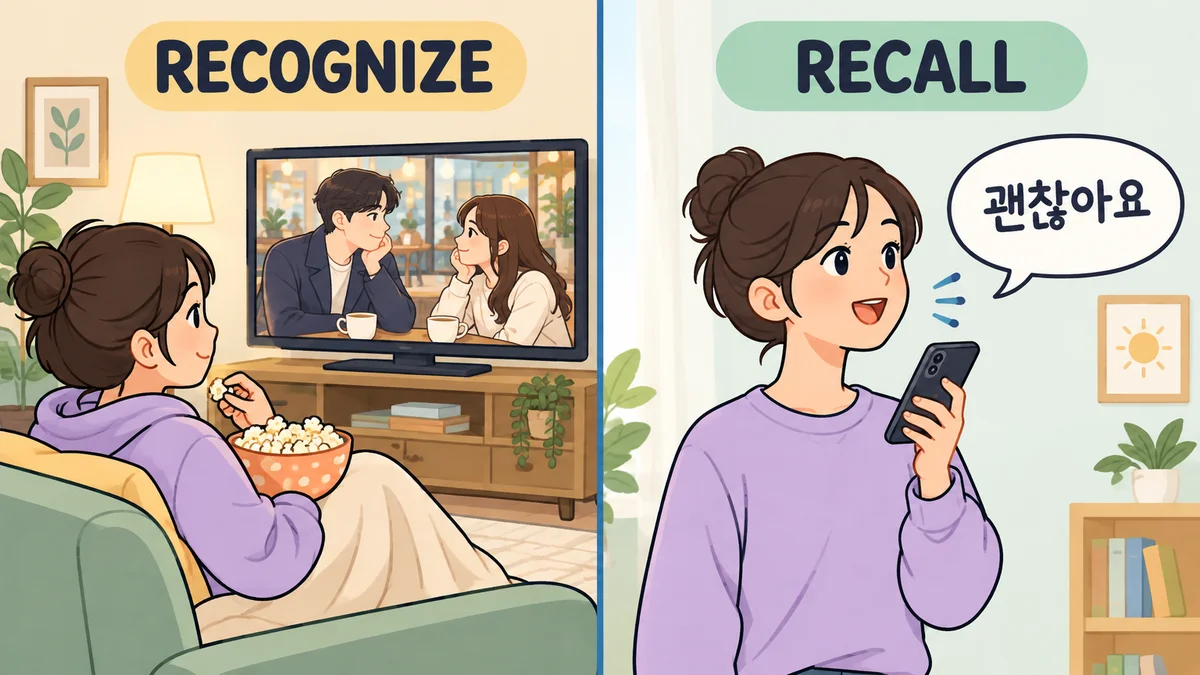
But here's the catch. Watching a drama puts you in the audience seat. You absorb, you recognize, you feel — and then the scene moves on without you. You never actually open your mouth.
The alternative is to stop watching the scene and step into it. Imagine being the character who says the next line. That one shift — from audience to actor — changes everything about how fast Korean sticks.
This post breaks down both methods honestly, so you can keep the magic of dramas while finally closing the speaking gap.
The Core Difference: Input vs. Output
Linguists split language learning into two buckets. Input is everything you take in — listening and reading. Output is everything you produce — speaking and writing. Don't worry about the jargon; the simple version is "stuff going into your head" vs. "stuff coming out of your mouth."
Watching dramas is almost pure input. Being in a drama scene forces output. Here's how they stack up:
| Watching K-dramas | Being in the scene (Teuida) | |
|---|---|---|
| Main skill trained | Listening, recognition | Speaking, recall |
| Your role | Audience | The character |
| Do you talk? | No | Yes, every line |
| Pace | The show's pace | Your pace |
| What you build | "I understand this" | "I can say this" |
| Real-life payoff | You follow conversations | You hold conversations |
Neither column is bad. The problem is that most learners live entirely in the left column and wonder why speaking feels impossible.
Recognition and recall are different muscles. You can recognize 괜찮아요 (gwaenchanayo), "it's okay / I'm fine," the instant you hear it — but recall means pulling that phrase out of nowhere, in the moment, with the right ending. Only output trains recall.
Common Mistakes Learners Make
The biggest trap is mistaking understanding for ability. You finish a 16-episode series and feel fluent because you followed every scene. Then a conversation starts and nothing comes out. Understanding is real progress — it's just not the same as speaking.
Another one: passive subtitle reading. If your eyes are glued to English subtitles, your brain reads English and your ears tune Korean out as background music. You feel like you're learning, but you're mostly reading.
Then there's rewinding the sad line fifty times but never saying it. You memorize the sound, not the skill. Feeling the emotion isn't the same as forming the sentence yourself.
Learners also tend to collect vocabulary they never use. You know 배고파 (baegopa), "I'm hungry," and 피곤해 (pigonhae), "I'm tired," but you've never once said them out loud to anyone. Words you don't speak don't stay.
And finally, copying drama speech without knowing the politeness level. Dramas are full of casual, intimate speech between close friends and lovers. Say those same lines to a shopkeeper and you'll sound rude without meaning to. More on that below.
A Step-by-Step Guide to Turning Watching Into Speaking
You don't have to quit dramas — you have to add a speaking layer. Here's a simple routine.
Step 1 — Watch the scene once, just for enjoyment. Feel it. No pausing, no studying. This is your input.
Step 2 — Rewatch one short exchange with Korean subtitles. Two or three lines, no more. Read along as you hear it.
Step 3 — Shadow it. Pause after a line and repeat it out loud, matching the rhythm and tone. Don't whisper. Actually say it.
Step 4 — Become the character. Cover the subtitles and deliver the line yourself, as if the other actor is waiting for you. This is the jump from watching to being in the scene.
Step 5 — Swap in your own words. If the line was 저는 학생이에요 (jeoneun haksaengieyo), "I'm a student," say 저는 선생님이에요 (jeoneun seonsaengnimieyo), "I'm a teacher." Now it's your sentence.
Step 6 — Check the politeness level. Ask whether the line is casual (반말, banmal) or polite (존댓말, jondaetmal), and decide which one you'd actually need in real life.
That sequence turns a passive binge into active practice. But doing it alone with a remote is clunky — which is exactly the gap Teuida was built to fill.
Real-Life Example Scenes
Here's what "being in the scene" looks like in practice. Instead of hearing these lines, you say them.
Scene 1 — Meeting someone new
A: 안녕하세요, 처음 뵙겠습니다. (annyeonghaseyo, cheoeum boepgesseumnida.) — "Hello, nice to meet you."
B (you): 네, 반갑습니다. 저는 민지예요. (ne, bangapseumnida. jeoneun Minji-yeyo.) — "Yes, nice to meet you. I'm Minji."
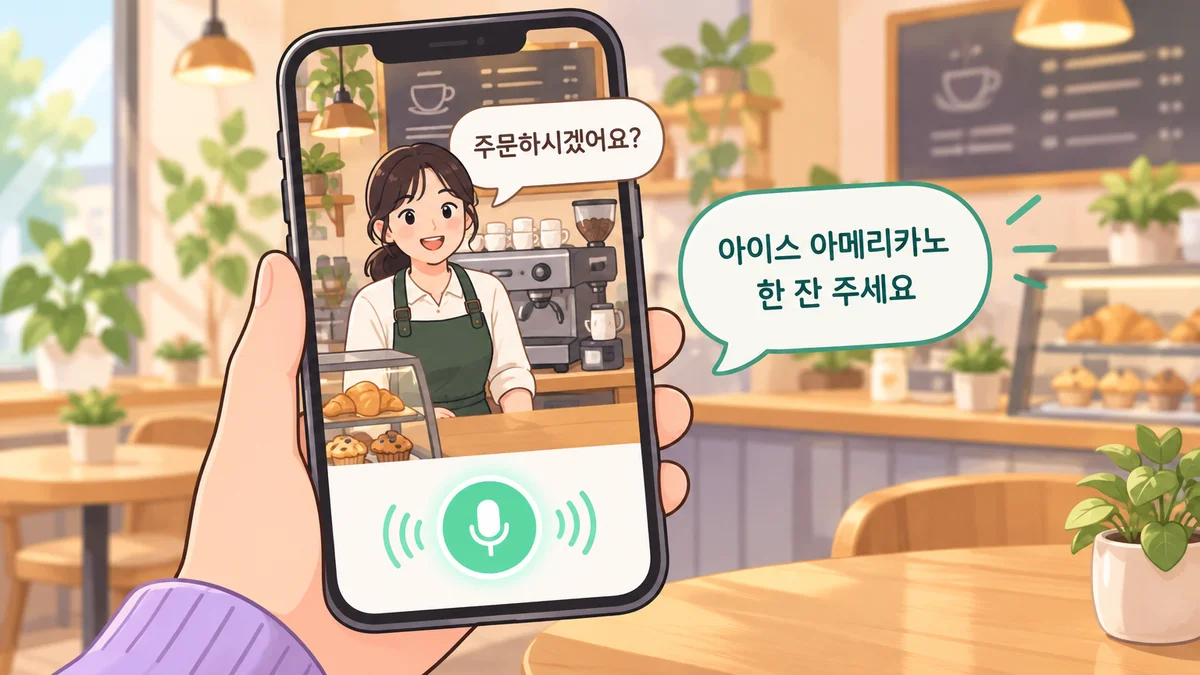
Scene 2 — Ordering at a café
Staff: 주문하시겠어요? (jumunhasigesseoyo?) — "Are you ready to order?"
You: 아이스 아메리카노 한 잔 주세요. (aiseu amerikano han jan juseyo.) — "One iced americano, please."
Staff: 네, 잠시만요. (ne, jamsimanyo.) — "Sure, one moment."
Scene 3 — The emotional drama line, done right
A: 나 너 좋아해. (na neo joahae.) — "I like you." (casual — to someone close)
You: 나도 좋아해. (nado joahae.) — "I like you too."
Notice how that last exchange uses 반말 (banmal), casual speech. It's perfect between close friends — and totally wrong for your new coworker. Saying these lines yourself is the moment that distinction finally clicks, because you have to choose which form comes out of your mouth.
Practice Tips (and Where Speaking Actually Happens)
The honest truth: the only way Korean sticks is by saying it out loud, in a real situation, over and over. Reading the lines in this post helps a little. Speaking them changes everything.
Here are tips that work:
- Speak before you feel ready. Waiting until you're "good enough" means you never start. Say the line now, imperfectly.
- Use full exchanges, not single words. Real conversations are back-and-forth. Practice both sides.
- Repeat the same scene until it's automatic. Fluency is a line you can say without thinking, not a line you can translate.
- Pick scenes you'd actually use — introductions, ordering, asking directions — so your practice becomes your real life.
This is exactly what Teuida is built for. Instead of watching dramas from the audience seat, you step inside K-drama-style scenes filmed with real people — not AI — and you say every line out loud as the character. The café scene above, the introduction, the confession — they live inside Teuida's Korean course, and the app's whole job is to give you the scene and the reason to speak it.
There's no grinding flashcards and no grammar drills first. You speak Korean from day one, in context, exactly like being cast in your own drama. Teuida's Story Hall even strings these scenes into full episodes, so you're not repeating dead phrases — you're living a little story and talking your way through it. It was built by bilingual tutors who've sat exactly where you are, and the goal is simple: a daily speaking habit and the confidence to actually talk.
Watching builds the dream. Being in the scene builds the skill.
Wrap-Up: Step Into the Scene
K-dramas gave you the love for Korean, and that's worth protecting. Keep watching — just don't stay only in the audience seat forever. Every scene you love is a scene you could be in.
Recognition is comfortable. Speaking is where real Korean is born. The jump is smaller than it feels, and it starts with one line said out loud today.
Stop rewinding the scene and start playing the role — practice these Korean lines out loud inside the scenes in Teuida's Korean course, and become the character instead of the viewer.


