
Heated bus stop seats (온열의자) and talking kiosks are everywhere in Korea. Learn key words like 포장, 매장 and 결제 to stay warm and order food without stress.
It's January in Seoul, you've been standing at the bus stop for four minutes, and your legs have stopped feeling like legs. Then you glance down and notice the bench is glowing faintly — and warm. You sit, and it's like a tiny miracle under your coat.
Korea is full of these small, futuristic kindnesses: heated seats at bus stops, and chatty kiosks that talk back when you order food or buy a ticket. The catch? Most of them speak to you in Korean. Let's learn the words that turn "wait, what did that machine just say?" into "oh, I know exactly what to do."
Why heated seats and talking kiosks matter for travellers
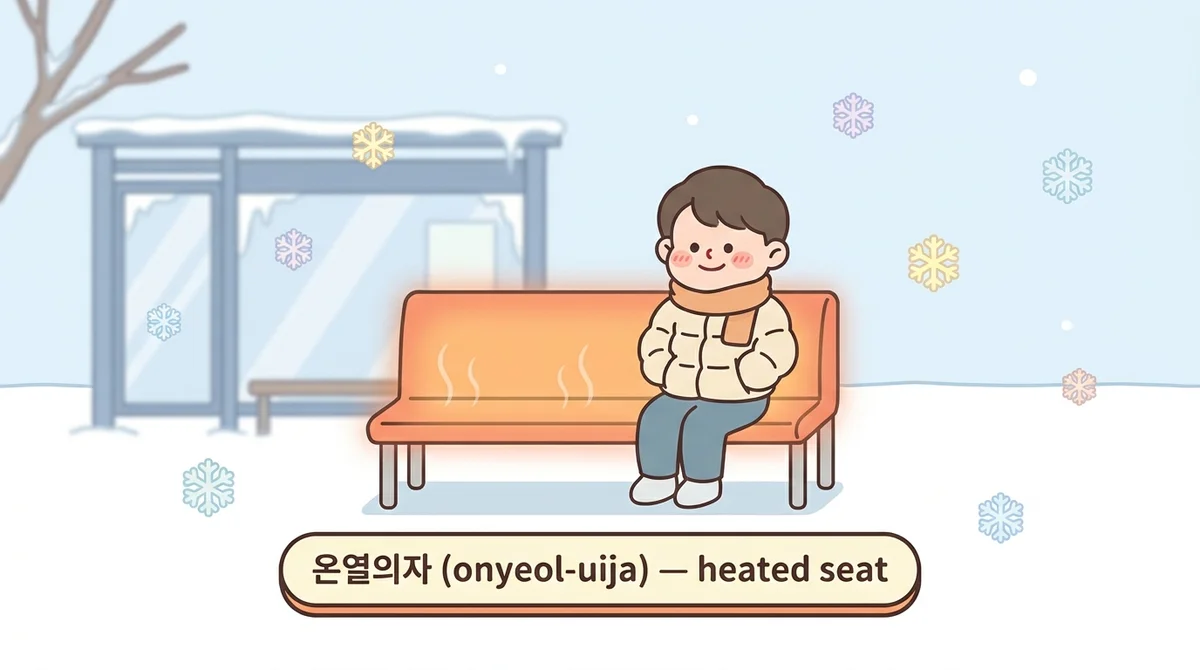
Korea has quietly become one of the most tech-friendly countries to walk around in. Bus stops in winter aren't just shelters anymore — many have 온열의자 (onyeol-uija), "heated seats," built right into the bench so you can wait out the cold in comfort.
And when you go to order a burger, buy a train ticket, or check in at a clinic, you'll often meet a 키오스크 (kioseukeu), "kiosk" — a self-service touchscreen. The newer ones are AI 음성 키오스크 (AI eumseong kioseukeu), "AI voice kiosks," that actually speak to you and listen for your answer.
These things are everywhere, and they're designed for locals, so a few Korean words go a long way. Knowing them means you stay warm, order correctly, and never freeze (literally or socially) in front of a machine with a line behind you.
The core words you'll actually see and hear
Let's break down the vocabulary into the two situations: the warm bus stop and the talking kiosk. Here's a quick reference you can glance at before your trip.
| Korean | Pronunciation | Meaning |
|---|---|---|
| 온열의자 | onyeol-uija | heated seat |
| 따뜻하다 | ttatteuthada | to be warm |
| 버스정류장 | beoseu-jeongnyujang | bus stop |
| 도착 | dochak | arrival |
| 키오스크 | kioseukeu | kiosk |
| 주문 | jumun | order |
| 결제 | gyeolje | payment |
| 포장 | pojang | to-go / takeout |
| 매장 | maejang | dine-in (lit. "store/venue") |
| 화면 | hwamyeon | screen |
| 음성 | eumseong | voice |
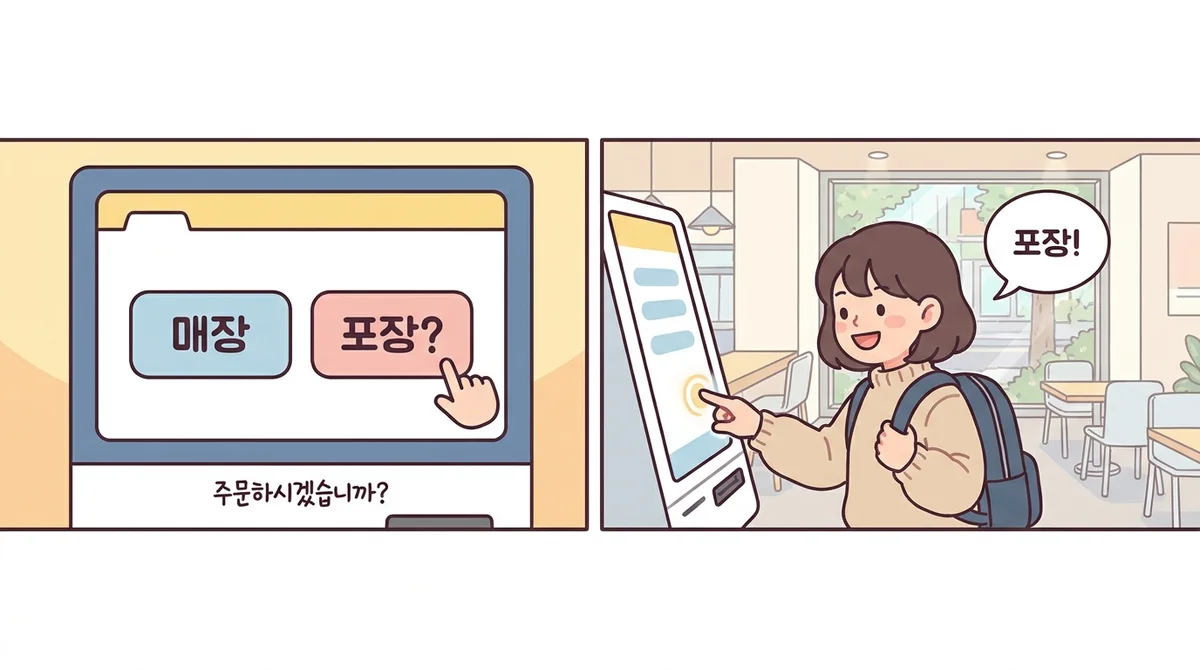
A few of these are worth saying out loud right now. 따뜻하다 (ttatteuthada), "to be warm," is the word you'll feel when you sit on that heated bench. And 포장 (pojang) vs 매장 (maejang) is the single most common question a food kiosk will ask you — takeout or eat-in.
Common mistakes travellers make
The first mistake is panicking at the kiosk. The screen fills with Korean, a voice starts talking, and people assume they have to understand every word. You don't — you only need to catch the key question and tap the right choice.
The second mistake is mixing up 포장 and 매장. If you tap 매장 (dine-in) but you're taking the food to your hotel, some places plate it on a tray instead of bagging it. Catch which one the kiosk is asking and you're fine.
A third one: assuming the heated seat is broken because it doesn't feel warm instantly. The 온열의자 (onyeol-uija) takes a moment, and it often only runs during cold months. Some even have a little sign that says 가동 중 (gadong jung), "in operation."
And finally, people ignore the language button. Many AI kiosks have an English/Chinese/Japanese option in the corner. But knowing the Korean words means you don't need it — and you'll understand the spoken prompts even faster.
Step-by-step: using a talking kiosk without stress
Here's the flow almost every Korean food or ticket kiosk follows. Learn the order once and it feels the same everywhere.
1. Choose dine-in or takeout. The kiosk opens with 매장 (maejang) or 포장 (pojang)? Tap the one you want.
2. Pick your items. Browse the 화면 (hwamyeon), "screen," and tap what you want. A voice kiosk may ask "무엇을 주문하시겠어요? (mueoseul jumun-hasigesseoyo?)" — "What would you like to order?"
3. Review your 주문 (jumun), "order." It shows a summary. Check the count and total.
4. Pay — 결제 (gyeolje). The kiosk asks "결제하시겠어요? (gyeolje-hasigesseoyo?)" — "Would you like to pay?" Tap yes, then tap or insert your card.
5. Take your receipt and number. It prints a number; wait for it on the screen or listen for it called out.
For the bus stop, the "steps" are gentler: find the 버스정류장 (beoseu-jeongnyujang), sit on the 온열의자 (onyeol-uija) if it's cold, and watch the arrival board for 도착 (dochak), "arrival," next to your bus number.
Real-life phrases and mini-dialogues
Here are natural lines for both situations. Say them out loud — these are exactly what comes out of your mouth on the trip.
At the bus stop, chatting with a local:
You: 이 의자 따뜻하네요! (i uija ttatteuthaneyo!)
"This seat is warm!"
Local: 네, 온열의자예요. 겨울에 좋아요. (ne, onyeol-uija-yeyo. gyeoure joayo.)
"Yes, it's a heated seat. It's nice in winter."
Asking which bus / when it comes:
You: 이 버스 언제 와요? (i beoseu eonje wayo?)
"When does this bus come?"
Board/Local: 곧 도착해요. 2분 남았어요. (got dochak-haeyo. i-bun namasseoyo.)
"It arrives soon. Two minutes left."
At the AI voice kiosk:
Kiosk: 매장에서 드시나요, 포장이세요? (maejang-eseo deusinayo, pojang-iseyo?)
"Dining in, or takeout?"
You: 포장이요. (pojang-iyo.)
"Takeout, please."
Kiosk: 결제하시겠어요? (gyeolje-hasigesseoyo?)
"Would you like to pay?"
You: 네, 카드로 할게요. (ne, kadeuro halgeyo.)
"Yes, I'll pay by card."
If you need the machine to slow down or switch:
You: 영어 있어요? (yeongeo isseoyo?)
"Is there English?"
You: 다시 한번요. (dasi hanbeonyo.)
"One more time, please."
Notice how short the useful answers are. 포장이요 (pojang-iyo) and 네, 카드로 할게요 (ne, kadeuro halgeyo) carry you through a whole transaction. You don't need paragraphs — you need a handful of confident lines.
Practice tips: say it before you need it
Here's the honest truth: reading this list once won't save you when a kiosk is talking and a queue is forming. These phrases only stick when they live in your mouth, not just your eyes. The difference between "I think I remember the word" and actually saying 포장이요 on reflex is practice out loud.
So rehearse the full flow before your trip. Say the kiosk's question, then say your answer, back and forth, until the rhythm feels automatic. Do it in the shower, on your commute, anywhere — out loud, every time.
This is exactly what Teuida is built for. Instead of grinding flashcards, you step into real-life Korean conversation scenes — filmed with real people, not AI avatars — and you speak the lines yourself. In Teuida's Korean course you can role-play ordering at a kiosk and chatting at a bus stop, saying 포장이요 and 이 의자 따뜻하네요 out loud in context, so the words come back to you when a real machine asks.
Because you're practising the actual situation — the takeout question, the payment prompt, the small talk on a cold bench — you build the muscle memory to speak, not just recognize. That's the whole point: when the kiosk talks, you talk back without freezing.
You've got this — warm seats and all
Korea rewards the traveller who learns just a few of its small, everyday words. The heated seat, the talking screen, the arrival board — none of them are obstacles once you know what they're saying to you.
Keep your answers short, listen for the key words — 포장, 매장, 결제, 도착 — and let the rest wash over you. You'll be surprised how smoothly a trip runs when a kiosk feels like a friendly question instead of a test.
Practice ordering at a Korean kiosk and chatting at a warm bus stop out loud in Teuida's Korean course — say every line before your trip, and arrive ready to talk.


