
Learn 100+ basic Korean words for beginners: greetings, numbers, family, food, places, and core verbs, each with Hangul, romanization, and audio to hear it.
The best basic Korean words to learn first fit into nine groups: greetings, question words, people and family, numbers, time, food, places, core verbs, and core adjectives. This list has a little over 100 of them. Every word is written in Hangul with its romanization and meaning, and you can tap any word in the tables, or any example sentence, to hear it. Learn Hangul first if you can, so you read the words as Koreans write them instead of relying on romanization.
Before you start: read Hangul first
Romanization only gets you close. The same Korean sound can be spelled several ways in English letters, and some Korean sounds have no exact English match. If you haven't learned the alphabet yet, our Hangul reading guide takes a few hours of practice, and every word below will be easier to remember after it.
Two notes on the tables:
- Romanization follows the Revised Romanization of Korean, the official system from the National Institute of Korean Language. It spells words the way they sound, so 감사합니다 is gamsahamnida, not gamsahabnida.
- The "Say it to" column tells you who you can use a word with. "Anyone" is safe with strangers, coworkers, and people older than you. "Close friends" words are casual, so keep them for close friends and people younger than you. "Family" marks words for your own family. 형, 오빠, 누나, and 언니 also work for close friends who are older than you.
Greetings and polite basics
You will hear and use these every day.
| Korean | Romanization | Meaning | Say it to |
|---|---|---|---|
| 안녕하세요 | annyeonghaseyo | Hello | Anyone |
| 안녕 | annyeong | Hi, bye | Close friends |
| 안녕히 가세요 | annyeonghi gaseyo | Goodbye (to someone leaving) | Anyone |
| 안녕히 계세요 | annyeonghi gyeseyo | Goodbye (when you are the one leaving) | Anyone |
| 감사합니다 | gamsahamnida | Thank you | Anyone |
| 고마워 | gomawo | Thanks | Close friends |
| 죄송합니다 | joesonghamnida | I'm sorry | Anyone |
| 미안해 | mianhae | Sorry | Close friends |
| 네 | ne | Yes | Anyone |
| 아니요 | aniyo | No | Anyone |
| 괜찮아요 | gwaenchanayo | It's okay, I'm fine, no thanks | Anyone |
| 실례합니다 | sillyehamnida | Excuse me | Anyone |
| 잠깐만요 | jamkkanmanyo | Just a moment, excuse me (to get past) | Anyone |
Example: 감사합니다, 괜찮아요. (gamsahamnida, gwaenchanayo.) Thank you, I'm fine.
괜찮아요 is one of the most useful words in Korean. It can mean "I'm okay," "it's fine," or a polite "no thanks" when someone offers you something.
Question words
With these eight words and a noun, you can ask most of the questions a beginner needs.
| Korean | Romanization | Meaning |
|---|---|---|
| 뭐 | mwo | What |
| 누구 | nugu | Who |
| 어디 | eodi | Where |
| 언제 | eonje | When |
| 왜 | wae | Why |
| 어떻게 | eotteoke | How |
| 얼마 | eolma | How much |
| 몇 | myeot | How many |
Example: 화장실이 어디예요? (hwajangsiri eodiyeyo?) Where is the restroom?
Example: 이거 얼마예요? (igeo eolmayeyo?) How much is this?
People and family
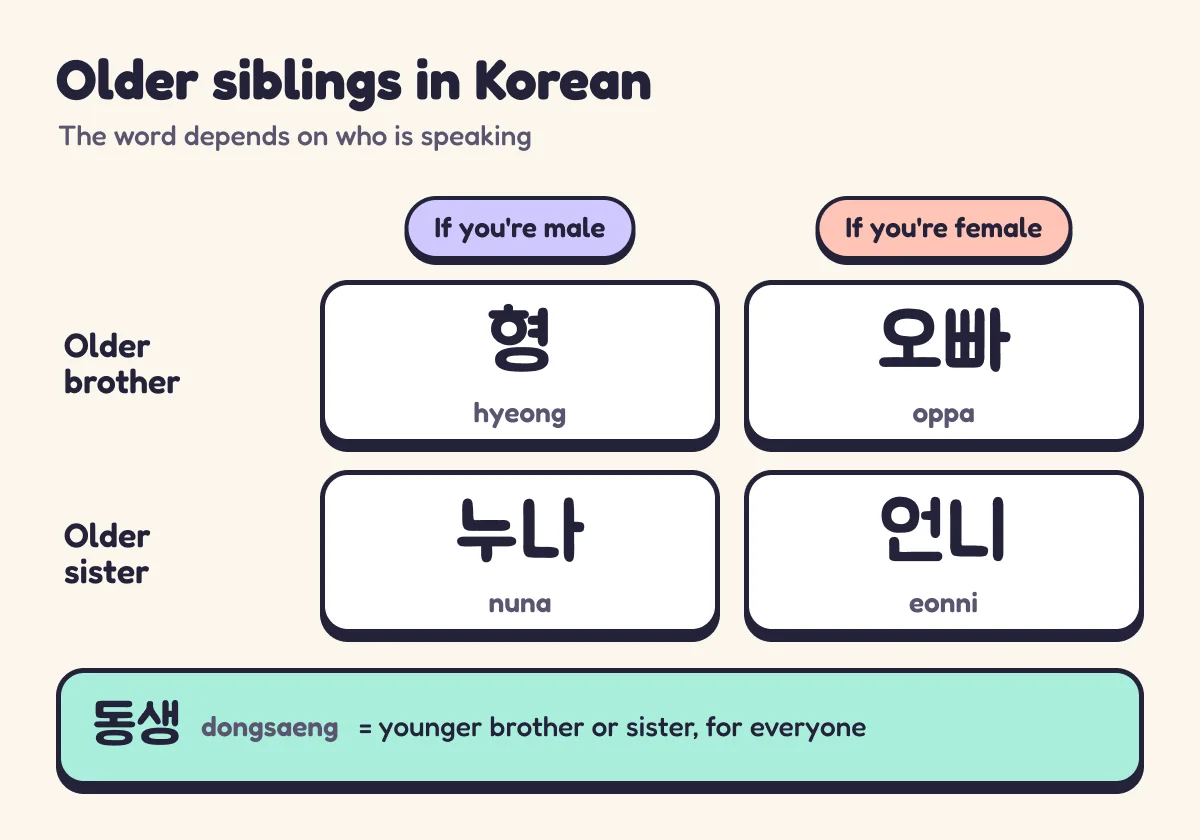
Korean has different words for older siblings depending on whether the speaker is male or female. Koreans also call close friends who are a little older 형, 오빠, 누나, or 언니.
| Korean | Romanization | Meaning | Say it to |
|---|---|---|---|
| 저 | jeo | I, me | Anyone |
| 나 | na | I, me | Close friends |
| 사람 | saram | Person | Anyone |
| 친구 | chingu | Friend | Anyone |
| 가족 | gajok | Family | Anyone |
| 엄마 | eomma | Mom | Family |
| 어머니 | eomeoni | Mother | Anyone |
| 아빠 | appa | Dad | Family |
| 아버지 | abeoji | Father | Anyone |
| 형 | hyeong | Older brother (said by a male) | Family |
| 오빠 | oppa | Older brother (said by a female) | Family |
| 누나 | nuna | Older sister (said by a male) | Family |
| 언니 | eonni | Older sister (said by a female) | Family |
| 동생 | dongsaeng | Younger sibling | Anyone |
Example: 저는 동생이 있어요. (jeoneun dongsaengi isseoyo.) I have a younger sibling.
Want more on 오빠, 언니, and titles like 선배 (seonbae)? Read our Korean honorifics guide. To use these words in a first conversation, see how to introduce yourself in Korean.
Numbers: Korean has two systems
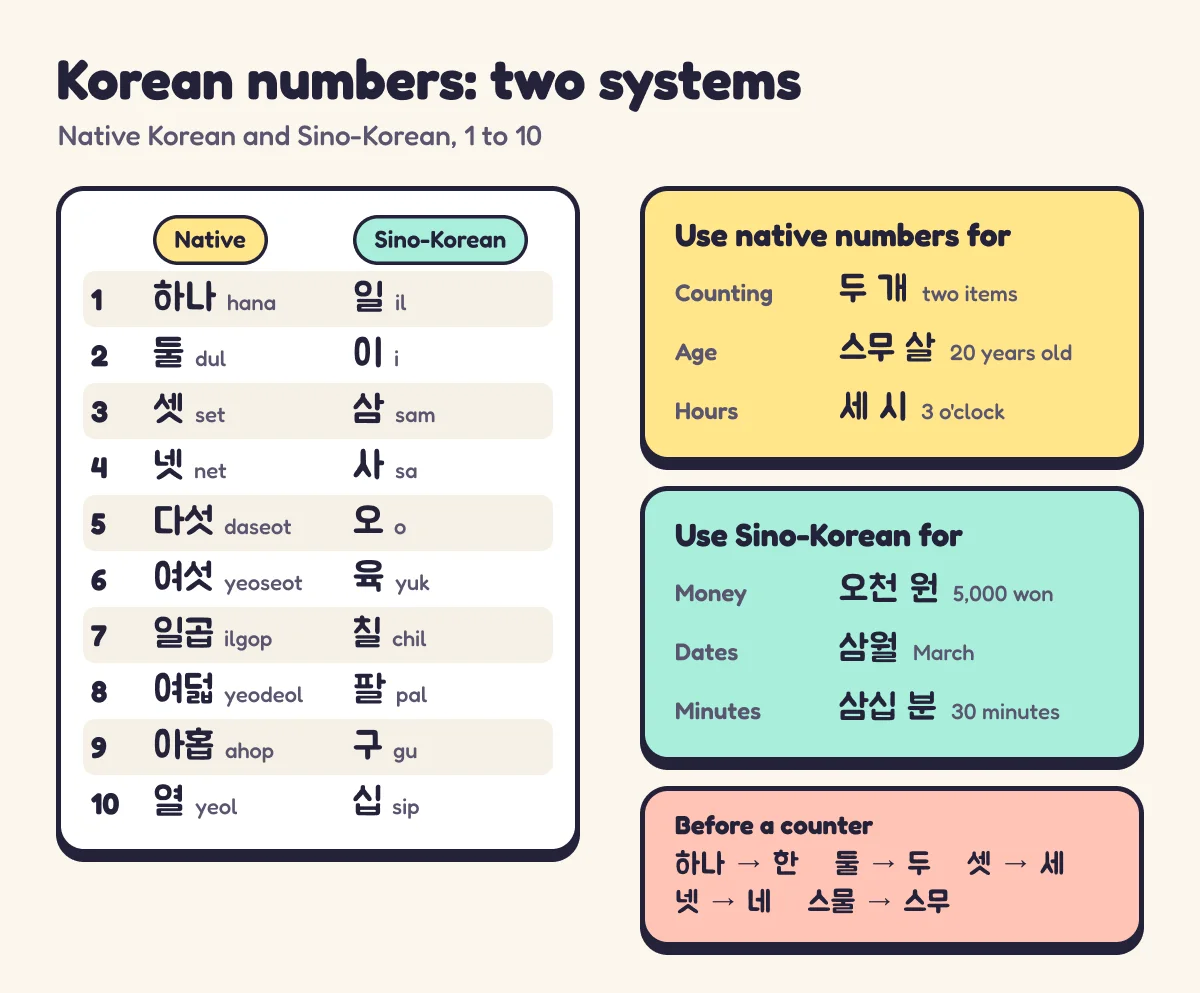
Korean uses two sets of numbers. Native Korean numbers count things, age, and hours. Sino-Korean numbers, which come from Chinese, are for dates, months, minutes, money, and phone numbers.
| Number | Native Korean | Romanization | Sino-Korean | Romanization |
|---|---|---|---|---|
| 1 | 하나 | hana | 일 | il |
| 2 | 둘 | dul | 이 | i |
| 3 | 셋 | set | 삼 | sam |
| 4 | 넷 | net | 사 | sa |
| 5 | 다섯 | daseot | 오 | o |
| 6 | 여섯 | yeoseot | 육 | yuk |
| 7 | 일곱 | ilgop | 칠 | chil |
| 8 | 여덟 | yeodeol | 팔 | pal |
| 9 | 아홉 | ahop | 구 | gu |
| 10 | 열 | yeol | 십 | sip |
| Use | Example | Number system |
|---|---|---|
| Counting things | 두 개 (du gae, two items) | Native |
| Age | 스무 살 (seumu sal, 20 years old) | Native |
| Hours | 세 시 (se si, 3 o'clock) | Native |
| Money | 오천 원 (ocheon won, 5,000 won) | Sino-Korean |
| Dates and months | 삼월 (samwol, March) | Sino-Korean |
| Minutes | 삼십 분 (samsip bun, 30 minutes) | Sino-Korean |
Before a counter word, 하나, 둘, 셋, and 넷 shorten to 한, 두, 세, and 네, and 스물 (20) shortens to 스무. That's why it's 커피 두 잔 (keopi du jan, two cups of coffee), not 둘 잔.
Example: 커피 두 잔 주세요. (keopi du jan juseyo.) Two coffees, please.
For more practice, our native vs. Sino-Korean numbers guide covers bigger numbers and more counters.
Time, days, and months
| Korean | Romanization | Meaning |
|---|---|---|
| 오늘 | oneul | Today |
| 내일 | naeil | Tomorrow |
| 어제 | eoje | Yesterday |
| 지금 | jigeum | Now |
| 아침 | achim | Morning, breakfast |
| 저녁 | jeonyeok | Evening, dinner |
| 시간 | sigan | Time, hours |
Days of the week all end in 요일 (yoil, day of the week).
| Korean | Romanization | Meaning |
|---|---|---|
| 월요일 | woryoil | Monday |
| 화요일 | hwayoil | Tuesday |
| 수요일 | suyoil | Wednesday |
| 목요일 | mogyoil | Thursday |
| 금요일 | geumyoil | Friday |
| 토요일 | toyoil | Saturday |
| 일요일 | iryoil | Sunday |
Months are simple: a Sino-Korean number plus 월 (wol, month). There are two exceptions. June is 유월 (yuwol), not 육월, and October is 시월 (siwol), not 십월.
| Month | Korean | Romanization |
|---|---|---|
| January | 일월 | irwol |
| February | 이월 | iwol |
| March | 삼월 | samwol |
| April | 사월 | sawol |
| May | 오월 | owol |
| June | 유월 | yuwol |
| July | 칠월 | chirwol |
| August | 팔월 | parwol |
| September | 구월 | guwol |
| October | 시월 | siwol |
| November | 십일월 | sibirwol |
| December | 십이월 | sibiwol |
Example: 오늘은 금요일이에요. (oneureun geumyoirieyo.) Today is Friday.
Food and drinks
Add 주세요 (juseyo, please give me) after a food or drink word and you can order in a restaurant or café.
| Korean | Romanization | Meaning |
|---|---|---|
| 물 | mul | Water |
| 밥 | bap | Rice, a meal |
| 커피 | keopi | Coffee |
| 차 | cha | Tea |
| 맥주 | maekju | Beer |
| 고기 | gogi | Meat |
| 김치 | gimchi | Kimchi |
| 빵 | ppang | Bread |
| 과일 | gwail | Fruit |
| 메뉴 | menyu | Menu |
| 주세요 | juseyo | Please give me |
| 맛있어요 | masisseoyo | It's delicious |
Example: 물 주세요. (mul juseyo.) Water, please.
For a full café conversation, see our Korean café phrases.
Places and getting around
| Korean | Romanization | Meaning |
|---|---|---|
| 집 | jip | Home, house |
| 학교 | hakgyo | School |
| 회사 | hoesa | Company, office |
| 화장실 | hwajangsil | Restroom |
| 식당 | sikdang | Restaurant |
| 가게 | gage | Store |
| 병원 | byeongwon | Hospital |
| 역 | yeok | Station |
| 지하철 | jihacheol | Subway |
| 버스 | beoseu | Bus |
Example: 저는 지금 집에 가요. (jeoneun jigeum jibe gayo.) I'm going home now.
Getting around Seoul? Our subway guide shows these words in real situations.
Core verbs
Korean verbs have a dictionary form ending in 다 (da). In conversation you change the ending. The polite present form ending in 요 (yo) is the safest one to learn first, because you can use it with almost anyone.
| Dictionary form | Romanization | Polite present | Romanization | Meaning |
|---|---|---|---|---|
| 하다 | hada | 해요 | haeyo | To do |
| 가다 | gada | 가요 | gayo | To go |
| 오다 | oda | 와요 | wayo | To come |
| 먹다 | meokda | 먹어요 | meogeoyo | To eat |
| 마시다 | masida | 마셔요 | masyeoyo | To drink |
| 보다 | boda | 봐요 | bwayo | To see, to watch |
| 듣다 | deutda | 들어요 | deureoyo | To listen |
| 말하다 | malhada | 말해요 | malhaeyo | To speak |
| 좋아하다 | joahada | 좋아해요 | joahaeyo | To like |
| 알다 | alda | 알아요 | arayo | To know |
| 있다 | itda | 있어요 | isseoyo | To have, there is |
| 없다 | eopda | 없어요 | eopseoyo | Not to have, there isn't |
Example: 저는 한국 드라마를 좋아해요. (jeoneun hanguk deuramareul joahaeyo.) I like Korean dramas.
Core adjectives
Korean adjectives work like verbs. 좋아요 (joayo) on its own already means "It's good."
| Dictionary form | Romanization | Polite present | Romanization | Meaning |
|---|---|---|---|---|
| 좋다 | jota | 좋아요 | joayo | Good |
| 싫다 | silta | 싫어요 | sireoyo | To dislike, not want |
| 크다 | keuda | 커요 | keoyo | Big |
| 작다 | jakda | 작아요 | jagayo | Small |
| 많다 | manta | 많아요 | manayo | Many, a lot |
| 비싸다 | bissada | 비싸요 | bissayo | Expensive |
| 싸다 | ssada | 싸요 | ssayo | Cheap |
| 맛있다 | masitda | 맛있어요 | masisseoyo | Delicious |
| 재미있다 | jaemiitda | 재미있어요 | jaemiisseoyo | Fun, interesting |
| 어렵다 | eoryeopda | 어려워요 | eoryeowoyo | Difficult |
Example: 한국어는 어려워요, 그런데 재미있어요. (hangugeoneun eoryeowoyo, geureonde jaemiisseoyo.) Korean is difficult, but it's fun.
How to remember 100 Korean words in 10 days
Plan on ten to fifteen minutes a day. For each word:
- Tap the word and listen to it.
- Say it out loud two or three times.
- Say the example sentence out loud, then make one sentence of your own.
In memory experiments, people remembered words they read aloud better than words they read silently. Researchers call this the production effect.
| Day | Words | Goal |
|---|---|---|
| 1 | Greetings and polite basics | Say all 13 without looking |
| 2 | Question words | Ask three questions with 어디, 얼마, and 뭐 |
| 3 | People and family | Introduce your family in three sentences |
| 4 | Numbers | Count 1 to 10 both ways, then say your age |
| 5 | Time and days | Say what day it is today and tomorrow |
| 6 | Months | Say your birthday month |
| 7 | Food and drinks | Order two things with 주세요 |
| 8 | Places | Ask where three places are |
| 9 | Verbs and adjectives | Say what you like and what's difficult |
| 10 | Review | Cover the Korean column and say every word from the English |
Say the words out loud with Teuida
Knowing a word and saying it in a conversation are different skills. Teuida is for the second one. Lessons are first-person videos where a tutor talks to you directly and explains a phrase piece by piece. You repeat each line out loud, with Hangul on screen and romanization as a guide, and get a grade for how accurately you said it the way the tutor taught. At the end of the lesson you can review the grades for all your lines together.
Start speaking Korean with Teuida
Sources
- Revised Romanization of Korean: National Institute of Korean Language, Romanization of Korean
- 유월 (June) and 시월 (October): Standard Korean Language Dictionary, 유월, 시월
- Production effect: MacLeod et al. (2010), The production effect: Delineation of a phenomenon, Journal of Experimental Psychology: Learning, Memory, and Cognition


