
Learn how to read Korean in a week. This Hangul alphabet guide covers the 14 consonants, 10 vowels, syllable blocks and batchim, with practice words and tips.
Korean looks like a wall of circles and lines the first time you see it. But it is one of the easiest scripts in the world to learn to read, because it was designed that way. Most of the letters are drawings of how your mouth makes the sound, and once you see that, you stop memorizing shapes and start reading.
This guide walks you through the Korean alphabet, called Hangul (한글), in an order where each step builds on the last: the five basic consonants, the strokes you add to them, the vowels, and how letters stack into syllable blocks. By the end you will be able to sound out words you already know, like 커피 (coffee) and 서울 (Seoul).
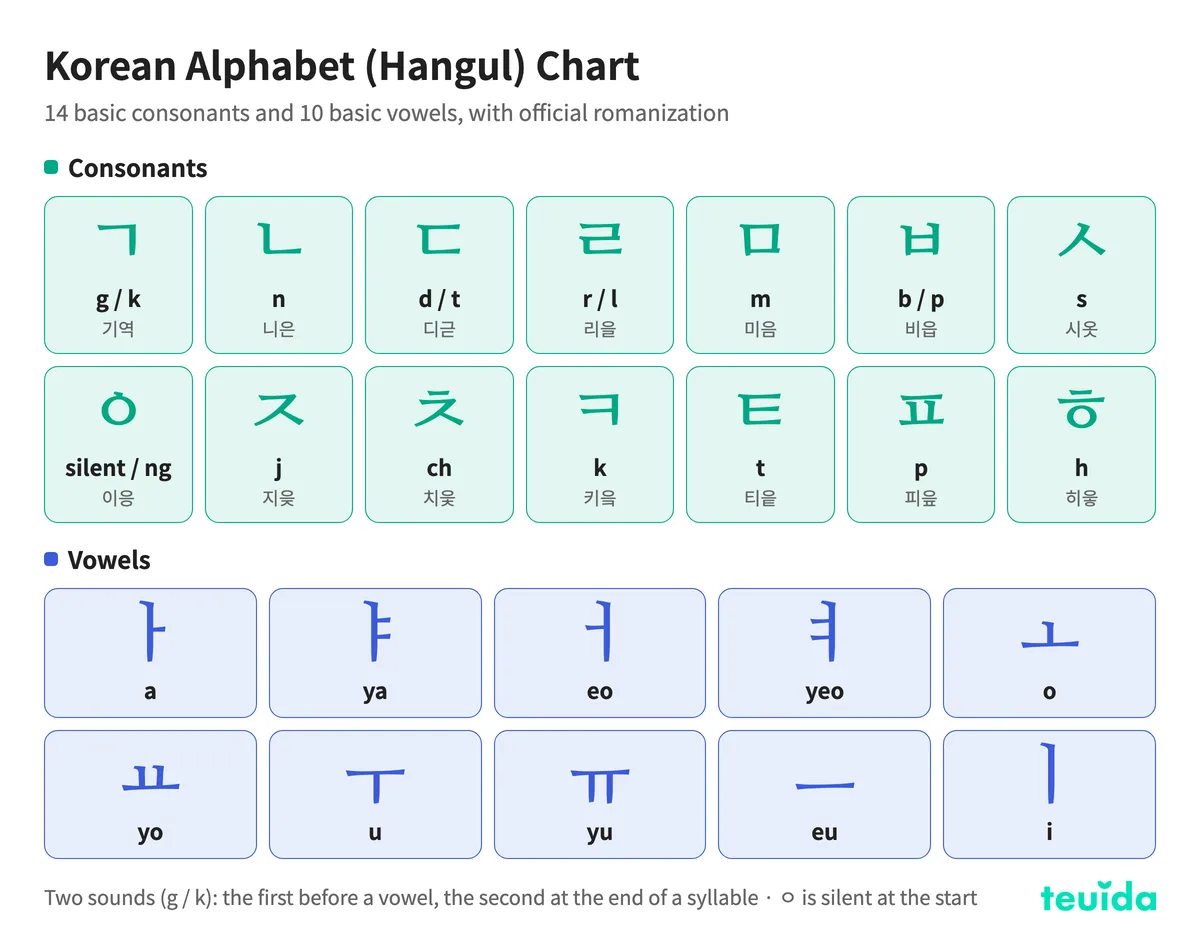
Korean alphabet chart: all 24 basic letters
Here is the whole Korean alphabet on one page: 14 basic consonants and 10 basic vowels, with the official romanization you see on Korean road signs. Consonants with two sounds, like ㄱ (g / k), use the first before a vowel and the second at the end of a syllable. The sections below explain why each letter looks the way it does.
| Consonant | Sound | Vowel | Sound |
|---|---|---|---|
| ㄱ | g / k | ㅏ | a |
| ㄴ | n | ㅑ | ya |
| ㄷ | d / t | ㅓ | eo |
| ㄹ | r / l | ㅕ | yeo |
| ㅁ | m | ㅗ | o |
| ㅂ | b / p | ㅛ | yo |
| ㅅ | s | ㅜ | u |
| ㅇ | silent / ng | ㅠ | yu |
| ㅈ | j | ㅡ | eu |
| ㅊ | ch | ㅣ | i |
| ㅋ | k | ||
| ㅌ | t | ||
| ㅍ | p | ||
| ㅎ | h |
Want to practice writing them? Our Hangul stroke order guide has free printable practice sheets for every letter.
Why Hangul is easy to learn
In the 1400s, Korean was written with Chinese characters. Only a small, educated class could read, because learning thousands of characters took years. King Sejong created a new alphabet in 1443, and in 1446 it was published with an explanation written by his scholars, so that ordinary people could learn to read in days rather than years. South Korea still celebrates this every October 9 on Hangul Day.
Two design choices make it easy:
- Each letter stands for one sound, with a few predictable shifts. Korean is an alphabet like English, not a set of word pictures. There are 14 basic consonants and 10 basic vowels.
- The shapes are logical. Consonants copy the position of your tongue, lips, or throat. Vowels are built from three simple strokes. Related sounds look related.
You will still need practice, especially for sounds English doesn't have. But you are learning a system with rules, which is far easier than memorizing 24 random shapes.
The five basic consonants
Start with five letters. Every other consonant is built from one of them.
| Letter | Name | Sound | What the shape shows |
|---|---|---|---|
| ㄱ | 기역 (giyeok) | g / k | The back of your tongue rising to block your throat |
| ㄴ | 니은 (nieun) | n | The tip of your tongue touching the ridge behind your top teeth |
| ㅁ | 미음 (mieum) | m | Your closed lips (the mouth seen from the front) |
| ㅅ | 시옷 (siot) | s | A tooth, where the hissing sound comes from |
| ㅇ | 이응 (ieung) | ng (or silent) | The open throat |
Say "g" and notice the back of your tongue lifting. Now look at ㄱ: it is that tongue, seen from the side. Say "n" and feel your tongue tip press up behind your teeth. That is ㄴ. These are the original explanations King Sejong's scholars gave, so they are more than memory tricks.
ㅇ has two jobs. At the start of a syllable it is silent and only holds the place where a consonant would go. At the bottom of a syllable it sounds like the "ng" in "sing."
Adding strokes: the other consonants
Korean adds a stroke to a basic letter to make a stronger version of the same sound. A stronger sound usually means more air comes out.
| Basic | Add strokes | Add more | Sound family |
|---|---|---|---|
| ㄱ (g/k) | ㅋ (k, with a puff of air) | Back of the tongue | |
| ㄴ (n) | ㄷ (d/t) | ㅌ (t, with a puff of air) | Tip of the tongue |
| ㅁ (m) | ㅂ (b/p) | ㅍ (p, with a puff of air) | Lips |
| ㅅ (s) | ㅈ (j) | ㅊ (ch, with a puff of air) | Teeth |
| ㅇ (silent/ng) | ㅎ (h) | Throat |
That covers 13 consonants. The 14th is ㄹ, which sits in the tongue-tip family with ㄴ, ㄷ, and ㅌ. It sounds like a light "r" between vowels and like "l" at the end of a syllable. Compare 노래 (norae, song), where it is an "r," with 서울 (Seoul), where it is an "l."
Every consonant also has a name, which you will hear when Koreans spell a word out loud. The names of the letters above are ㅋ 키읔 (kieuk), ㄷ 디귿 (digeut), ㅌ 티읕 (tieut), ㅂ 비읍 (bieup), ㅍ 피읖 (pieup), ㅈ 지읒 (jieut), ㅊ 치읓 (chieut), ㅎ 히읗 (hieut), and ㄹ 리을 (rieul). Most names follow one pattern: the letter with ㅣ, then 으 with the letter as its final consonant, like 니 + 은 = 니은 for ㄴ. ㄱ, ㄷ, and ㅅ are the exceptions.
Hold your hand in front of your mouth and say ㄱ, then ㅋ. You should feel a strong puff of air on ㅋ and much less on ㄱ. Korean uses that puff to tell words apart, so it is worth practicing early.
A note on g/k, d/t, b/p, and j
At the start of a word, ㄱ, ㄷ, ㅂ, and ㅈ sound closer to k, t, p, and ch, but without the strong puff of air. Between vowels they sound closer to g, d, b, and j. That is why you see 김치 written as "kimchi" on menus but as "gimchi" in the official romanization. Both spellings point at the same sound, which sits between the English g and k. Listen to native audio rather than trusting either spelling.
The vowels: heaven, earth, and person
All Korean vowels are made from three strokes:
- a dot for heaven (today written as a short stroke)
- a flat line ㅡ for the earth
- a standing line ㅣ for a person
Put a short stroke on the side of ㅣ or above or below ㅡ, and you get a new vowel. Double the short stroke, and you add a "y" sound in front.
| Vowel | Sound | Like the English... | With an extra stroke | Sound |
|---|---|---|---|---|
| ㅏ | a | "a" in father | ㅑ | ya |
| ㅓ | eo | "u" in up, with your jaw a little lower | ㅕ | yeo |
| ㅗ | o | "o" in go, without the "w" at the end | ㅛ | yo |
| ㅜ | u | "oo" in moon | ㅠ | yu |
| ㅡ | eu | "oo" in good, with your lips spread flat | ||
| ㅣ | i | "ee" in see |
The short stroke points right on ㅏ and left on ㅓ, up on ㅗ and down on ㅜ. If you can tell those four apart by the direction of the stroke, you have half the vowels already.
ㅓ and ㅡ are the two sounds English speakers find hardest, because English has no exact match. Spend extra time on them, saying 어 and 으 out loud while watching your lips in a mirror. For 어 your mouth is open and relaxed. For 으 your lips stay flat, as if you were about to smile.
How letters stack into syllable blocks
Korean doesn't write letters in a single line like English. It groups them into blocks, and each block is one syllable. Every block starts with a consonant and has a vowel.
Rule 1: tall vowels go on the right. If the vowel is built on the standing line (ㅏ ㅑ ㅓ ㅕ ㅣ), the consonant sits to its left.
- ㄴ + ㅏ = 나 (na)
- ㅁ + ㅓ = 머 (meo)
Rule 2: flat vowels go underneath. If the vowel is built on the flat line (ㅗ ㅛ ㅜ ㅠ ㅡ), the consonant sits on top.
- ㄴ + ㅗ = 노 (no)
- ㅁ + ㅜ = 무 (mu)
Rule 3: a syllable that starts with a vowel uses ㅇ. Since every block needs a consonant at the start, the silent ㅇ fills the spot.
- ㅇ + ㅏ = 아 (a)
- ㅇ + ㅜ = 우 (u)
Rule 4: a final consonant goes at the bottom. This bottom consonant is called 받침 (batchim).
- ㄴ + ㅜ + ㄴ = 눈 (nun, "eye" or "snow")
- ㅅ + ㅏ + ㄹ = 살 (sal, flesh, or a year of age)
Read a block top to bottom and left to right, the same order you would read a short English word. 한 is ㅎ + ㅏ + ㄴ: "han." 글 is ㄱ + ㅡ + ㄹ: "geul." Put them together and you have just read 한글.
Final consonants (batchim) in one table
A consonant at the bottom of a block is pronounced shorter than at the top. Your mouth moves into position and stops without releasing the sound. Many letters share the same sound at the bottom, so there are only seven final sounds to learn. The table also lists ㄲ and ㅆ, double consonants you will meet in the next section.
| Final sound | Letters that make it | Example |
|---|---|---|
| k | ㄱ ㅋ ㄲ | 책 (chaek, book) |
| n | ㄴ | 산 (san, mountain) |
| t | ㄷ ㅌ ㅅ ㅆ ㅈ ㅊ ㅎ | 옷 (ot, clothes) |
| l | ㄹ | 물 (mul, water) |
| m | ㅁ | 밤 (bam, night) |
| p | ㅂ ㅍ | 밥 (bap, rice or a meal) |
| ng | ㅇ | 방 (bang, room) |
When the next syllable starts with ㅇ, the final consonant usually slides over and is pronounced at the start of the next syllable. 음악 (music) is read "eu-mak," and 한국어 (the Korean language) is read "han-gu-geo." This is one of the main reasons words sound different from how they look. Our guide to batchim covers the rules in more detail.
Double consonants and combined vowels
Once the basics feel comfortable, you will meet two more groups. At first it is enough to recognize them when you see them.
Five double consonants. Writing a consonant twice makes it tense: you tighten your throat and release the sound with no puff of air. Each one's name starts with 쌍 (ssang, double).
| Letter | Name | Sound | Example |
|---|---|---|---|
| ㄲ | 쌍기역 (ssang-giyeok) | kk | 꿈 (kkum, dream) |
| ㄸ | 쌍디귿 (ssang-digeut) | tt | 떡 (tteok, rice cake) |
| ㅃ | 쌍비읍 (ssang-bieup) | pp | 빵 (ppang, bread) |
| ㅆ | 쌍시옷 (ssang-siot) | ss | 싸요 (ssayo, it's cheap) |
| ㅉ | 쌍지읒 (ssang-jieut) | jj | 짜요 (jjayo, it's salty) |
Compare 불 (bul, fire), 풀 (pul, grass), and 뿔 (ppul, horn). The only difference is how much air and tension go into the first sound, and they are three different words.
Eleven combined vowels. Each one is written by combining basic vowels you already know, usually two of them. Some, like ㅘ (wa), sound like two vowels said quickly together. Others, like ㅐ and ㅔ, are single sounds.
| Vowel | Sound | Vowel | Sound |
|---|---|---|---|
| ㅐ | ae | ㅘ | wa |
| ㅔ | e | ㅙ | wae |
| ㅒ | yae | ㅚ | oe |
| ㅖ | ye | ㅝ | wo |
| ㅢ | ui | ㅞ | we |
| ㅟ | wi |
In everyday Seoul speech, ㅐ and ㅔ sound almost the same, and so do ㅙ, ㅚ, and ㅞ. You need to know which one a word uses when you spell it, but you won't be misunderstood if you pronounce them the same way.
Practice: read words you already know
Start with words you may already know. Many are borrowed from English, and the rest are Korean words that have traveled abroad. Sound out each block, then say the whole word at normal speed.
| Korean | Sound it out | Meaning |
|---|---|---|
| 커피 | keo-pi | coffee |
| 카페 | ka-pe | café |
| 피자 | pi-ja | pizza |
| 버스 | beo-seu | bus |
| 택시 | taek-si | taxi |
| 아이스 아메리카노 | a-i-seu a-me-ri-ka-no | iced americano |
| 서울 | seo-ul | Seoul |
| 김치 | gim-chi | kimchi |
| 라면 | ra-myeon | ramen |
| 사랑 | sa-rang | love |
Look at 버스 and 아이스. English "bus" ends in a consonant, but Korean adds the vowel ㅡ so the "s" can stand in its own block. You will see this a lot in borrowed words.
Watch out for ㅅ before ㅣ: it sounds like "sh," so 시 is "shi" and 택시 sounds like "taek-shi."
Next, find Korean on things around you: song titles, the opening credits of a K-drama, the menu of a Korean restaurant. Reading even one word a day helps the letters stick.
Common mistakes beginners make
Learning through romanization. Romanized spelling helps on day one, but it hides real differences. "eo" and "o" look similar in English letters and are different sounds in Korean. Move to reading Hangul directly as soon as you can.
Mixing up ㅓ and ㅗ. Check which side the short stroke is on. ㅗ has it on top and needs rounded lips. ㅓ points left and needs a relaxed, open mouth.
Forgetting that ㅇ is silent at the start. 아 is "a," not "nga." The ㅇ only sounds like "ng" when it is at the bottom.
Reading letter by letter. Train your eyes to take in a whole block as one syllable. 한 is one beat, "han," not three separate sounds.
Skipping the puff of air. ㅂ, ㅍ, and ㅃ are three different sounds. If you say them all like the English "p," words like 불, 풀, and 뿔 will sound the same. The same goes for ㄱ, ㅋ, and ㄲ.
A one-week plan
You don't need long study sessions. Twenty to thirty minutes a day is enough to finish the alphabet in a week.
| Day | Learn | Practice |
|---|---|---|
| 1 | The five basic consonants and why they look the way they do | Write each one five times while saying its sound |
| 2 | The added-stroke consonants and ㄹ | Say ㄱ / ㅋ with your hand in front of your mouth |
| 3 | The ten basic vowels | Read 가 to 기 across every vowel |
| 4 | Syllable blocks, rules 1 to 3 | Build 20 blocks from letters you know |
| 5 | Final consonants | Read 책, 산, 옷, 물, 밤, 밥, 방 |
| 6 | Double consonants and combined vowels | Read 꿈, 떡, 빵, then the practice word table |
| 7 | Review | Read a song title or menu and say it out loud |
Say everything out loud. Reading silently teaches your eyes the shapes, but your mouth needs practice too.
For the writing practice on days 1 to 3, our Hangul stroke order guide shows the order of every stroke and has free printable practice sheets.
Say it out loud with Teuida
Once you can read Hangul, the next goal is saying full sentences clearly enough that a Korean speaker understands you the first time. Teuida lessons are first-person videos where a tutor talks to you directly. The tutor breaks a phrase like 안녕하세요 into parts, explains what 안녕 and 하세요 mean, and has you say each one, with Hangul on screen and romanization such as "annyeong" as a guide while you are starting out. Each time you say a line, you get a grade for how accurately you said it the way the tutor taught, and at the end of the lesson you can review the grades for all your lines together.
To see which other apps help with vocabulary, grammar and listening alongside Teuida, read our guide to the best apps to learn Korean.
Sources
- Memory of the World Register nomination form: Hunmin Chongum (National Treasure No. 70), UNESCO
- Romanization of Korean, National Institute of Korean Language
- Standard Language Regulations, Part 2: Standard Pronunciation (표준어 규정 제2부 표준 발음법), Article 8, National Institute of Korean Language


