
Learn how to write in Korean: stroke order for all 24 Hangul letters, how syllable blocks fit together, and free printable practice sheets (PDF).
To write in Korean, you write Hangul (한글, officially romanized as Hangeul), the Korean alphabet. It has 14 basic consonants and 10 basic vowels, and you combine them into square syllable blocks, one block per syllable. Most of the stroke order comes down to two rules: top to bottom, and left to right. This guide shows the stroke order for all 24 basic letters and how they fit into a block.
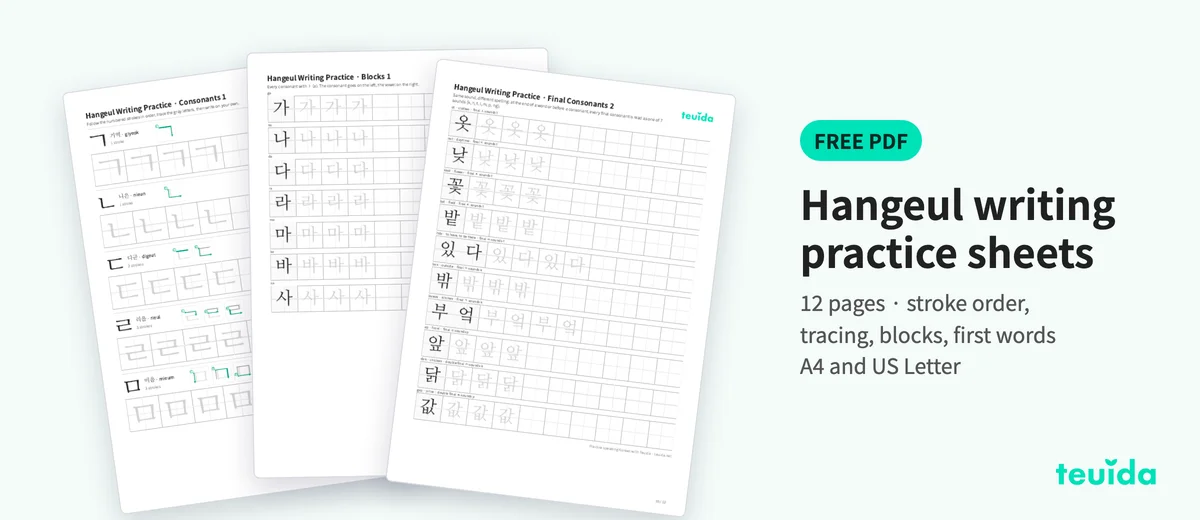
Free Hangul writing practice sheets (PDF, 12 pages)
Stroke diagrams and tracing boxes for every basic letter, syllable blocks, 10 first words, and a blank grid.
Before you write: learn to read the letters
Writing goes faster when you already know what each letter sounds like, because you can say the sound while your hand makes the shape. If Hangul is completely new to you, spend a day with our Hangul reading guide first. It explains why the letters look the way they do, which also makes them easier to draw.
How to write in Korean: stroke order rules
Korean writing for beginners comes down to 24 basic shapes, each with one to four strokes, which makes it much simpler than Chinese or Japanese. The two main rules, plus two details, cover almost every letter:
- Top to bottom. Vertical strokes go down. When a letter has strokes stacked on top of each other, write the top one first.
- Left to right. Horizontal strokes go to the right. When strokes sit side by side, write the left one first.
- A corner is one stroke. ㄱ and ㄴ each have a bend, but you draw each one without lifting your pen.
- Circles start at the top. ㅇ is one stroke that starts at the top and goes counterclockwise (to the left) in one motion.
How to write Korean consonants
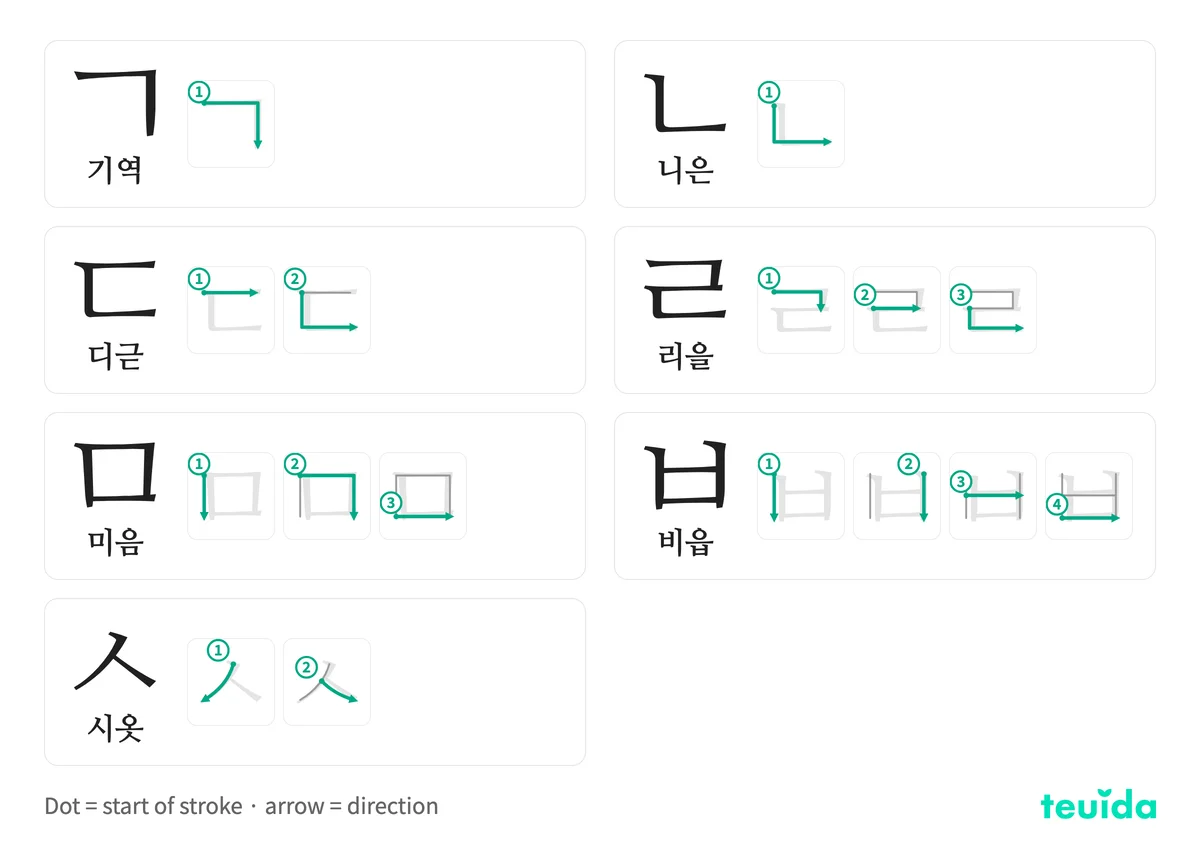
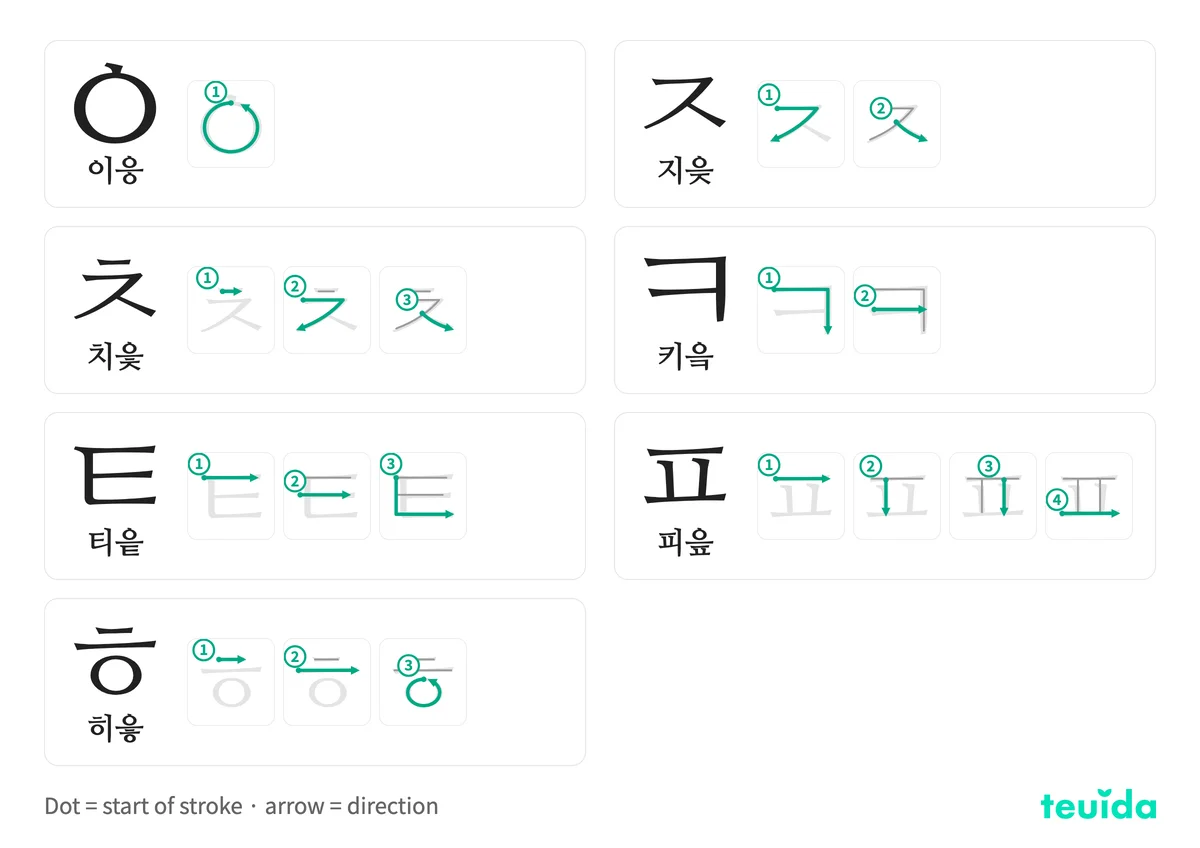
Here are the 14 basic consonants with their names and stroke counts. In the diagrams, the numbered dot shows where each stroke starts, and the arrow shows its direction.
| Letter | Name | Strokes | Stroke order |
|---|---|---|---|
| ㄱ | 기역 (giyeok) | 1 | Across, then bend down |
| ㄴ | 니은 (nieun) | 1 | Down, then bend right |
| ㄷ | 디귿 (digeut) | 2 | ① Top line ② ㄴ shape |
| ㄹ | 리을 (rieul) | 3 | ① ㄱ shape ② Middle line ③ ㄴ shape |
| ㅁ | 미음 (mieum) | 3 | ① Left side down ② Top and right side (ㄱ shape) ③ Bottom line |
| ㅂ | 비읍 (bieup) | 4 | ① Left side ② Right side ③ Middle line ④ Bottom line |
| ㅅ | 시옷 (siot) | 2 | ① Sweep down to the left ② Sweep down to the right, starting from the middle of the first stroke |
| ㅇ | 이응 (ieung) | 1 | One circle, starting at the top and going counterclockwise |
| ㅈ | 지읒 (jieut) | 2 | ① Across, then sweep down to the left ② Sweep down to the right |
| ㅊ | 치읓 (chieut) | 3 | ① Short line on top ② Across, then sweep down to the left ③ Sweep down to the right |
| ㅋ | 키읔 (kieuk) | 2 | ① ㄱ shape ② Middle line |
| ㅌ | 티읕 (tieut) | 3 | ① Top line ② Middle line ③ ㄴ shape |
| ㅍ | 피읖 (pieup) | 4 | ① Top line ② Left inner line ③ Right inner line ④ Bottom line |
| ㅎ | 히읗 (hieut) | 3 | ① Short line on top ② Longer line across ③ Circle |
How many strokes is ㅈ? Charts usually count 3, with the top line written separately from the ㅅ below it. In everyday handwriting, many Koreans join the top line and the left sweep into one stroke, which makes it 2. Our diagrams show the 2-stroke form. Both are fine; just keep one form.
You can learn the consonants faster in families, because related sounds share a shape:
- ㄱ and ㅋ: ㅋ is ㄱ with one extra line in the middle.
- ㄴ, ㄷ, ㅌ, and ㄹ: ㄷ adds a top line to ㄴ, and ㅌ adds a middle line to ㄷ. ㄹ is ㄱ, a middle line, and ㄴ stacked together.
- ㅁ, ㅂ, and ㅍ: all three are built from vertical and horizontal lines. Write them in the order shown, finishing with the bottom line.
- ㅅ, ㅈ, and ㅊ: ㅈ adds a top line to ㅅ, and ㅊ adds a short stroke above ㅈ.
- ㅇ and ㅎ: ㅎ is ㅇ with a short stroke and a line on top.
The extra strokes follow the top-to-bottom rule. When the extra stroke sits on top (ㄷ, ㅈ, ㅊ, ㅎ), you write it first. When it sits in the middle (ㅋ, ㅌ), it comes after the line above it.
How to write Korean vowels
Most basic vowels are a long line plus one or two short strokes; ㅡ and ㅣ are a single line. The long line decides where the vowel goes in a syllable block, so it helps to sort the vowels into two groups.
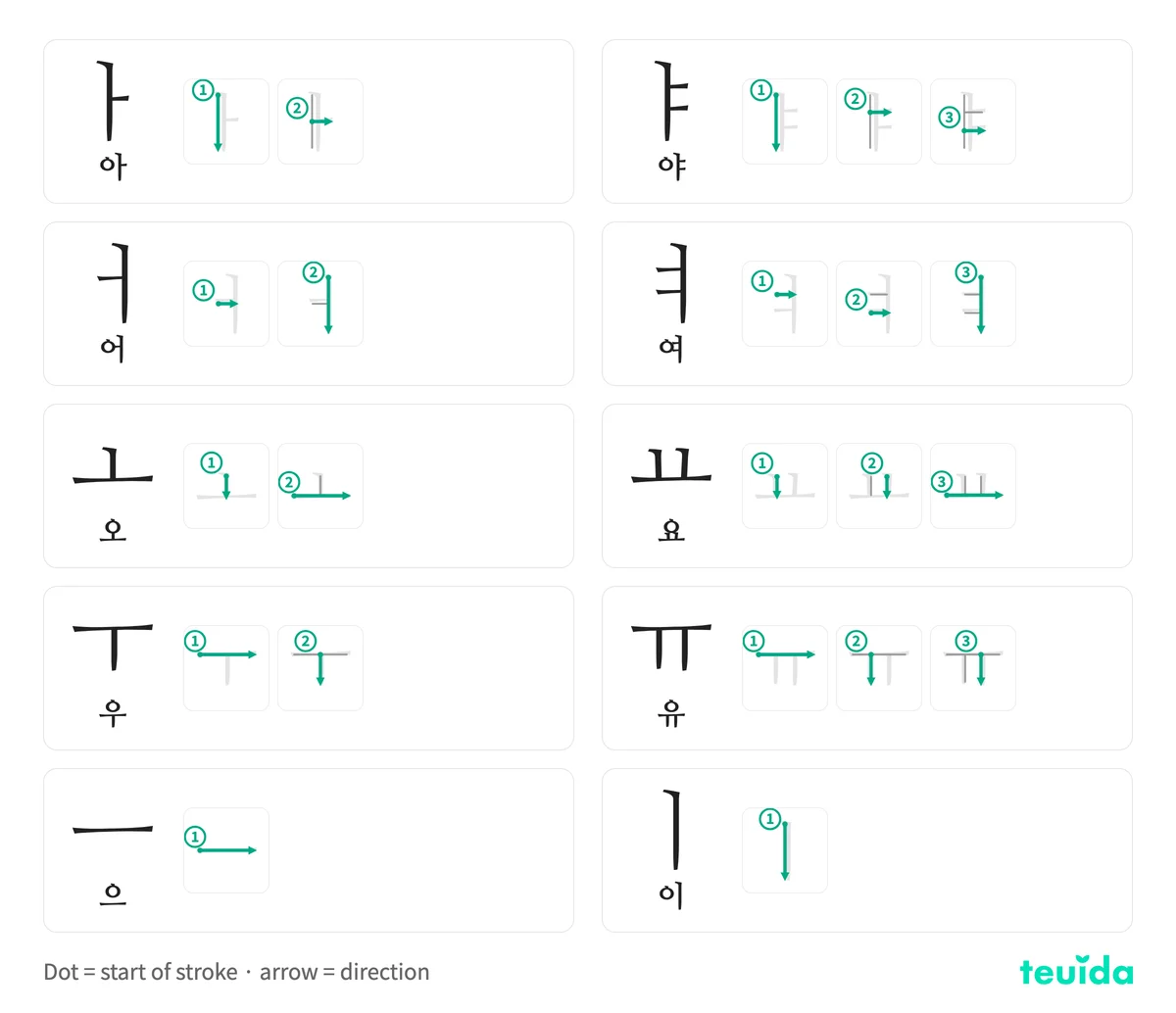
Vertical vowels have a long vertical line. They sit to the right of the consonant.
| Vowel | Sound | Strokes | Stroke order |
|---|---|---|---|
| ㅏ | a | 2 | ① Long line down ② Short stroke to the right |
| ㅑ | ya | 3 | ① Long line down ②③ Two short strokes, top one first |
| ㅓ | eo | 2 | ① Short stroke on the left ② Long line down |
| ㅕ | yeo | 3 | ①② Two short strokes, top one first ③ Long line down |
| ㅣ | i | 1 | One line down |
Horizontal vowels have a long horizontal line. They sit below the consonant.
| Vowel | Sound | Strokes | Stroke order |
|---|---|---|---|
| ㅗ | o | 2 | ① Short stroke down ② Long line across |
| ㅛ | yo | 3 | ①② Two short strokes, left one first ③ Long line across |
| ㅜ | u | 2 | ① Long line across ② Short stroke down |
| ㅠ | yu | 3 | ① Long line across ②③ Two short strokes, left one first |
| ㅡ | eu | 1 | One line across |
The pattern is the same as the consonants: whatever is on the left or on top comes first. In ㅓ, the short stroke is on the left, so you write it before the long line. In ㅏ, it is on the right, so it comes second.
How to write syllable blocks
Korean groups the letters of each syllable into a block, and every block takes up about the same square space. Inside a block you write in this order: first consonant, vowel, then the final consonant if there is one.
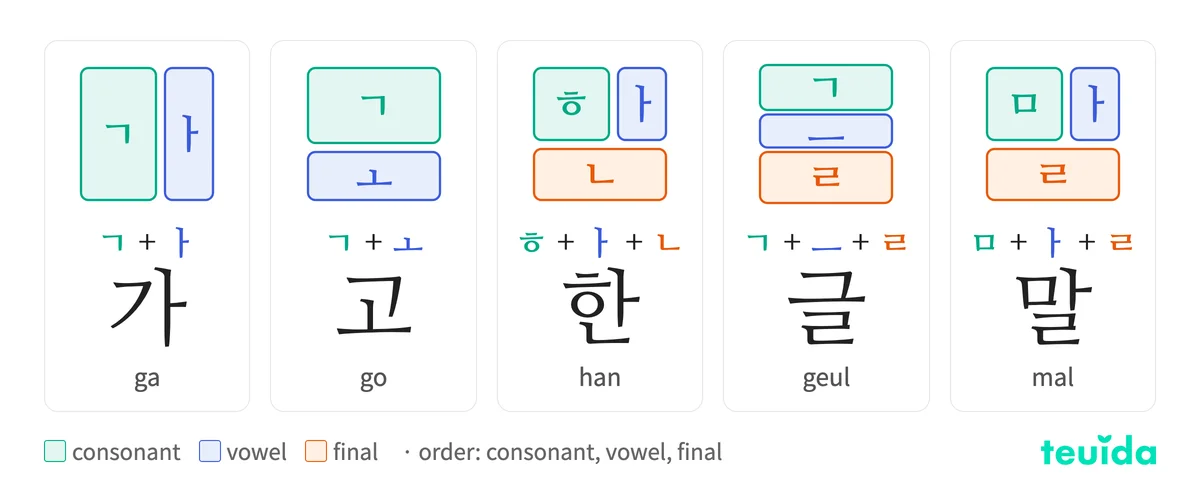
| Block | Letters | Layout |
|---|---|---|
| 가 (ga) | ㄱ + ㅏ | Consonant on the left, vertical vowel on the right |
| 고 (go) | ㄱ + ㅗ | Consonant on top, horizontal vowel below |
| 한 (han) | ㅎ + ㅏ + ㄴ | Consonant and vertical vowel on top, final consonant below |
| 글 (geul) | ㄱ + ㅡ + ㄹ | Consonant, horizontal vowel, final consonant stacked |
| 말 (mal) | ㅁ + ㅏ + ㄹ | Same as 한 |
A few things to know when you build blocks:
- Every block starts with a consonant. If a syllable starts with a vowel sound, you write ㅇ as a silent placeholder. That's why "a" is written 아 (a), not ㅏ alone.
- Letters change size, and sometimes shape. The stroke order never changes, but ㄱ in 가 is narrow and its downstroke slants to the lower left, while ㄱ in 고 is short and wide and drops straight down.
- The final consonant goes at the bottom. Korean calls it 받침 (batchim). Two different consonants can sit there together, as in 읽 (ik, the root of "to read"), but most blocks have one or none. Our batchim guide explains how final consonants change pronunciation.
Write 한글 now: ㅎ, ㅏ, ㄴ for the first block, then ㄱ, ㅡ, ㄹ for the second, keeping the two blocks the same size. You just wrote the name of the alphabet.
Korean handwriting vs fonts
Printed Korean comes in many fonts, and some letters look different in print from how people write them by hand.
- Our diagrams: they use a serif style called 명조 (myeongjo), like many Korean handwriting workbooks. Copy the stroke order and proportions. You can skip small serif details, such as the tiny mark on top of ㅇ, and write a plain circle.
- ㅈ and ㅊ: some fonts draw ㅈ like a ㅅ with a separate line on top, which is the 3-stroke form mentioned above. Copying either form is fine.
- The short top stroke of ㅊ and ㅎ: depending on the font, it can be a short vertical stroke, a slanted one, or a short horizontal line. All of them are correct. Our diagrams use a short horizontal line. Pick one form and stay consistent.
- Size inside a block: fonts make every block exactly the same size. In handwriting, aim for blocks that are roughly even. Small differences are normal.
Double consonants and combined vowels
Once you know the 24 basic letters, the rest are combinations.
- Double consonants (ㄲ, ㄸ, ㅃ, ㅆ, ㅉ): write the same consonant twice, side by side and a little narrower, each with its usual stroke order. The left one comes first.
- Combined vowels (ㅐ, ㅔ, ㅘ, ㅝ, ㅢ, and others): write the vowels they are built from, in left-to-right, top-to-bottom order. ㅐ is ㅏ followed by ㅣ. ㅘ is ㅗ followed by ㅏ, so in a block like 과 (gwa) the vowel wraps around the bottom and right of the consonant.
Writing words, sentences, and your name
Spaces go between words, not between syllables. Korean word spacing (띄어쓰기, ttuieosseugi) works like English, but a word can be several blocks long, and small grammar words called particles attach to the word before them without a space. For example:
- 저는 학생이에요. (Jeoneun haksaengieyo.) "I am a student."
Here 저 (jeo, I) and the particle 는 (neun) are written together as 저는, and 학생이에요 (haksaengieyo, am a student) is one unit. When you are starting out, copy the spacing from example sentences rather than guessing.
Your name in Korean is an approximation. Korean doesn't have every English sound, so names are written with the closest Korean sounds. There is no "f" or "v," for example. Korea's official loanword rules spell names by pronunciation, but people often use other spellings in practice:
| English name | Official spelling | Also common | Sounded out |
|---|---|---|---|
| Emma | 에마 | 엠마 | e-ma / em-ma |
| Michael | 마이클 | ma-i-keul | |
| Sarah | 세라 | 사라 | se-ra / sa-ra |
If you search "how to write [word] in Korean," you will usually get one of two things: the Korean word with the same meaning (water is 물, mul), or the English word spelled in Hangul. Both are useful, so check which one you need.
For numbers, Korean uses the same digits as English (1, 2, 3) in everyday writing. Learning how to say them is the harder part: see our guide to native and Sino-Korean numbers.
Typing Korean on your phone and computer
Most Korean you write day to day will be typed. Phones and computers already include a Korean keyboard; you only need to turn it on and pick the 2-set layout (두벌식, dubeolsik).
- iPhone: Settings > General > Keyboard > Keyboards > Add New Keyboard > Korean, then choose Standard (the 2-set layout).
- Android (Gboard): Gboard settings > Languages > Add keyboard > Korean, then choose the 2-set (QWERTY-style) layout rather than 천지인 (cheonjiin). Samsung Keyboard and other Android keyboards use different menus.
- Mac: System Settings > Keyboard > Text Input > Edit > + > Korean > 2-Set Korean.
- Windows 11: Settings > Time & language > Language & region > Add a language > Korean. Switch keyboards with Windows key + Space, then press Right Alt (the 한/영 key) to toggle between English and Hangul.
These steps follow each company's official help pages as of November 2026; menu names can change with updates.
The 2-set layout puts consonants on the left half of the keyboard and vowels on the right. You type letters in writing order (consonant, vowel, final consonant), and the keyboard assembles the blocks for you. Hold Shift for double consonants like ㄲ and ㅆ.
How to practice Korean handwriting: a 7-day plan
Spend 10 to 15 minutes a day. Say every letter or block out loud while you write it.
| Day | Practice sheet | Goal |
|---|---|---|
| 1 | Consonants 1 (ㄱ to ㅁ) | Fill each row: 4 traced, 4 on your own, saying the name |
| 2 | Consonants 2 (ㅂ to ㅊ) | Same, plus review day 1 from memory |
| 3 | Consonants 3 (ㅋ to ㅎ) | Write all 14 consonants from memory, then check |
| 4 | Vowels 1 (ㅏ to ㅗ) | Write each vowel, then pair it with ㅇ: 아 (a), 야 (ya), 어 (eo), 여 (yeo), 오 (o) |
| 5 | Vowels 2 (ㅛ to ㅣ) | Same: 요 (yo), 우 (u), 유 (yu), 으 (eu), 이 (i) |
| 6 | Blocks 1 to 3 | Write 가 (ga) to 하 (ha), then ㄱ with every vowel |
| 7 | Final consonants 1 and 2, First words, Blank grid | Do the two final-consonant pages, then 10 words like 한국 (Hanguk, Korea) and 커피 (keopi, coffee), then your name |
If you want to see how writing fits with reading and speaking, read Speaking, reading, or writing Korean: what's easiest? or follow our 30-day beginner roadmap.
You can write it, now say it
Writing and speaking are separate skills. You can write 안녕하세요 (annyeonghaseyo, hello) perfectly and still freeze when you need to say it to someone. Teuida is for the speaking part. Lessons are first-person videos where a tutor talks to you directly and explains a phrase piece by piece. You repeat each line out loud, with Hangul on screen and romanization as a guide, and get a grade for how accurately you said it the way the tutor taught. At the end of the lesson you can review the grades for all your lines together.
Start speaking Korean with Teuida
Sources
- Stroke order: 글씨방, 한글 쓰기 순서
- Direction of ㅇ and the short top line of ㅊ and ㅎ: 90 Day Korean, Hangul stroke order
- Stroke count of ㅈ (3 in charts, 2 in everyday handwriting): 나무위키, ㅈ
- Windows Korean keyboard and the Right Alt toggle: Microsoft Learn, Korean IME
- Android: Gboard Help, add a language
- Mac: Apple Support, write in another language on your Mac
- iPhone: Apple Support, add or change keyboards on iPhone


