
Turn K-pop lyrics into real Korean speaking: which lines sound natural, how sung and spoken Korean differ, polite forms like 보고 싶어요, and a 6-step routine.
You already know the feeling. The chorus hits, you belt out the Korean part perfectly, and you don't understand a single word you just sang. You can mimic the sound flawlessly, but if a Korean person said that same line to you on the street, you'd freeze.
That gap is frustrating — but it's also a goldmine. You're already memorizing Korean every time you replay your favorite track. The trick is turning that passive singalong into real, usable speaking. Let's do exactly that.
Why K-Pop Lyrics Are Actually Great for Speaking
Here's the thing most people miss: you learn song lyrics without even trying. Your brain locks onto melody, repeats it hundreds of times, and stores whole phrases as single chunks. That's precisely how fluent speakers store language — in chunks, not isolated words.
So K-pop gives you something textbooks can't: emotional repetition. You want to say the line again. You already have the rhythm and the sounds in your mouth.
The catch is that lyrics are stylized. They're poetry, not everyday chat. Some lines are pure gold for real conversation, and some will make a native speaker tilt their head. The skill is knowing which is which — and that's what we'll build here.
What You Can and Can't Steal Straight From a Song
Not every lyric transfers to real life. Songs drop particles for rhythm, use dramatic or old-fashioned phrasing, and lean on metaphors nobody says out loud. But plenty of lines are completely natural — those are the ones to mine.
Here's a quick way to sort what you hear:
| Lyric type | Example feel | Use it in real speech? |
|---|---|---|
| Everyday phrases | 보고 싶어 (bogo sipeo), "I miss you" | Yes — exactly as sung |
| Dropped-particle lines | 나 너 좋아 (na neo joa), "I like you" | Mostly — add 를/을 in careful speech |
| Dramatic / poetic | 내 심장을 가져가 (nae simjangeul gajyeoga), "take my heart" | Rarely — it's a metaphor |
| Slang / casual endings | 괜찮아 (gwaenchana), "it's okay" | Yes — super common |
| Old or literary forms | 그대 (geudae), "you (poetic)" | No — use 너 or 당신 instead |
The sweet spot is the everyday phrases and casual slang. Those are real Korean people genuinely say, delivered by singers with clear emotion — perfect models to copy out loud.
Common Mistakes Learners Make With Lyrics
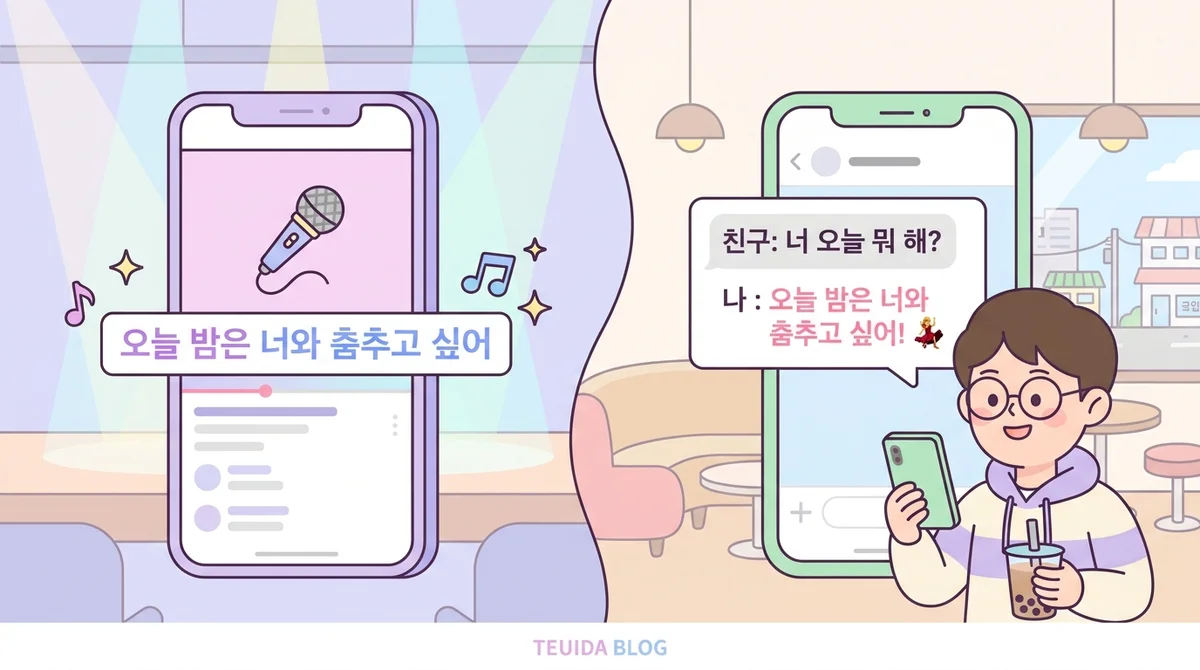
Singing the romanization, not the Korean. If you only ever read "saranghae," you never learn to read 사랑해 (saranghae), "I love you." Always pull up the Hangul and match the sounds to the letters. That's how the pronunciation actually sticks.
Copying the melody's pronunciation. Singers stretch vowels and shift stress to fit the beat. 좋아 might be sung as "jo-OH-ah" over three notes, but spoken it's a quick, flat 좋아 (joa). If you only know the sung version, your spoken Korean sounds strange.
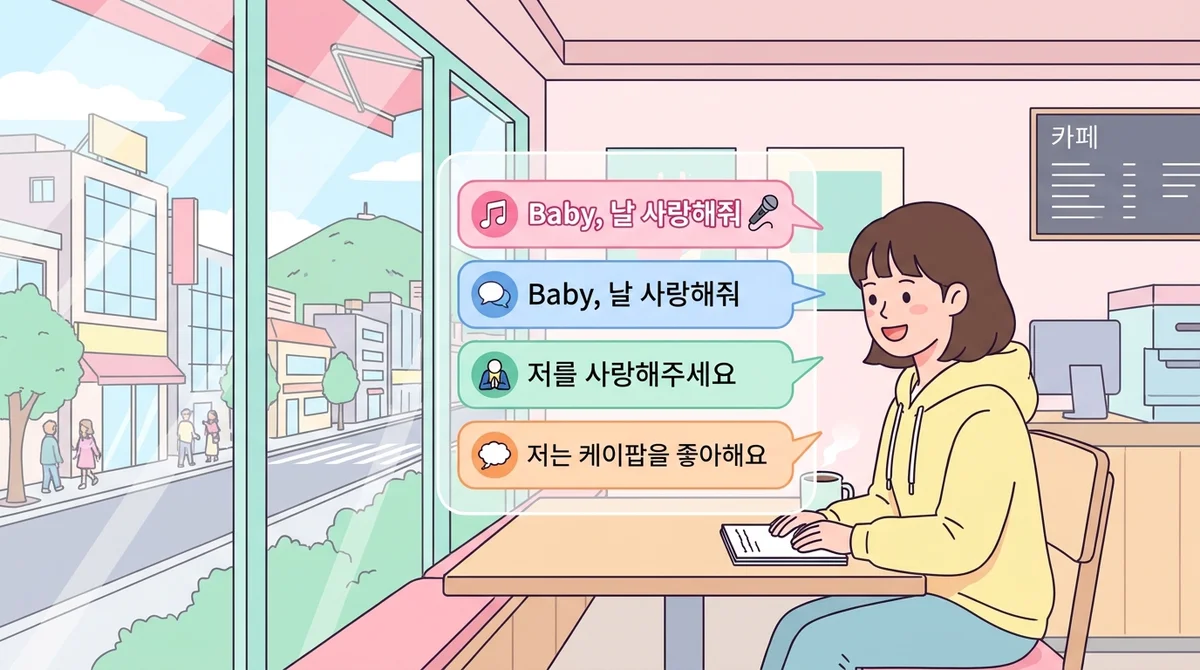
Assuming every line is polite. Most K-pop is in 반말 (banmal), casual speech, because it's aimed at peers or a loved one. Say those same lines to a stranger, a teacher, or an elder and it comes off rude. You need to know how to bump it up to polite form.
Learning phrases with no context. 가지 마 (gaji ma), "don't go," is pure drama. Great for singing, odd to say to your coworker. Always ask yourself: who would say this, and to whom?
A Step-By-Step Way to Turn a Lyric Into Speaking
Pick one song you love and work through it like this. One song, done properly, beats ten songs skimmed.
Step 1 — Find the Hangul and a real translation. Look up the official lyrics in 한글 (hangeul), Korean script. Pair them with a reliable line-by-line translation, not a loose poetic one.
Step 2 — Pick 3 to 5 usable lines. Hunt for the everyday phrases from our table above. Ignore the metaphors for now. You want lines you could imagine actually saying.
Step 3 — Break each line into words. Take 보고 싶었어 (bogo sipeosseo), "I missed you," and see its parts: 보다 (boda) "to see," plus the "want to" ending, plus past tense. You don't need grammar names — just notice the pieces.
Step 4 — Say the spoken version, not the sung one. Drop the melody. Say it at a normal, flat conversational speed. This is the single most important step for speaking.
Step 5 — Swap in the polite form. Practice both. 보고 싶어 (bogo sipeo) is casual; 보고 싶어요 (bogo sipeoyo) is polite. Knowing both means you can use the phrase with anyone.
Step 6 — Build your own sentence. Change one word. 보고 싶어 → 집에 가고 싶어 (jibe gago sipeo), "I want to go home." Now it's your Korean, not just the song's.
Real Lines From K-Pop, Ready to Speak
Here are common K-pop lines that double as genuinely useful speaking phrases. Each has the casual and polite form so you can actually use them.
보고 싶어 (bogo sipeo) — "I miss you."
Polite: 보고 싶어요 (bogo sipeoyo).
엄마, 보고 싶어요. (eomma, bogo sipeoyo.) — "Mom, I miss you."
괜찮아 (gwaenchana) — "It's okay / I'm fine."
Polite: 괜찮아요 (gwaenchanayo).
A: 미안해요. (mianhaeyo.) — "I'm sorry."
B: 괜찮아요. (gwaenchanayo.) — "It's okay."
사랑해 (saranghae) — "I love you."
Polite: 사랑해요 (saranghaeyo).
가족을 사랑해요. (gajogeul saranghaeyo.) — "I love my family."
너무 좋아 (neomu joa) — "I really like it / I love it."
Polite: 너무 좋아요 (neomu joayo).
이 노래 너무 좋아요. (i norae neomu joayo.) — "I really love this song."
왜 그래 (wae geurae) — "What's wrong? / Why are you like that?"
Polite: 왜 그래요 (wae geuraeyo).
왜 그래요? 무슨 일 있어요? (wae geuraeyo? museun il isseoyo?) — "What's wrong? Is something going on?"
Here's a tiny dialogue stitched from lines you'd actually hear in songs, made real for conversation:
A: 오랜만이야! 보고 싶었어. (oraenmaniya! bogo sipeosseo.) — "Long time no see! I missed you."
B: 나도! 잘 지냈어? (nado! jal jinaesseo?) — "Me too! Have you been well?"
A: 응, 괜찮아. 너는? (eung, gwaenchana. neoneun?) — "Yeah, I'm good. You?"
Notice how every line there came from phrases you've probably already sung — just spoken plainly.
How to Actually Make It Stick
Reading lyrics in silence won't make you a speaker. You already proved that — you can read your favorite chorus and still freeze in a real conversation. The only thing that closes that gap is saying the lines out loud, at normal speaking speed, until your mouth knows them without the music.
So after you pull a phrase from a song, say it ten times. Say the casual version, then the polite version. Then put it into a situation: greeting a friend, answering a question, comforting someone. Speaking it in a scene is what turns a memorized lyric into language you own.
This is exactly where Teuida fits. Instead of singing into the void, you step into real-life Korean conversation scenes — filmed with real people, K-drama style — and say the lines out loud yourself. The phrases you've been collecting from songs, like 보고 싶었어 or 괜찮아요, show up in natural spoken context, so you practice them the way you'd actually use them, not the way you'd sing them.
Teuida's Korean course is built speaking-first: you talk from day one, in situations like meeting a friend, apologizing, or catching up after a long time — the same emotional moments K-pop lyrics are made of. You bring the vocabulary you already love; Teuida gives you the scene to speak it in.
Keep the Music, Add the Speaking
K-pop already did half the work for you. It got Korean into your head and made you want to say it again. Now you just redirect that energy — pull the real, usable lines, strip off the melody, and speak them like a person instead of singing them like a track.
Start with one song today. Find three lines you can actually use, and say them out loud until they feel natural. Then take those exact phrases into Teuida's Korean course and practice them in a real conversation scene — out loud, line by line, the way you'll really speak them.


