
Improve your Spanish speaking fast: shadow native speakers, learn whole phrases instead of single words, and role-play real café and directions scenes aloud.
You've been studying Spanish for weeks. You know your verb conjugations, you've got a notebook full of vocabulary, and you can read a menu without panicking. But then someone actually speaks to you — and your mouth freezes. The words are in there somewhere, but they won't come out.
If that sounds familiar, you're not stuck and you're not slow. You just haven't been practicing the one thing you actually want to get better at: speaking. The good news is that speaking improves fast once you train it directly. Here are the top three ways to make that happen.
Why Speaking Feels So Much Harder Than Reading
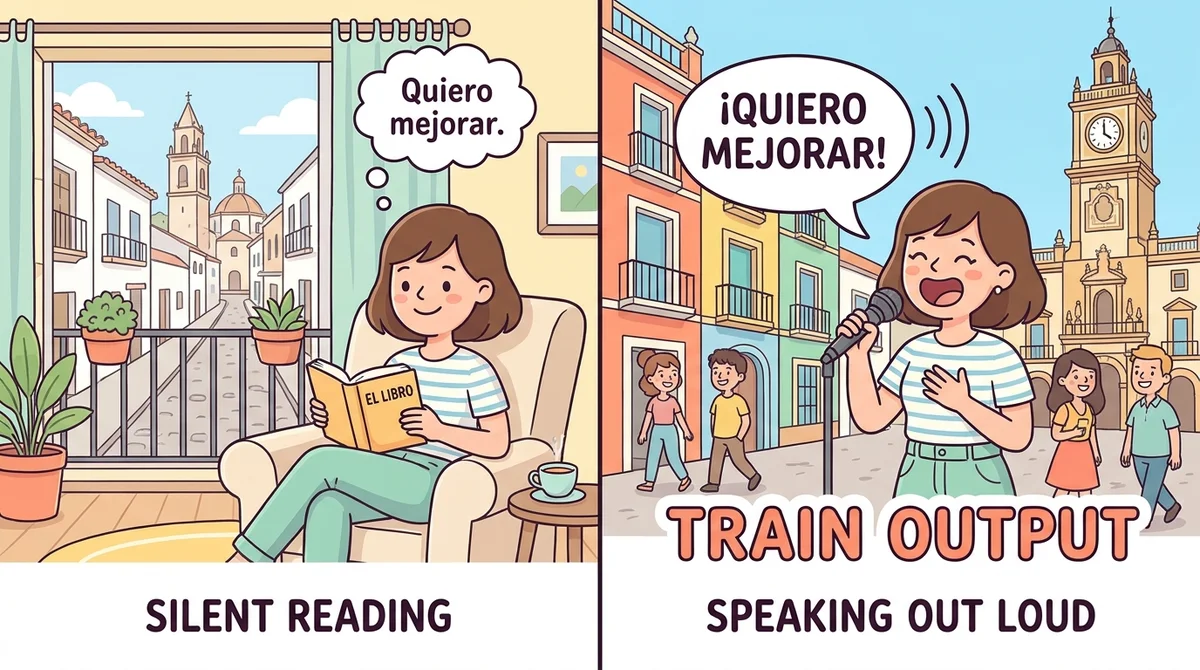
Reading and listening are what we call "passive" skills — your brain recognizes words someone else chose. Speaking is "active": you have to pull the words out yourself, in the right order, in real time, out loud. Those are completely different muscles.
Most learners spend 90% of their time on passive skills — textbooks, flashcards, grammar videos — and then wonder why speaking feels impossible. It's not a mystery. You get good at what you practice, and if you never practice talking, talking stays scary.
The fix isn't more grammar. It's shifting your practice toward producing Spanish out loud. The three methods below do exactly that, and they work faster than you'd expect because they target the real bottleneck.
The Core Idea: Train Output, Not Just Input
Before the three methods, it helps to see the difference clearly. Everything that makes you fluent lives on the "output" side of this table — but it's usually the side we neglect.
| Type | What you do | Example activity | Builds speaking? |
|---|---|---|---|
| Input | Take Spanish in | Reading, listening, flashcards | Helps a little |
| Output | Put Spanish out | Speaking, saying lines aloud | Yes — directly |
Input matters, of course. You can't say words you've never heard. But input alone creates a "recognition-only" vocabulary — you understand gracias (GRAH-syas), "thank you," when you hear it, yet you hesitate to say it yourself.
The three methods below all push the same lever: they make you produce Spanish with your own voice. That's what turns recognition into real speaking.
Mistakes That Keep Your Speaking Stuck
Before we get to the methods, let's clear out the habits that quietly sabotage most learners.
Studying silently. Reading a phrase in your head is not the same as saying it. Your tongue, lips and jaw need the reps too. Silent study builds a reader, not a speaker.
Translating word-for-word from English. Spanish isn't English with different words. If you build every sentence by translating from English first, you'll always be two steps behind in a real conversation. The goal is to think in chunks of Spanish, not to translate on the fly.
Waiting until you're "ready." There is no magic level where speaking suddenly feels safe. The learners who improve fastest start talking while they still make mistakes — because mistakes are how speaking gets corrected and refined.
Fearing pronunciation so much you whisper. Spanish pronunciation is actually one of the most forgiving for English speakers — it's mostly consistent. The vowels a, e, i, o, u are pure and short (ah, eh, ee, oh, oo) and they almost never change. Say them boldly.
The Top 3 Methods, Step by Step
Here they are — the three highest-impact ways to speed up your Spanish speaking. Do all three and you'll feel a difference in a couple of weeks.
1. Shadowing — copy out loud, immediately
Shadowing means listening to a native speaker and repeating what they say out loud, right away, matching their rhythm and melody as closely as you can.
- Find a short clip with clear Spanish — a dialogue, not a lecture.
- Play one line. Pause. Say it out loud, copying the speaker's tone.
- Don't aim for perfect understanding first. Aim for a good copy.
- Repeat the same clip until the lines feel smooth in your mouth.
Shadowing trains your pronunciation, your rhythm and your speed all at once. It's the fastest way to stop sounding robotic, because you're borrowing a real speaker's flow instead of inventing your own.
2. Speak in full phrases, not single words
Fluent speech is built from chunks, not individual words. Instead of memorizing quiero (KYEH-roh), "I want," and café (kah-FEH), "coffee," separately, learn the whole phrase:
Quiero un café, por favor. — "I want a coffee, please."
Now you have a ready-made building block you can fire off instantly, no assembly required. Collect these phrases like LEGO bricks. When you have twenty useful ones memorized as whole units, you can already handle a surprising number of real situations.
3. Role-play real situations out loud
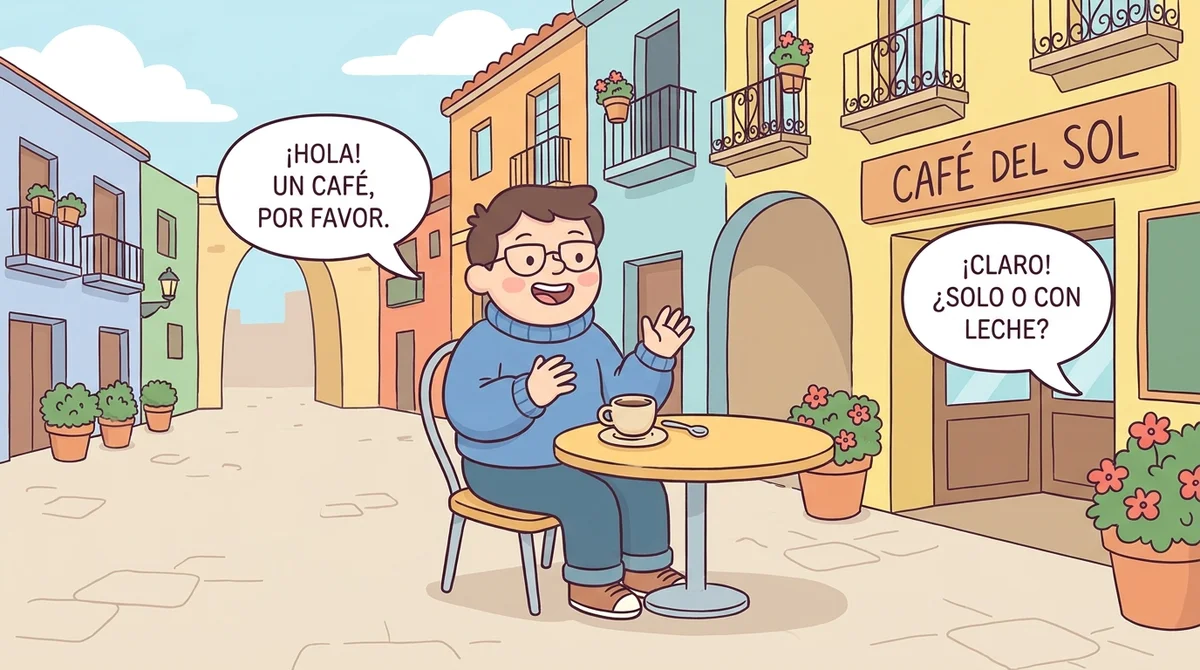
This is the big one. Pick a realistic scene — ordering food, asking for directions, introducing yourself — and act out both sides of the conversation, out loud, as if it's really happening.
- Set the scene: a café, a hotel check-in, meeting someone new.
- Say your lines, then say the reply you'd expect, then respond again.
- Do it standing up, with gestures. Make it feel real.
Role-play works because it rehearses the exact words in the exact order you'll need them. When the real moment comes, your mouth has already been there. That familiarity is what kills the freeze.
Real-Life Spanish You Can Practice Today
Here are three mini-dialogues built from common, high-frequency phrases. Read each line out loud — don't just scan it. Play both characters.
At a café
A: ¡Hola! ¿Qué le pongo? (OH-lah, keh leh PON-goh) — "Hi! What can I get you?"
B: Hola, quiero un café con leche, por favor. — "Hi, I'd like a coffee with milk, please."
A: ¿Algo más? (AL-goh mas) — "Anything else?"
B: No, nada más. Gracias. — "No, nothing else. Thank you."
Asking for directions
A: Perdón, ¿dónde está el baño? (pehr-DON, DON-deh es-TAH el BAH-nyo) — "Excuse me, where's the bathroom?"
B: Está al fondo, a la derecha. (es-TAH al FON-doh, a la deh-REH-chah) — "It's at the back, on the right."
A: ¡Muchas gracias! — "Thank you very much!"
Meeting someone
A: Hola, me llamo Ana. ¿Y tú? (meh YAH-moh) — "Hi, my name's Ana. And you?"
B: Me llamo Luis. Mucho gusto. (MOO-choh GOOS-toh) — "My name's Luis. Nice to meet you."
A: Igualmente. (ee-gwal-MEN-teh) — "Likewise."
Notice how short and repeatable these are. Say each dialogue three times out loud until the replies feel automatic. That's the whole method in miniature: real phrases, said aloud, in a scene.
Practice Tips That Make It Stick
Here's the honest truth behind all three methods: the only way speaking improves is by speaking. Not thinking about speaking, not planning to speak someday — opening your mouth and making the sounds, today, even imperfectly.
So build a tiny daily habit. Five minutes of talking out loud beats an hour of silent reading. Consistency wins. Speak on your walk, in the shower, to your mirror — anywhere you can be a little loud without feeling weird.
The hard part for most people is finding something to actually talk with. Talking to yourself works, but it's more motivating to practice inside real scenes with real replies. That's exactly what Teuida's Spanish course is built for.
Teuida is a speaking-first app — you say Spanish out loud from day one instead of grinding flashcards. You step into real-life conversation scenarios, filmed with real people, and you say the lines yourself: ordering at the café, asking for directions, introducing yourself — the very situations in this post. Story Hall links these scenes into little episodes, so you're not repeating dead phrases, you're living a mini-story in Spanish.
It covers all three methods at once. You shadow real speakers, you absorb whole natural phrases, and you role-play complete scenes by speaking every line aloud. It was built by bilingual tutors who learned a language from scratch themselves, so the whole thing is designed to get nervous learners talking and keep a daily speaking habit going — the speaking is the point.
Keep Going — You're Closer Than You Think
Fast progress in Spanish speaking isn't about talent or a secret method. It's about shifting your practice from silent input to spoken output: shadow, speak in phrases, role-play real scenes. Do those three things a little every day and the freeze starts to melt within weeks.
You already know more Spanish than you can currently say out loud. The gap between the two is just practice — the spoken kind. So close it.
Practice these exact café, directions and introduction scenes out loud in Teuida's Spanish course, and start speaking Spanish today.


