
Your Korean is correct but still sounds foreign? Fix the real accent tells: 받침 linking, sound changes, flat intonation and vowels, plus shadowing practice.
You can read a menu in Korean, text your friends in 한국어 (hangugeo), "Korean," and hold a real conversation. But then a native speaker tilts their head slightly and asks, "외국분이세요?" (oegukbuniseyo?), "Are you a foreigner?" — and you realize your words are right, but your sound gives you away.
That gap is incredibly common, and honestly, it's a great place to be. You've done the hard part. What's left isn't more vocabulary or grammar — it's polishing the music underneath your Korean so it finally matches the meaning you already know.
Why "Correct" Korean Still Sounds Foreign
Here's the thing most intermediate learners miss: pronunciation isn't just individual sounds. You probably nailed the alphabet years ago. The accent that lingers usually comes from the layers above the letters — rhythm, intonation, and the little sound changes that happen when words bump into each other.
Native speakers don't consciously hear your vowels. They hear your melody and your timing. When those are off, your Korean feels "textbook" even when every word is technically correct.
The good news is that these are learnable, fixable habits. You're not re-learning Korean — you're tuning it.
The Four Layers That Give You Away
Most lingering accents come from one of four places. Let's break them down so you know exactly what to listen for in your own speech.
| Layer | What it is | Common learner slip |
|---|---|---|
| Intonation | The rise and fall of a sentence | Flat, even delivery or English-style stress |
| Batchim linking | Final consonants connecting to the next word | Pronouncing each syllable in isolation |
| Sound changes | Consonants shifting next to each other | Saying words "as written" instead of as spoken |
| Vowel precision | Short, clean Korean vowels | Gliding or lengthening vowels like in English |
Let's look at the two that trip up advanced learners the most.
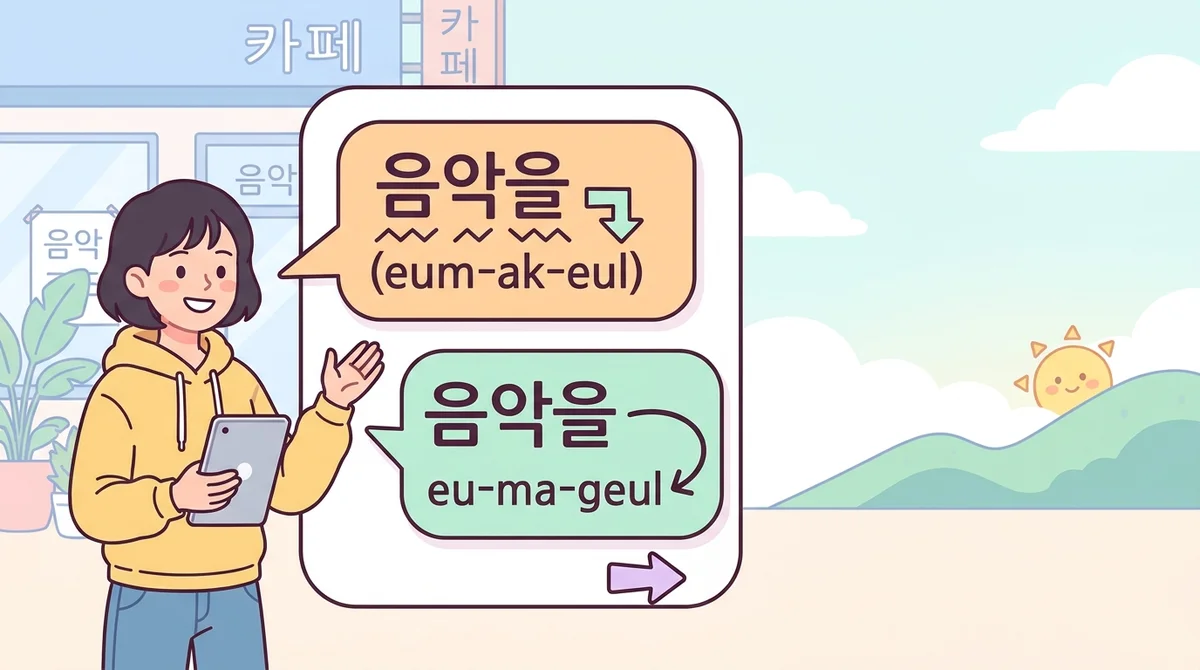
Batchim (받침) linking. A 받침 is the final consonant at the bottom of a syllable block. When the next syllable starts with a vowel, that consonant slides over. 음악 (eumak), "music," plus 을 becomes 음악을 — pronounced eu-ma-geul, not eum-ak-eul. If you stop the sound at every block, your speech sounds chopped and robotic.
Sound changes (음운 변화). Korean reshapes sounds when consonants meet. 한국말 (hangungmal), "the Korean language," is written with a ㄱ but pronounced han-gung-mal — the ㄱ softens into an ㅇ sound because of the ㅁ that follows. Natives do this automatically. Reading "as spelled" is one of the biggest accent tells.
Common Mistakes That Keep You Sounding Foreign
If you've plateaued on pronunciation, you're probably making at least one of these without realizing it.
1. Stressing syllables like English. English leans hard on one syllable per word. Korean is much more even — syllables get roughly equal time. When you stress 안녕하세요 (annyeonghaseyo), "hello," like an-NYEONG-ha-se-yo, it instantly sounds non-native. Keep it smooth and level.
2. Making the final rise too strong. English yes/no questions swoop up dramatically. Korean questions rise, but gently. Over-swooping makes you sound cartoonish.
3. Ignoring tense and aspirated consonants. The difference between 달 (dal), "moon," 딸 (ttal), "daughter," and 탈 (tal), "mask," is real and meaningful. Many learners collapse all three into one soft sound.
4. Adding vowels that aren't there. English speakers love inserting a tiny "uh" after consonants. 책 (chaek), "book," should end crisply — not chaek-uh.
5. Treating ㅓ and ㅗ as the same. 서울 (seoul), "Seoul," uses ㅓ, a relaxed "uh"-ish sound — not the rounded "oh" of ㅗ. Mixing them is one of the most common vowel slips.
A Step-by-Step Plan to Sound More Native
You don't fix an accent by reading about it. You fix it by training your ear and mouth together, in this order.
Step 1 — Diagnose, don't guess. Record yourself reading three or four sentences, then listen back critically. Better yet, compare it to a native recording of the same lines. You'll hear the gaps immediately — usually rhythm and intonation first.
Step 2 — Learn the sound-change rules that matter most. Focus on linking (받침 flowing into the next vowel), nasalization (ㄱ, ㄷ, ㅂ softening before ㄴ, ㅁ), and ㄹ/ㄴ assimilation. You don't need every rule — these three cover most everyday speech.
Step 3 — Shadow native audio. Pick a short clip — a drama line, a podcast sentence — and speak along with it in real time, matching speed and melody. This is the single most powerful technique for native-like rhythm.
Step 4 — Slow down, then speed up. Say the sentence slowly with perfect linking and intonation, then gradually increase to natural speed. Speed built on bad habits just locks them in.
Step 5 — Get feedback on the specific sounds. This is where most self-learners get stuck. You can't fully hear your own errors, so you need something — or someone — to point them out.
Real Example Sentences to Practice
Let's put the theory into your mouth. Read each one out loud, paying attention to the linking and melody notes.
Linking practice. Let the final consonants slide into the next word.
밥을 먹었어요.
(ba-beul meo-geo-sseo-yo)
"I ate a meal."
Notice: 밥을 is ba-beul, not bap-eul. 먹었어요 flows as meo-geo-sseo-yo.
Sound-change practice. The ㄱ softens before the ㄴ.
한국 노래 좋아해요.
(han-gung no-rae jo-a-hae-yo)
"I like Korean songs."
한국 becomes han-gung before 노래, and 좋아해요 links into jo-a-hae-yo.
Intonation practice. A gentle rise at the end — not a big swoop.
지금 시간 있어요?
(ji-geum si-gan i-sseo-yo?)
"Do you have time right now?"
A short, soft lift on the final 요 is all you need.
Here's a mini-dialogue to run through at natural speed:
A: 주말에 뭐 했어요?
(ju-ma-re mwo hae-sseo-yo?)
"What did you do on the weekend?"
B: 친구랑 영화 봤어요. 진짜 재밌었어요!
(chin-gu-rang yeong-hwa bwa-sseo-yo. jin-jja jae-mi-sseo-sseo-yo!)
"I watched a movie with a friend. It was really fun!"
Say it a few times. Notice how 주말에 becomes ju-ma-re and 재밌었어요 flows as one smooth wave, not five separate blocks.

How to Actually Make It Stick
Here's the uncomfortable truth: you cannot polish pronunciation silently. Reading these tips won't change a single sound in your mouth. The only thing that rewires your accent is speaking out loud, repeatedly, in real sentences.
That speaking part is the piece most intermediate learners are missing. You've outgrown beginner apps, but you don't have a Korean speaker on call to talk with every day. So you read about linking and intonation, nod along, and never say enough Korean out loud for the new habits to set.
This is exactly what Teuida is built for. Instead of flashcards and grammar drills, you speak Korean out loud from the start. You role-play real-life conversation scenes filmed with real people: ordering food, chatting about your weekend, reacting to a friend. Those are the same natural, flowing sentences from this post, so every scene is another chance to say them with the linking and rhythm you just learned.
For the accent-polishing you're after, that means you can run the linking, sound-change, and intonation patterns we covered in actual spoken scenarios, hear how close you are to native, and adjust on the spot. It's the closest thing to shadowing with a patient tutor who never gets tired of correcting your 받침.
Ten focused minutes a day of speaking — not reading about speaking — is what finally closes that last gap between "correct" and "native."
You're Closer Than You Think
Sounding native isn't a talent you're born with. It's a set of small, trainable habits — linking your 받침, letting your consonants shift naturally, keeping your vowels crisp, and riding the gentle Korean melody instead of the English one.
You already did the heavy lifting. Now it's just tuning. Pick one sentence from this post, say it out loud five times with perfect linking, and feel the difference.
Then take it further: role-play a real Korean conversation in Teuida's Korean course and say every line out loud today.


