
What is Hangeul Day? Korea's October 9 holiday for 한글 explained — King Sejong's story, why the alphabet is easy, and Korean phrases to celebrate out loud.
You're scrolling through your Korean friend's feed in early October and suddenly everyone's posting about letters. Not birthdays, not a festival — the alphabet itself. There are banners, museum visits, even a day off work.
If you've ever wondered why Koreans celebrate their writing system like a national hero, you're about to meet one of the most beautiful holidays in the world: Hangeul Day.
What Hangeul Day Actually Is
Hangeul Day — written 한글날 (han-geul-nal), "Hangeul Day" — is a Korean national holiday that celebrates the invention of 한글 (han-geul), the Korean alphabet. It falls on October 9th every year, and in South Korea it's an official public holiday, meaning schools and many offices close.
Here's the part that surprises most learners: almost no other country has a public holiday dedicated to its alphabet. Koreans are deeply, openly proud of 한글, and Hangeul Day is when that pride comes out in full.
The holiday marks the day in 1446 when the alphabet was officially published to the public in a document called 훈민정음 (hun-min-jeong-eum), which roughly means "the proper sounds for the instruction of the people." That name alone tells you the whole story — this alphabet was made for the people.
The Story Behind the Alphabet
To understand why the day matters, you have to understand what came before it.
For centuries, Koreans wrote using Chinese characters called 한자 (han-ja), "Chinese characters." The problem? 한자 has thousands of characters and took years to master. Only the wealthy and educated could read and write, while ordinary people were left out completely.
Then came King Sejong the Great — 세종대왕 (se-jong-dae-wang) — who ruled in the 15th century. He wanted every single person, rich or poor, to be able to read and write. So he and a group of scholars created a brand-new alphabet designed to be learned in days, not years.
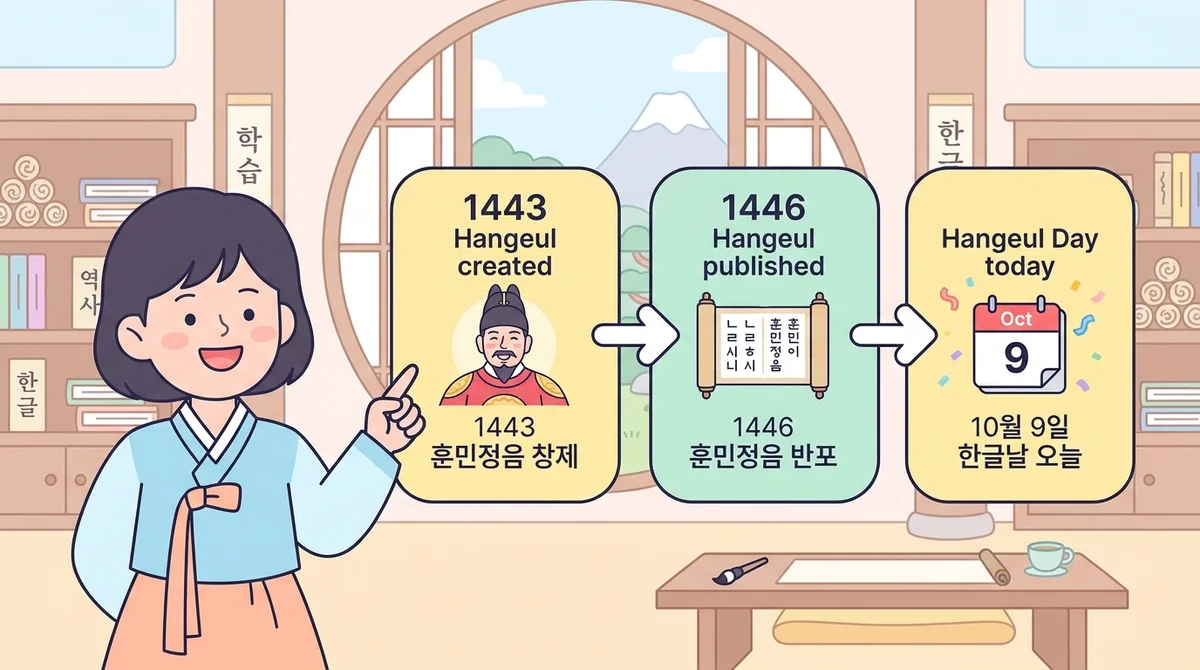
What makes 한글 genius is that the letters aren't random shapes. The consonants are drawn to mirror the shape your mouth and tongue make when you say them. The vowels are built from three simple symbols representing sky, earth, and humankind. It's a writing system engineered from the ground up — and that's exactly why it feels so logical to learn.
Why Hangeul Is Easier Than You Think
A lot of beginners freak out when they first see Korean script. It looks like mysterious blocks. But here's the truth: 한글 is one of the most beginner-friendly writing systems on the planet.
Let's compare it to what most English speakers already know.
| Feature | English (Latin alphabet) | 한글 (Hangeul) |
|---|---|---|
| Number of basic letters | 26 | 24 (14 consonants, 10 vowels) |
| Spelling matches sound | Often not (think "though," "through") | Almost always — you read it as written |
| Letters hint at pronunciation | No | Yes — consonant shapes mirror the mouth |
| Time to learn the basics | Lifelong spelling quirks | A few hours to a weekend |
See the difference? In English, "ough" can be pronounced about six different ways. In 한글, once you learn a letter's sound, it stays that sound. That consistency is a gift.
For example, the letter ㅁ (m) always sounds like "m." The letter ㅏ (a) always sounds like "ah." Stack them into a block and you get 마 (ma). No surprises, no silent letters, no exceptions hiding in the corner.
Common Mistakes Learners Make About Hangeul Day
Even enthusiastic learners get a few things wrong. Let's clear them up now.
Mistake 1: Calling 한글 "Korean." 한글 is the alphabet — the writing system. The language is 한국어 (han-gu-geo), "the Korean language," or 국어 (gu-geo) when Koreans refer to their own. Hangeul Day celebrates the letters, not the language as a whole.
Mistake 2: Thinking 한글 and 한자 are the same. They're totally different. 한자 means Chinese characters; 한글 is the native Korean alphabet. Mixing these up in front of a Korean friend is a classic beginner slip.
Mistake 3: Writing letters in a straight line. 한글 letters don't sit side by side like English. They stack into neat syllable blocks. For example, 한 is actually three letters — ㅎ + ㅏ + ㄴ — bundled into one square.
Mistake 4: Assuming it's a tiny local holiday. It's a full national public holiday with museum events, writing contests, and nationwide celebration. People take it seriously.
How to Celebrate Hangeul Day (Even From Abroad)
You don't have to be in Korea to join in. Here's a simple step-by-step way to make October 9th yours as a learner.
Step 1: Learn the story. You just did. Knowing why 한글 exists makes every letter feel meaningful.
Step 2: Write your name in 한글. This is the classic Hangeul Day activity. Sound out your name and build the blocks. Seeing yourself in Korean script for the first time is a genuine little thrill.
Step 3: Learn five new letters. If you don't know the alphabet yet, Hangeul Day is the perfect excuse to start. Five a day and you'll finish the whole set in under a week.
Step 4: Visit (or virtually tour) the museum. The National Hangeul Museum in Seoul posts exhibits online, and many Korean cultural centers worldwide hold events.
Step 5: Say a Hangeul Day greeting out loud. This is where it stops being history and starts being your Korean. More on that next.
Real Phrases for Hangeul Day
Let's get practical. Here are natural phrases you can actually use on October 9th — each in script, pronunciation, and meaning.
- 한글날이에요. (han-geul-na-ri-e-yo.) — "It's Hangeul Day."
- 오늘은 한글날이에요. (o-neu-reun han-geul-na-ri-e-yo.) — "Today is Hangeul Day."
- 한글을 배우고 있어요. (han-geu-reul bae-u-go i-sseo-yo.) — "I'm learning Hangeul."
- 세종대왕님 덕분이에요. (se-jong-dae-wang-nim deok-bu-ni-e-yo.) — "It's all thanks to King Sejong."
- 한글은 정말 아름다워요. (han-geu-reun jeong-mal a-reum-da-wo-yo.) — "Hangeul is really beautiful."
Now here's a mini-dialogue you could have with a Korean friend on the day:
You: 오늘 한글날이에요? (o-neul han-geul-na-ri-e-yo?) — "Is today Hangeul Day?"
Friend: 네, 맞아요! 한글 배우고 있어요? (ne, ma-ja-yo! han-geul bae-u-go i-sseo-yo?) — "Yes, that's right! Are you learning Hangeul?"
You: 네, 조금요. 한글 정말 재미있어요. (ne, jo-geu-myo. han-geul jeong-mal jae-mi-i-sseo-yo.) — "Yes, a little. Hangeul is really fun."
Friend: 잘하고 있어요! (jal-ha-go i-sseo-yo!) — "You're doing great!"
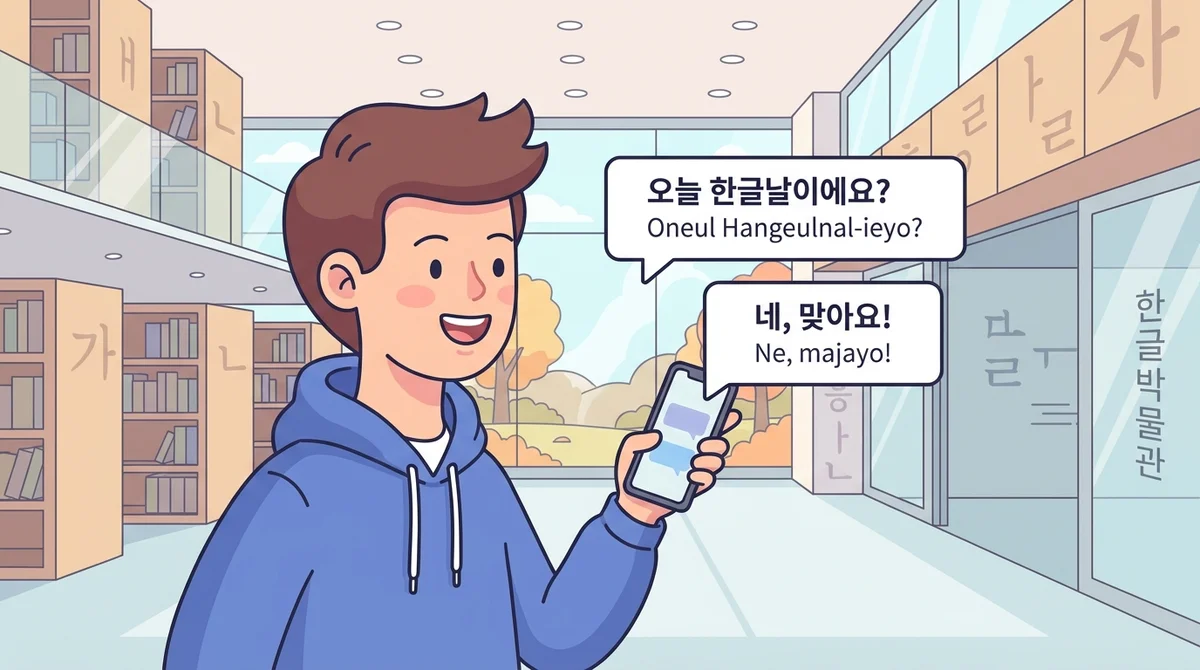
Notice how friendly and simple these are. You don't need advanced grammar to take part — you just need the confidence to say them out loud.
Practice Tips: Make Hangeul Stick by Speaking It
Here's the thing nobody tells beginners: you can memorize all 24 letters and still freeze the moment someone asks you a question. Recognizing 한글 on a page and speaking it are two completely different skills.
The letters only truly click when you say them out loud, over and over, in real sentences. That's when the shapes stop being drawings and start being sounds that live in your mouth.
So on Hangeul Day, don't just read — talk. Say your name in 한글. Say 한글날이에요 to your reflection. Record yourself and listen back.
This is exactly what Teuida's Korean course is built for. Instead of grinding flashcards, you jump into K-drama-style conversation scenarios and speak from day one — including the real greetings and self-introductions you'd use around Hangeul Day. You role-play actual situations out loud, and Teuida's AI pronunciation feedback scores how you say each phrase and shows you how to fix it. It's the next best thing to a Korean friend sitting beside you.
Because Teuida was built by bilingual tutors, the focus is confidence and daily habit — small, speakable wins that add up. By the time next October 9th rolls around, you won't just know about 한글. You'll be chatting in it.
Keep the Celebration Going
Hangeul Day is more than a date on the calendar. It's a reminder that this alphabet was created as a gift — made simple on purpose, so that anyone willing to try could learn it. That includes you.
So take the first step today. Sound out your name, learn five letters, and say one phrase out loud. The alphabet King Sejong designed for everyone is genuinely within your reach.
Ready to actually speak it? Open Teuida's Korean course, role-play a real conversation, and get your Hangeul pronunciation scored out loud.


