Improve your Korean speaking fast with 3 habits: speak out loud every day, learn chunks like 물 좀 주세요 instead of single words, and role-play real scenes.
You've studied Korean for months. You know the alphabet, you've got a notebook full of vocabulary, and you can read a menu without panicking. But the moment a real Korean person says 안녕하세요 (annyeonghaseyo), "hello," your brain freezes and nothing comes out.
If that sounds like you, you're not behind — you're just missing the one thing textbooks can't give you: actual speaking practice. The good news? Speaking is a skill you can grow fast if you focus on the right things. Let's look at the top three.
Why Speaking Is the Hardest Part — And the Fastest to Fix
Here's the thing most learners don't realize: understanding Korean and speaking Korean use two completely different muscles.
Reading and listening are passive skills — your brain recognizes something that's already there. Speaking is an active skill — you have to pull the words out, arrange them, and say them before the moment passes. That's a much harder job, and it only gets better with repetition.
The frustrating part is that most study methods barely train speaking at all. Flashcards test recognition. Grammar drills test rules. But none of them make you open your mouth. That's exactly why so many learners can read a whole paragraph yet can't order a coffee.
The flip side is encouraging: because so few learners actually practice speaking, even a little focused speaking practice puts you ahead fast. You don't need years. You need the right three habits.
The Core 3: What Actually Moves the Needle
Let's be honest about what works. Not every study activity is equal when your goal is fluent, confident speech. Here's how the big methods compare.
| Method | Builds recognition? | Builds speaking? | Speed of results for speaking |
|---|---|---|---|
| Flashcards / vocab apps | ✅ Strong | ❌ Weak | Slow |
| Grammar textbooks | ✅ Strong | ❌ Weak | Slow |
| Watching K-dramas | ✅ Medium | ❌ Weak | Slow |
| Speaking out loud daily | ✅ Medium | ✅ Strong | Fast |
| Role-playing real scenes | ✅ Strong | ✅ Strong | Fastest |
Notice the pattern? The methods that make you produce Korean out loud are the only ones that reliably grow your speaking. Everything else helps, but it's support, not the main event.
So the top three ways below all share one principle: you have to speak. Let's break them down.
Way 1: Speak Out Loud Every Single Day — Even Alone
The single biggest change you can make is to stop studying Korean silently.
Your mouth needs to learn the shapes of Korean sounds the same way your fingers learn a song on the piano. Korean has sounds that don't exist in English — like the difference between ㄱ (g), ㄲ (kk), and ㅋ (k), or the tense ㅃ in 빵 (ppang), "bread." You can read about these forever, but your tongue only learns them by doing them.
So say everything out loud. When you learn a new word, don't just read 사랑해요 (saranghaeyo), "I love you" — say it ten times. Record yourself on your phone and play it back. You'll catch things your eyes never would.
A simple daily routine that works:
- Shadowing: Play a short Korean clip, pause after each line, and repeat it exactly — same rhythm, same melody.
- Self-talk: Narrate your day in Korean. 지금 커피를 마셔요 (jigeum keopireul masyeoyo), "I'm drinking coffee now."
- Read aloud: Take any simple text and read it out loud instead of silently.
Even five focused minutes a day beats an hour of silent reading. Consistency is what rewires your mouth.

Way 2: Learn Full Phrases, Not Lonely Words
The second big speed-up: stop collecting single words and start collecting ready-to-use chunks.
When you memorize isolated vocabulary, you still have to build the sentence from scratch every time you speak — and that's exactly what causes the freeze. But if you memorize whole phrases, you can just pull them out and say them.
Compare these two approaches:
| Word-by-word thinking | Chunk thinking |
|---|---|
| "water" = 물 (mul)… now how do I ask for it? | 물 좀 주세요 (mul jom juseyo), "Water, please." |
| "this" = 이거 (igeo)… "how much"… 얼마…? | 이거 얼마예요? (igeo eolmayeyo?), "How much is this?" |
| "where"… "bathroom"… "is"…? | 화장실이 어디예요? (hwajangsiri eodiyeyo?), "Where's the bathroom?" |
The chunk column is what real speakers actually use. These are complete, polite, natural sentences you can deploy instantly in a shop, a café, or on the street.
Build a small bank of 20–30 everyday chunks and drill them out loud until they're automatic. You'll be shocked how far a handful of solid phrases carries you in a real conversation.
Way 3: Practice in Real Situations, Not in a Vacuum
The third accelerator is context. Your brain remembers language far better when it's attached to a situation.
Memorizing 얼마예요? (eolmayeyo?), "how much is it?" from a list is fine. But practicing it as if you're standing in a market, pointing at a bag of apples is what makes it stick — and makes it come out when you actually need it.
This is why role-play beats rote memorization every time. When you rehearse a real scene — ordering food, checking into a guesthouse, asking for directions — you're training the exact words, tone, and reflexes you'll use in that moment. The practice matches the performance.
You don't need a tutor sitting across from you to do this. You need realistic scenarios and the willingness to say the lines out loud, in order, as if they were really happening.
Real-Life Mini-Dialogues to Practice Today
Let's make this concrete. Here are three short exchanges covering everyday situations. Read every line out loud — both sides — until they feel natural in your mouth.
At a café:
- You: 아메리카노 한 잔 주세요. (amerikano han jan juseyo.) — "One Americano, please."
- Barista: 네, 따뜻한 거요? (ne, ttatteutan geoyo?) — "Sure, hot one?"
- You: 아니요, 아이스로 주세요. (aniyo, aiseuro juseyo.) — "No, iced, please."
Asking for directions:
- You: 저기요, 지하철역이 어디예요? (jeogiyo, jihacheollyeogi eodiyeyo?) — "Excuse me, where's the subway station?"
- Passerby: 저쪽으로 쭉 가세요. (jeojjogeuro jjuk gaseyo.) — "Go straight that way."
- You: 감사합니다! (gamsahamnida!) — "Thank you!"
Shopping:
- You: 이거 얼마예요? (igeo eolmayeyo?) — "How much is this?"
- Clerk: 만 오천 원이에요. (man ocheon wonieyo.) — "15,000 won."
- You: 너무 비싸요. 좀 깎아 주세요. (neomu bissayo. jom kkakka juseyo.) — "That's too expensive. Please give me a discount."
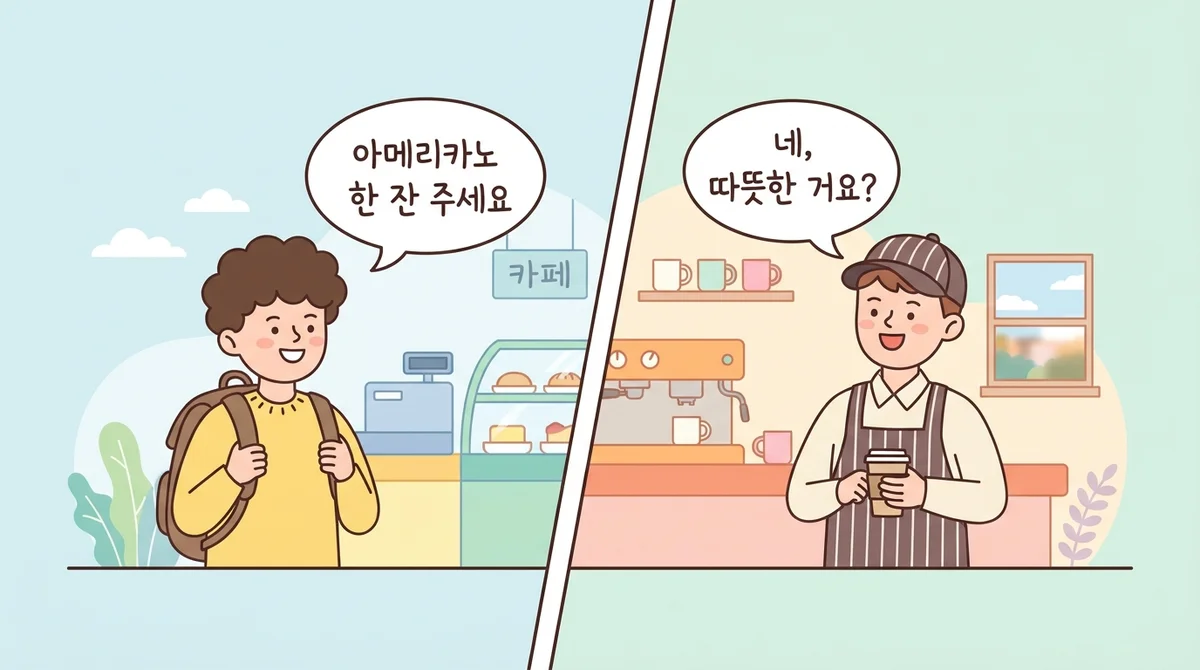
Notice how each line is a reusable chunk. Swap 아메리카노 for 라떼 (latte), "latte," and you've got a brand-new order. That's how a few dialogues turn into dozens of real conversations.
Practice Tips: Make It Stick by Saying It Out Loud
Here's the honest truth that ties all three methods together: Korean speaking only improves when you speak. You can read this article five times, but your mouth won't change until it actually forms the words.
So build a tiny daily speaking habit and protect it. Five minutes beats zero. Pick one dialogue, say both sides out loud, and come back to it tomorrow. Repetition out loud is the whole game.
This is exactly where Teuida fits in. Teuida is a speaking-first app — in its Korean course you step into real-life conversation scenes filmed with real people (K-drama-style situations, not AI-generated), and you say every line out loud. That means you're not memorizing a vocabulary list; you're actually ordering the coffee, asking for directions, and haggling at the market — the exact situations from the dialogues above.
Because the scenes are built around real moments, you're practicing full phrases in context, which hits all three of our top methods at once: daily out-loud speaking, ready-made chunks, and real situations. Teuida was built by bilingual tutors who've been exactly where you are, and the whole point is simple — give you a reason to open your mouth and speak Korean every day, so one day it just comes out.
Each time you say a line, you get a grade for how accurately you said it the way the tutor taught, and at the end of the lesson you can review the grades for all your lines together. Just you, a real scene, and your own voice getting more confident each time.
You're Closer Than You Think
Speaking Korean fast isn't about talent or endless hours. It's about three simple moves: speak out loud daily, learn full phrases instead of lonely words, and practice in real situations. Do those three, and your speaking will outpace learners who've studied twice as long in silence.
The frozen-brain moment at 안녕하세요 (annyeonghaseyo) fades surprisingly quickly once your mouth has done the reps. Every line you say out loud today is a line that'll be ready when a real conversation starts.
So pick one dialogue from this post, open Teuida's Korean course, and role-play it out loud right now — your future, confident Korean-speaking self starts with that first spoken line.