
Learn popular Korean onomatopoeia like 두근두근, 반짝반짝 and 깜짝. See how 의성어 and 의태어 work, with easy patterns, common mistakes and dialogues to say out loud.
You're watching a K-drama and a character's heart starts racing. Suddenly the screen fills with 두근두근 (dugeun-dugeun), and you have no idea whether that's a name, a sound, or a snack. But the vibe? The vibe you understand perfectly.
That's the magic of Korean onomatopoeia. These little words carry so much feeling that they jump off the page and the screen, and once you learn a handful of them, Korean suddenly sounds more alive — and a lot more fun to speak.
What Korean Onomatopoeia Actually Is
Onomatopoeia are words that imitate sounds or describe actions and feelings. English has them too — "buzz," "splash," "boom." But Korean uses them way more often, and in way more situations than English does.
Korean actually has two closely related families of these words:
- 의성어 (uiseong-eo) — "sound-imitating words," like the bark of a dog or the ring of a phone.
- 의태어 (uitae-eo) — "manner-imitating words," which describe how something looks, moves, or feels, even when there's no sound at all.
That second group is the one that surprises most learners. Korean has specific words for sparkling, for walking unsteadily, for a heart thumping with nerves — all as single, bouncy words.
You'll meet them constantly: in webtoons, in song lyrics, in variety shows, in everyday chat. Learning them isn't just vocabulary padding — it's how you start to sound natural instead of textbook-stiff.
The Core: Patterns That Make Them Easy
Here's the good news. Korean onomatopoeia follow patterns, so they're far less random than they look. Most of them come in repeated pairs — you say the same chunk twice, which gives them that cute, rhythmic feel.
Once your ear tunes into the doubling, you'll start recognizing new ones on your own.
| Korean | Pronunciation | Meaning |
|---|---|---|
| 두근두근 | dugeun-dugeun | heart pounding (nervous/excited) |
| 반짝반짝 | banjjak-banjjak | sparkling, twinkling |
| 깜짝 | kkamjjak | startled, surprised |
| 콜록콜록 | kollok-kollok | cough cough |
| 쿵쿵 | kung-kung | heavy thudding (footsteps/heartbeat) |
| 데굴데굴 | degul-degul | rolling around |
| 꿀꺽 | kkulkkeok | gulp (swallowing) |
| 주룩주룩 | juruk-juruk | rain pouring down |
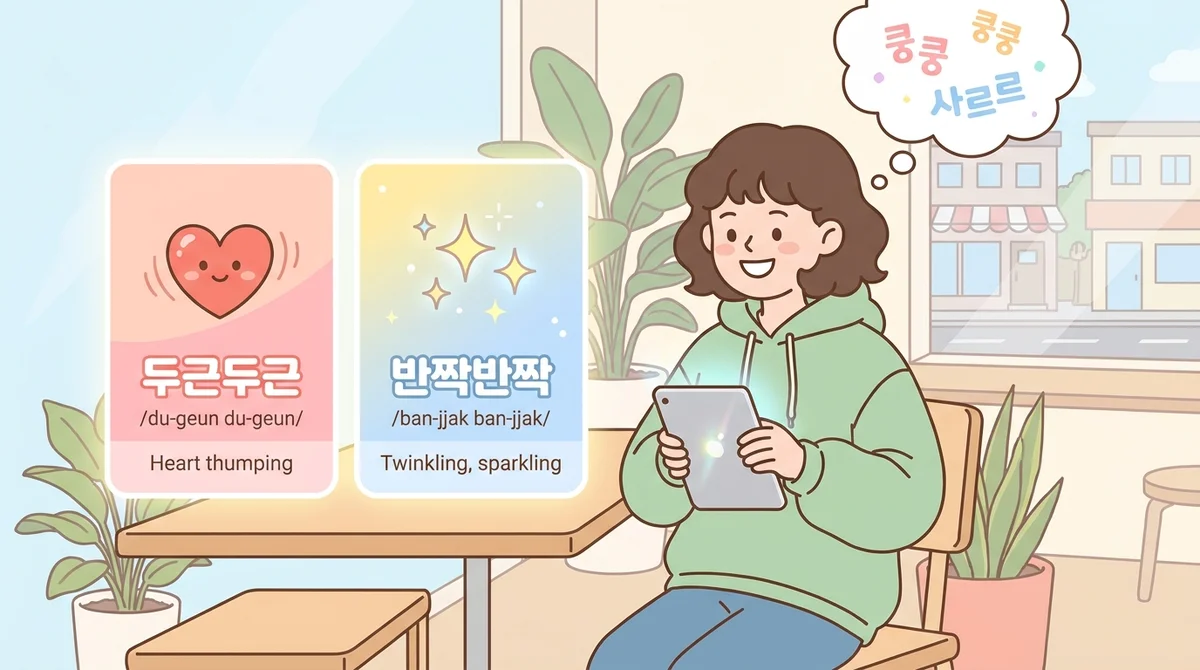
Notice another neat trick: Korean often swaps vowels to change the size or mood of a sound. Bright vowels (ㅏ, ㅗ) feel small, light, and cute. Dark vowels (ㅓ, ㅜ) feel bigger, heavier, or more serious.
- 반짝 (banjjak) — a small, cute sparkle.
- 번쩍 (beonjjeok) — a big, sudden flash (like lightning).
Same word, different vowel, different feeling. Korean does this on purpose, and it's everywhere.
Common Mistakes Learners Make
Mistake 1: Saying only half of a doubled word. Many onomatopoeia need the repetition. Saying 두근 (dugeun) once sounds incomplete, like saying "knock" when you mean "knock knock." For the heart-pounding feeling, you want the full 두근두근 (dugeun-dugeun).
Mistake 2: Forgetting they often pair with a verb. Onomatopoeia frequently team up with 하다 (hada), "to do," or a matching verb. 반짝반짝 (banjjak-banjjak) becomes 반짝반짝하다 (banjjak-banjjak-hada), "to sparkle." Dropping the verb can leave your sentence hanging.
Mistake 3: Translating them word-for-word from English. English "gulp" and Korean 꿀꺽 (kkulkkeok) overlap, but Korean has far more of these, and they slot into speech differently. Don't assume there's always a tidy one-to-one match — learn each in a real phrase instead.
Mistake 4: Ignoring the vowel mood. Using the dark, heavy version when you mean something light can sound a little off. Describing a baby's cute little rolling tumble with a big, heavy sound word feels mismatched to native ears. Pay attention to whether the vowels are bright or dark.
How to Use Them: Simple Rules
You don't need grammar gymnastics. Here's the practical workflow.
Step 1 — Use it as a standalone reaction. The quickest way in. See something shocking? Just say 깜짝이야! (kkamjjak-iya!), "Oh, you startled me!" One word does the work.
Step 2 — Attach 하다 (hada) to turn it into a verb. This is your Swiss-army move.
- 반짝반짝 (banjjak-banjjak) → 반짝반짝해요 (banjjak-banjjak-haeyo), "it's sparkling."
- 두근두근 (dugeun-dugeun) → 두근두근해요 (dugeun-dugeun-haeyo), "my heart is pounding."
Step 3 — Drop it in front of a matching verb to add flavor. The onomatopoeia acts like an adverb, coloring the action.
- 비가 주룩주룩 와요 (biga juruk-juruk wayo), "the rain is pouring down."
- 눈이 반짝반짝 빛나요 (nuni banjjak-banjjak binnayo), "the eyes are sparkling."
Step 4 — Match the vowel mood to the feeling. Bright and cute, or dark and heavy — pick the one that fits. This is the step that makes you sound natural rather than just correct.
Real-Life Examples and Mini-Dialogues
Let's put them into conversation, the way you'd actually hear them.
Scene 1 — Before a first date
A: 나 지금 너무 떨려. 심장이 두근두근해.
(na jigeum neomu tteollyeo. simjangi dugeun-dugeun-hae.)
"I'm so nervous right now. My heart is pounding."
B: 괜찮아, 잘할 거야!
(gwaenchana, jalhal geoya!)
"It's okay, you'll do great!"
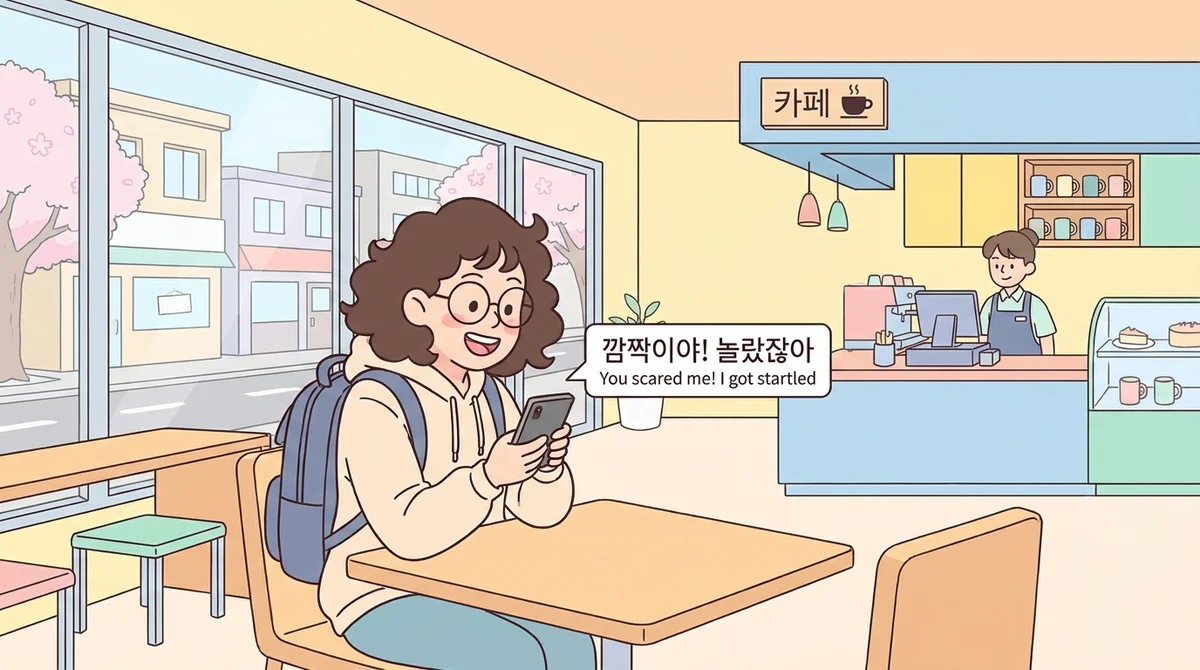
Scene 2 — Someone sneaks up on you
A: 야!
(ya!)
"Hey!"
B: 아, 깜짝이야! 놀랐잖아.
(a, kkamjjak-iya! nollatjana.)
"Ah, you scared me! I got startled."
Scene 3 — Looking out the window
A: 밖에 비 와?
(bakke bi wa?)
"Is it raining outside?"
B: 응, 주룩주룩 와. 우산 챙겨.
(eung, juruk-juruk wa. usan chaenggyeo.)
"Yeah, it's pouring. Grab an umbrella."
Scene 4 — Admiring the night sky
A: 와, 별이 반짝반짝 빛나!
(wa, byeori banjjak-banjjak binna!)
"Wow, the stars are twinkling!"
B: 진짜 예쁘다.
(jinjja yeppeuda.)
"They're really pretty."
Notice how natural these feel. These aren't fancy words — they're the ones real people reach for first. That's exactly why they stick.
Practice Tips: Say Them Out Loud
Here's the honest truth about onomatopoeia: you cannot learn them silently. These words are their sound and rhythm. Reading 두근두근 (dugeun-dugeun) on a flashcard does almost nothing — but saying it twice, feeling that little bounce in your mouth, locks it in instantly.
So read every example in this post out loud, right now. Exaggerate the doubling. Lean into the bright or dark vowel. The sillier it feels, the better it sticks.
Then put it in a real situation. That's where Teuida comes in. Teuida is a speaking-first app — instead of grinding flashcards, you step into real-life conversation scenes, filmed with real people, and say the lines out loud yourself. In the Korean course, you'll hit everyday moments where these exact words come alive: reacting with 깜짝이야! (kkamjjak-iya!) when something surprises you, telling a friend your heart is 두근두근 (dugeun-dugeun) before something big.
Because you're speaking inside a story, not reciting a list, the rhythm of these words becomes muscle memory. You're not memorizing 반짝반짝 (banjjak-banjjak) — you're saying it while looking at a sparkling night sky in a scene. That context is what turns recognition into real speaking.
Try saying each line in a scene a couple of times until it flows without thinking. That out-loud repetition, tied to a situation, is how onomatopoeia stop feeling foreign and start feeling like yours.
Keep Going — You've Got This
Korean onomatopoeia are one of the most joyful parts of the language. They're short, they're bouncy, and they instantly make you sound more expressive and more native. You don't need dozens — even the handful in this post will show up again and again in dramas, songs, and real conversations.
Pick two favorites today. Maybe 두근두근 (dugeun-dugeun) and 반짝반짝 (banjjak-banjjak). Say them out loud until they feel easy, then listen for them in the next episode you watch — you'll catch them, I promise.
Ready to actually use them? Practice these out loud in Teuida's Korean course, saying every line inside real conversation scenes until the rhythm feels like second nature.


