
Build a free Korean study stack: 10 resources for grammar, vocabulary, listening and speaking, from TTMIK to Naver Dictionary, plus a simple daily routine.
You've decided to learn Korean, you open a new browser tab, and suddenly there are a thousand options screaming for your attention. Half of them want your credit card before you've learned how to say 안녕하세요 (annyeonghaseyo), "hello."
Here's the good news: some of the best Korean learning tools on the planet are completely free. You just need to know which ones are worth your time, and — more importantly — what each one is actually good at. Let's build you a free Korean toolkit that works.
Why Mixing Free Resources Beats Using Just One
No single free resource does everything well. A YouTube channel can explain grammar beautifully but can't make you speak. A dictionary website is perfect for looking up a word but won't teach you a conversation. An app might drill vocabulary but skip the "why."
So the smart move isn't finding the one perfect resource — it's stacking a few that cover each other's blind spots. You want something for grammar, something for vocabulary, something for listening, and something for speaking out loud. When those four bases are covered, you have a complete free study plan.
The list below is organized around exactly that idea. Each resource has one thing it does better than the others, and I'll tell you what that is so you don't waste hours figuring it out yourself.
The Top 10 Free Korean Resources at a Glance
Here's the full lineup first, so you can see how the pieces fit together before we dig into each one.
| # | Resource | Type | Best for |
|---|---|---|---|
| 1 | Talk To Me In Korean | Website + YouTube | Structured grammar lessons |
| 2 | Teuida | App | Speaking out loud in real scenes |
| 3 | Naver Dictionary | Website + App | Accurate word lookups |
| 4 | Go! Billy Korean | YouTube | Clear grammar explanations |
| 5 | How To Study Korean | Website | Deep grammar reference |
| 6 | Korean Unnie | YouTube | Beginner-friendly vocabulary |
| 7 | Anki | App | Custom flashcard memorization |
| 8 | KBS / TV with Korean subtitles | Video | Real native listening |
| 9 | HelloTalk | App | Chatting with native speakers |
| 10 | Dong-A / NHK-style news "Easy Korean" | Website | Reading practice by level |
Now let's go through them one at a time.
The 10 Resources and What Each One Does Best
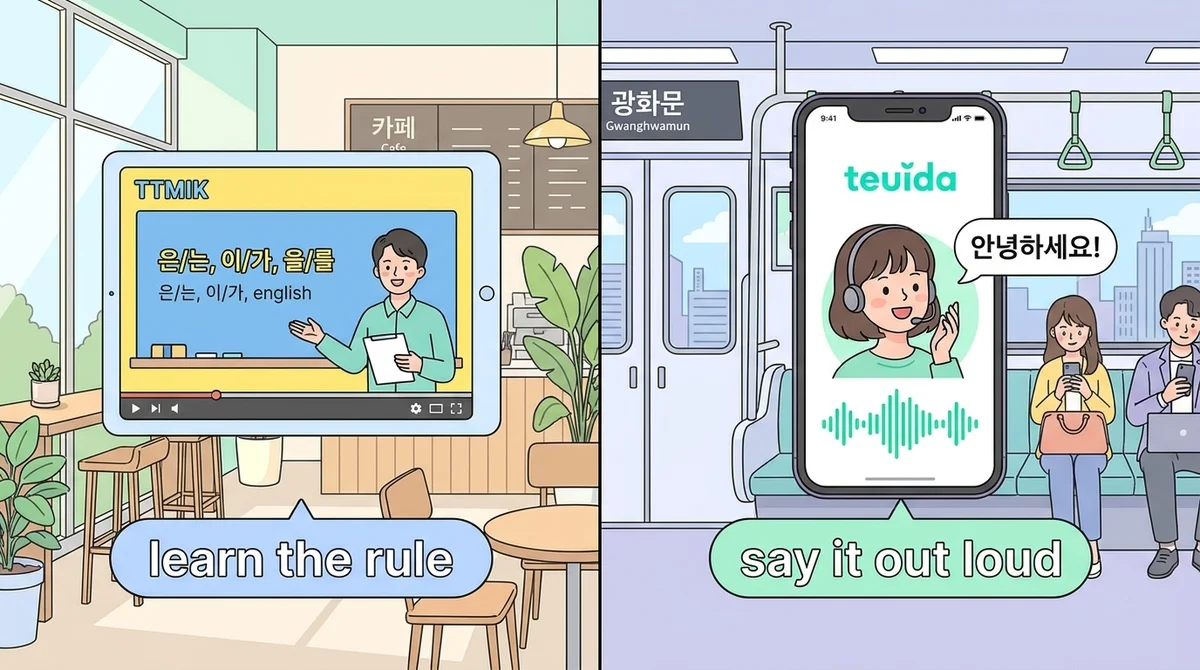
1. Talk To Me In Korean (TTMIK). This is the classic starting point, and for good reason. Their free lessons are organized into clear levels, so you always know what comes next. The grammar is explained in a friendly, conversational way, and their free PDFs and YouTube videos cover everything from 은/는 (eun/neun), the topic markers, to full sentence building. Strength: a structured roadmap so beginners aren't lost.
2. Teuida. Most free tools teach you about Korean. Teuida gets you speaking it. It's a speaking-first app built around real-life conversation scenes — filmed with real people, K-drama style — where you say the lines out loud yourself. More on how to use this later, because it fills the biggest gap every other resource leaves open. Strength: actually opening your mouth and talking from day one.
3. Naver Dictionary. Google Translate will betray you. Naver Dictionary won't. It's the dictionary Koreans themselves trust, with example sentences, nuance notes, and audio of native pronunciation for nearly every word. Strength: trustworthy, context-rich word lookups.
4. Go! Billy Korean. Billy's YouTube channel is a grammar goldmine. He takes confusing points — like the difference between 이/가 (i/ga) and 은/는 (eun/neun) — and slows them down until they click. His beginner playlist alone could carry you for months. Strength: patient, no-jargon grammar video explanations.
5. How To Study Korean. This website is a free textbook in disguise. Each lesson is long, detailed, and packed with example sentences and vocabulary lists you can download. It's less flashy but more thorough than almost anything else free online. Strength: deep-dive grammar reference when you want the full "why."
6. Korean Unnie. Bright, upbeat, and made for total beginners. Her videos teach practical vocabulary and phrases — greetings, food, shopping — in a way that feels like chatting with a fun friend. Strength: approachable beginner vocabulary and motivation.
7. Anki. A free flashcard app that uses spaced repetition, meaning it shows you a word right before you'd naturally forget it. You can build your own decks or download shared Korean ones. It's not pretty, but it's ruthlessly effective for memorization. Strength: making vocabulary stick long-term.
8. TV and video with Korean subtitles. Watching Korean shows with Korean subtitles (not just English) trains your ear and your reading at the same time. Start with content made for kids or variety shows with lots of on-screen text. Strength: real, natural listening practice.
9. HelloTalk. A language-exchange app where you message native Korean speakers who want to learn your language. You help them, they correct your Korean. It's free, human, and surprisingly warm. Strength: real conversations with native speakers.
10. Easy Korean news / graded reading sites. Several sites publish news and short articles written in simpler Korean for learners. Reading real material — even simplified — builds vocabulary in context far better than isolated word lists. Strength: level-appropriate reading practice.
Common Mistakes Learners Make With Free Resources
The biggest trap? Collecting resources instead of using them. It feels productive to bookmark twelve YouTube channels and download five apps, but watching one more "how to learn Korean" video is not the same as learning Korean.
The second mistake is studying only passively. You can watch grammar videos for a year and still freeze up when a real Korean person says 뭐 드릴까요? (mwo deurilkkayo?), "what can I get you?" Recognizing Korean and producing Korean are two different skills, and free video courses mostly train the first one.
Third: skipping the alphabet. Please learn 한글 (hangeul), the Korean alphabet, in your first week. It's genuinely learnable in a few days, and every resource above becomes ten times more useful once you can read. Relying on romanization forever will quietly cap how far you can go.
And fourth: jumping between methods with no plan. One day it's an app, the next a textbook, the next a drama. Pick a small stack, give it a few weeks, and build a routine.
A Simple Step-by-Step Plan Using These Free Tools
Here's how to turn ten resources into one clean routine. You don't need all of them at once.
- Week 1 — Learn 한글. Use a free YouTube series (Go! Billy and Korean Unnie both have good ones) until you can read basic syllables. Don't move on until you can.
- Daily, 15 min — Grammar. Work through TTMIK or How To Study Korean in order. One small lesson a day beats a marathon once a week.
- Daily, 10 min — Vocabulary. Review your Anki deck. Add new words you meet during the day from Naver Dictionary.
- Daily, 10 min — Speaking out loud. This is where Teuida fits — act out a real scene and say every line yourself. We'll unpack this in the next section.
- A few times a week — Listening. Watch a short clip with Korean subtitles. Pause, repeat lines you catch.
- Weekly — Real contact. Send a few messages on HelloTalk, or read one Easy Korean article and look up the words you don't know.
Notice the order: input (grammar, vocab, listening) plus output (speaking, messaging). Most learners do only input. The ones who actually get fluent protect that speaking slot.
Real Korean You Can Practice Today
Let's make this concrete. Here are a few lines you could pull from any of these resources and start using right now — read them out loud as you go.
Greeting a new language-exchange partner:
- 안녕하세요, 만나서 반가워요. (annyeonghaseyo, mannaseo bangawoyo.) — "Hello, nice to meet you."
Asking for help when you don't understand:
- 천천히 말해 주세요. (cheoncheonhi malhae juseyo.) — "Please speak slowly."
- 이거 무슨 뜻이에요? (igeo museun tteusieyo?) — "What does this mean?"
A tiny café mini-dialogue:
- A: 아메리카노 한 잔 주세요. (amerikano han jan juseyo.) — "One americano, please."
- B: 따뜻한 거요, 아이스요? (ttatteutan geoyo, aiseuyo?) — "Hot or iced?"
- A: 아이스로 주세요. (aiseuro juseyo.) — "Iced, please."
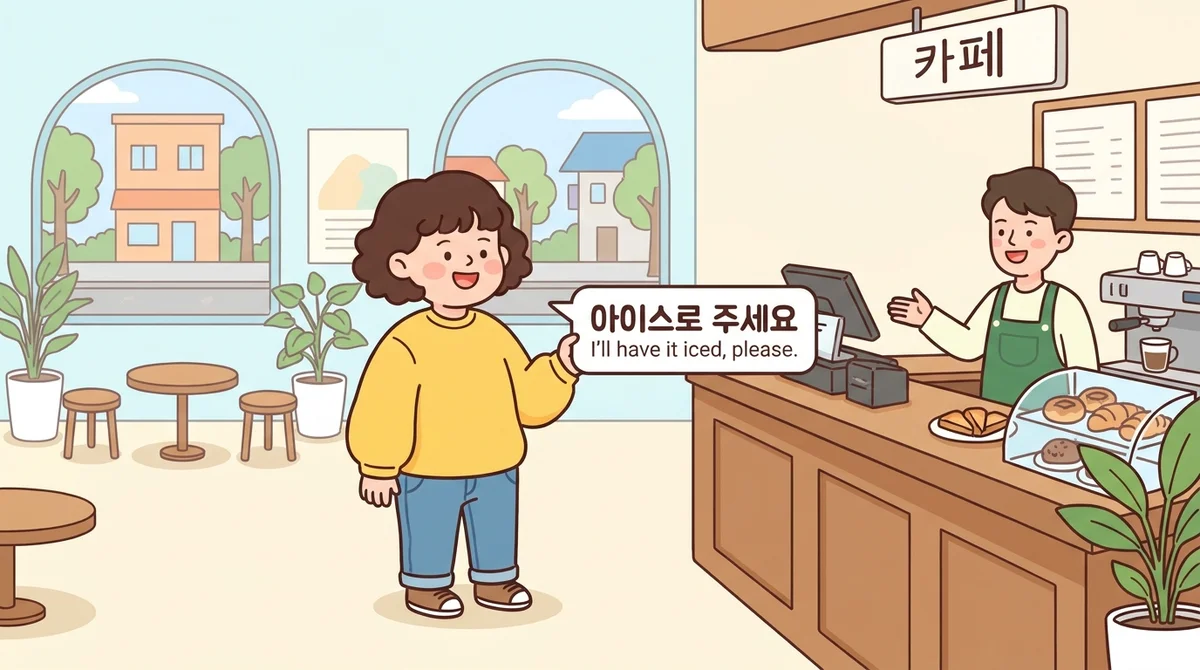
Say each line out loud twice. Notice how 주세요 (juseyo), "please give me," shows up again and again — that's a pattern worth drilling until it's automatic.
Practice Tips: Why Speaking Out Loud Is the Missing Piece
Here's the uncomfortable truth about free resources: almost all of them train you to recognize Korean, and almost none of them force you to speak it. You can finish every TTMIK level, max out your Anki deck, and still panic the moment someone actually talks to you.
Speaking is a physical skill. Your mouth has to learn the shapes, your brain has to produce sentences under light pressure, and the only way to build that is to actually say things out loud — ideally in realistic situations, not isolated drills.
That's exactly the gap Teuida is built to fill, and why it earns a place in a free Korean toolkit. In Teuida's Korean course you step into real-life conversation scenes — ordering at that café, meeting someone new, asking for directions — filmed with real people, and you say every line out loud yourself. The Story Hall links these scenes into episodes, so you're not reciting flashcards; you're having a conversation. It was built by bilingual tutors who learned Korean themselves, so the scenes are the exact situations you'll actually hit.
Teuida doesn't rank you — it just hands you the scene and the reason to speak. Pair it with your grammar and vocabulary resources above, and you cover the one thing the others can't. Pull the café dialogue from the last section and role-play it in Teuida's Korean course, saying each line out loud until it feels natural.
You Already Have Everything You Need
The best part of this whole list? It's all free. You don't need a pricey course or a tutor to start — you need a small, smart stack of tools and the habit of showing up every day.
Pick one grammar resource, one way to drill vocabulary, one listening habit, and one way to speak out loud. Keep it for three weeks. You'll be amazed how fast 안녕하세요 stops feeling foreign.
So start today: learn 한글 this week, and the moment you can read a single sentence, open Teuida's Korean course and say your first real line out loud.


