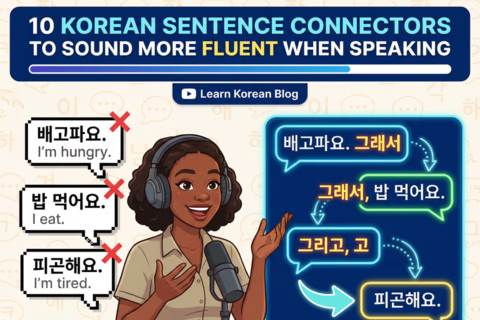
Learn how Korean sentence enders like 요, 입니다, and 해 work in real conversations. See when to use each level so you can speak naturally, even as korean for beginners.
If you are korean for beginners and trying to learn korean, sentence enders can feel really confusing.
You might think:
- Why does everything end with 요?
- When do I use 입니다 instead of 예요?
- How do friends actually talk to each other?
Take a breath. This is all normal. Korean sentence endings carry a lot of meaning about politeness, emotion, and relationship.
In this lesson, we will walk through:
- The main sentence enders you need to know
- What they really mean in the korean language
- Real conversation examples for each level
- When to use which ending in everyday life
You are doing great already, so let us go step by step.
1. What are Korean sentence enders, really?
In Korean, the verb usually comes last. After the verb root, you add an ending that shows:
- Politeness level
- Mood, for example question, suggestion, command
- How close you feel to the other person
So the ending is not just grammar. It is a big part of your social signal.
Compare:
- 가요 – I go, polite, neutral
- 갑니다 – I go, very formal, polite
- 가 – I go, casual, close friends, or talking down
- 가요? – Do you go, polite question
- 갈까요? – Shall we go, polite suggestion
Same basic korean words, very different feeling. Combined with the right particles, these endings shape the whole tone of a sentence.
If you know the korean alphabet, try to sound these out and focus on the ending part. This will help your ear a lot when you learn to speak korean.
2. Three big politeness levels you actually need
There are many styles in textbooks, but in real life you mainly need these three:
- Formal polite 입니다 / 합니다
- Standard polite 해요 style
- Casual 해 style
We will look at each with real korean phrases.
2.1 Formal polite endings: 입니다, 합니다
Use this when you want to sound professional, respectful or when you are speaking in public.
You will hear it:
- In news
- In presentations and speeches
- In announcements
- Sometimes at work, to customers or in very formal companies
Examples
저는 학생입니다.
I am a student.
오늘 회의가 있습니다.
There is a meeting today.
감사합니다. / 고맙습니다.
Thank you.
Mini dialogue, office meeting
A: 안녕하십니까, 저는 민수입니다.
Hello, I am Minsu.
B: 만나서 반갑습니다. 저는 소피아입니다.
Nice to meet you. I am Sophia.
Notice every sentence ends with ㅂ니다 or similar. Very polite, a little distant. As someone learning korean for beginners, you do not need to speak this way all the time, but it is good to understand it.
2.2 Standard polite endings: 아요 / 어요 (해요 style)
This is the most useful level in spoken Korean.
You use it:
- With strangers
- In shops and cafes
- With teachers
- With coworkers you are not close to
- With older people, unless they tell you to drop the 요
It is polite but warm and natural. For most people who learn korean, this is their main target.
Examples
저는 한국어 공부해요.
I study Korean.
뭐 먹어요?
What do you eat, what are you eating?
지금 집에 가요.
I am going home now.
Mini dialogue, at a café
A: 뭐 마실래요?
What would you like to drink?
B: 아이스 아메리카노 주세요.
Iced americano please.
A: 여기서 드세요, 가져가세요?
Here or to go?
B: 여기서 마실게요.
I will drink here.
Everything ends with 요, polite and friendly.
If you often use a learn korean app, you will see this style again and again in dialogues because it is the safest default.
2.3 Casual endings: 해 style
Use this style with:
- Close friends
- Younger people you are close to
- Siblings or sometimes cousins
- Yourself, thinking out loud
It feels close and relaxed. But be careful, it can feel rude if you use it with strangers, older people, or in formal situations.
Examples
나 집에 가.
I am going home.
뭐 해?
What are you doing?
이거 진짜 맛있어.
This is really tasty.
Mini dialogue, chatting with a friend
A: 오늘 뭐 해?
What are you doing today?
B: 영화 볼 거야. 너는?
I am going to watch a movie. You?
A: 나도 영화 보고 싶어. 같이 보자.
I want to watch a movie too. Let us watch together.
Short, casual endings. No 요 anywhere.
If you mostly use polite forms in your language study app, that is okay. You can add casual endings later when you feel more confident about who it is safe to use them with.
3. Common sentence enders for questions, suggestions and more
Now that you know the big three levels, let us look at some useful endings that appear a lot in real korean phrases.
3.1 Simple questions: …요? / …습니까?
Most of the time, a polite question is just:
- Polite verb + 요 + rising voice
지금 뭐 해요?
What are you doing now?
어디 가요?
Where are you going?
몇 시에 만나요?
What time shall we meet?
In very formal speech, questions use 습니까:
이름이 뭐입니까?
What is your name?
어디에서 일하십니까?
Where do you work?
As korean for beginners, it is enough to focus on the 요 questions first.
3.2 Soft, polite suggestions: -(으)까요? / -(으)실래요?
Use these when you want to suggest doing something together, in a gentle way.
같이 밥 먹을까요?
Shall we eat together?
내일 만날까요?
Shall we meet tomorrow?
뭐 마실래요? 커피 드실래요?
What would you like to drink? Would you like coffee?
These endings are perfect when you want to sound kind and polite, especially to people you do not know well yet.
3.3 Polite requests and commands: -(으)세요
Use -(으)세요 to ask someone politely to do something.
여기 보세요.
Please look here.
천천히 말해주세요.
Please speak slowly.
안으로 들어오세요.
Please come inside.
You will hear this from staff in shops and from teachers. It is soft but still clearly a request or instruction.
3.4 Casual suggestions and commands: -자, -어 / -아
With friends, casual endings change.
Suggestion -자
같이 가자.
Let us go together.
밥 먹자.
Let us eat.
Casual command -어 / -아
빨리 와.
Come quickly.
이거 봐.
Look at this.
These are strong if you use them with people who are not close to you, so keep them for trusted friends.
3.5 Emotional endings: -네요, -군요, -잖아요, -거든요
These endings add feeling and nuance, so you will hear them a lot in dramas and in natural conversations.
- 네요
Soft surprise, new realisation.
여기가 진짜 예쁘네요.
Wow, this place is really pretty.
한국어 발음이 좋네요.
Your Korean pronunciation is good.
- 군요
Similar to -네요, but a bit more like discovering something. Often slightly more formal.
오늘 날씨가 춥군요.
The weather is cold today, I see.
- 잖아요
“You know…, as you know…, come on…”
피곤하잖아요.
You know we are tired.
내가 말했잖아요.
I told you, remember.
- 거든요
Explaining a reason or giving background.
내일 바쁘거든요.
Because I am busy tomorrow.
한국 친구가 있거든요.
Because I have a Korean friend.
These can be tricky at first, but they make your korean vocabulary sound much more natural once you start using them, especially alongside natural sentence connectors that link your ideas together.
4. Which sentence ending should I use with whom?
Here is a simple guide you can remember while you learn korean and meet people.
- With shop staff, taxi drivers, strangers
- Use: 아요 / 어요 (standard polite)
- With teachers, bosses, older coworkers
- Use: 아요 / 어요 as a safe base
- Sometimes 입니다 / 습니다 in very formal situations
- With friends your age, people younger than you
- Start with 아요 / 어요
- If they say you can speak casually, switch to 해 style
- In work emails, presentations
- Use: 입니다 / 습니다, more formal vocabulary
If you are not sure, polite 요 style is almost always safe. Think of it as your default setting while you are still learning korean for beginners.
5. Real-life scenarios with full dialogues
Let us put it together with three short dialogues.
5.1 Scenario 1: First time meeting someone older (polite)
A: 안녕하세요. 처음 뵙겠습니다. 저는 마리아예요.
Hello. Nice to meet you. I am Maria.
B: 안녕하세요. 저는 지훈이에요.
Hello. I am Jihoon.
A: 한국어 공부해요?
Do you study Korean?
B: 네, 요즘 열심히 공부해요.
Yes, these days I study hard.
All sentences end with 요, so you sound respectful and friendly.
5.2 Scenario 2: Two close friends
A: 야, 오늘 뭐 해?
Hey, what are you doing today?
B: 그냥 집에서 쉬어. 너는?
I am just resting at home. You?
A: 나 영화 보고 싶어. 같이 보자.
I want to watch a movie. Let us watch together.
Casual endings, very relaxed. Good for practice once you have more Korean friends.
5.3 Scenario 3: At work, talking to a customer
Staff: 어서 오세요. 뭐 찾으세요?
Welcome. What are you looking for?
Customer: 검은색 재킷 있어요?
Do you have a black jacket?
Staff: 네, 여기 있습니다. 한번 입어 보세요.
Yes, here it is. Please try it on.
Standard polite endings everywhere, with one formal 있습니다. This is typical in stores and customer service.
If you practise these kinds of dialogues with a learn korean app or other language learning tools, you will start to feel which ending matches which situation.
6. How to study sentence enders without feeling overwhelmed
If this feels like a lot, that is okay. Here are some gentle study ideas.
6.1 Focus on one level at a time
First, get very comfortable with 요 endings. Use them in your own simple sentences like:
- 오늘 피곤해요.
- 커피 좋아해요.
- 한국어 재미있어요.
Then slowly notice casual and formal styles when you hear Korean.
6.2 Collect real-life examples as “sentence cards”
Instead of only memorising grammar rules, write down full sentences you actually hear or see.
For example:
- 천천히 말해주세요.
- 같이 갈까요?
- 지금 뭐 해요?
These become part of your active korean vocabulary. This method is often the best way to learn korean sentence endings in a natural way.
6.3 Use speaking-focused tools, not only textbooks
Many free language learning apps are good for basic korean words, but sentence enders are all about feeling and sound. It helps a lot to repeat after native speakers.
That is where apps like Teuida can support you. Inside the teuida app and teuida korean app, you:
- Listen to short dialogues for real situations
- Speak out loud and get feedback
- Hear how sentence endings change with friends, strangers, and elders
You can search for teuida korean in your app store. There is a teuida free version to try. If you enjoy it, you can upgrade to teuida premium later.
Compared with some other language learning applications, this kind of interactive speaking can be a strong best app to learn korean style option, especially if your goal is to actually talk, not just read.
Use it together with your favourite language study app, short videos, and notes. A small mix of tools is usually the best way to learn korean in a relaxed and steady way.