Learn Korea’s emergency numbers, what disaster alerts mean, and simple Korean phrases to use when you need help.
Emergency Contacts in Korea: What to Do When You Need Help
Being in a new country can feel exciting, but it is also smart to know what to do in an emergency. Save these numbers before you need them. A few minutes now can make a stressful moment feel much more manageable later.
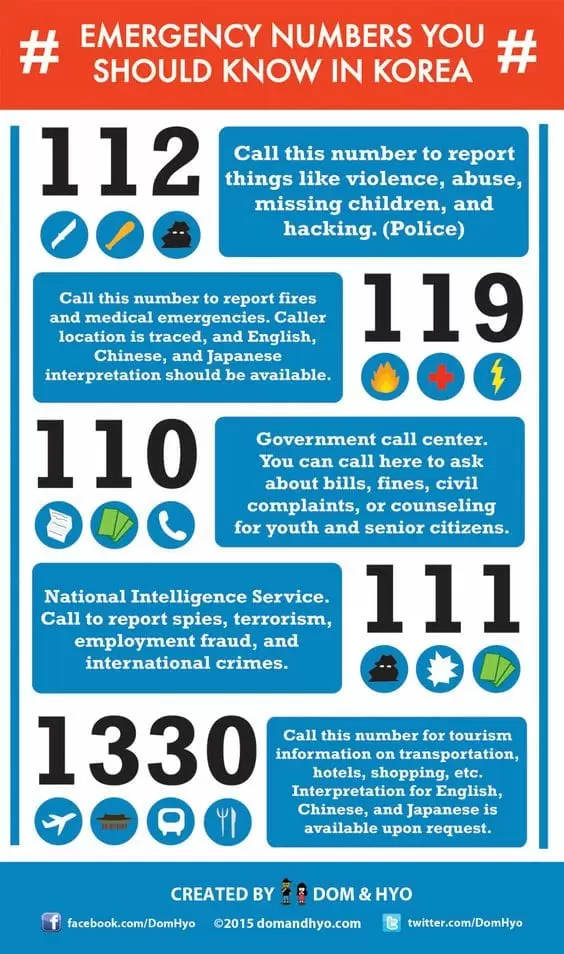
In Korea, the two most important emergency numbers are easy to remember:
- 112 for police
- 119 for fire, rescue, and ambulance services
You can call these numbers when you are in immediate danger, see a crime, need an ambulance, spot a fire, or need urgent rescue help.
Call 112 for the Police
Call 112 when you need police help. This may include theft, assault, threats, harassment, a traffic accident, or a situation where you feel unsafe.
You can say:
경찰이 필요해요.
Gyeongchari piryohaeyo.
“I need the police.”
도와주세요.
Dowajuseyo.
“Please help me.”
위험해요.
Wi-heomhaeyo.
“It is dangerous.”
Try to share your location as clearly as possible. Look for a building name, a subway station exit, a nearby café, or an address on a map app. If you are still building up your basic Korean for tourists, a few key phrases like these can go a long way in an emergency.
Call 119 for an Ambulance, Fire, or Rescue
Call 119 for a medical emergency, a fire, rescue assistance, or urgent medical transport. It is the number to use if someone is seriously injured, unconscious, having trouble breathing, or needs an ambulance quickly.
Useful phrases:
구급차가 필요해요.
Gugeupchaga piryohaeyo.
“I need an ambulance.”
불이 났어요.
Buri nasseoyo.
“There is a fire.”
사람이 다쳤어요.
Saram-i dacheosseoyo.
“Someone is injured.”
영어 할 수 있어요?
Yeongeo hal su isseoyo?
“Can you speak English?”
Do not worry about perfect pronunciation. Speak slowly, give your location, and explain what happened in simple words. You are doing great just by asking for help.
Other Helpful Numbers to Save
1339 is the infectious-disease emergency line. It can be useful for health guidance related to infectious diseases.
1330 is the Korea Travel Hotline. It can help international visitors with travel support and interpretation assistance in several languages. It is especially useful when the situation is not an immediate life-threatening emergency but you need help communicating or finding local support.
For a true emergency, call 112 or 119 first.
What Emergency Alerts in Korea Mean
You may receive loud emergency alerts on your phone while you are in Korea. These are public safety messages, often sent for local risks such as severe weather, heavy rain, heat waves, wildfires, traffic restrictions, missing-person notices, or other safety concerns.
The messages are usually location-based, so someone in Seoul may receive a different alert from someone in Busan. If you're new to the country, it also helps to know how to ask for directions in Korean so you can describe where you are quickly. Korea’s National Disaster and Safety Portal provides real-time emergency alerts, weather information, safety guidance, and nearby facility information.
Many alerts arrive in Korean first. You may also see an English translation, but the official alert portal notes that automatic translations can contain errors. When an alert seems serious, check the location, the time, and any action instructions carefully.
A quick way to read an alert is to look for these Korean words:
- 주의: caution
- 경보: warning
- 대피: evacuate
- 폭우: heavy rain
- 태풍: typhoon
- 산불: wildfire
- 지진: earthquake
- 실종: missing person
For example:
호우경보 발효
A heavy-rain warning is in effect.
안전한 곳으로 대피하세요.
Please evacuate to a safe place.
A Simple Emergency Plan for Korea
Before your next trip, commute, or weekend adventure, save 112, 119, 1330, and 1339 in your phone. Keep your accommodation address saved in Korean and English. You can also take a screenshot of your location in a map app.
Learning a little korean language, starting with the phrases in our guide to Korean phrases before arrival, can help you feel calmer in urgent moments. You do not need to speak perfectly. A clear location, a simple explanation, and a request for help are enough to get started.
Let’s walk through this together: save the numbers, practice two or three phrases, and remember that help is only a call away.