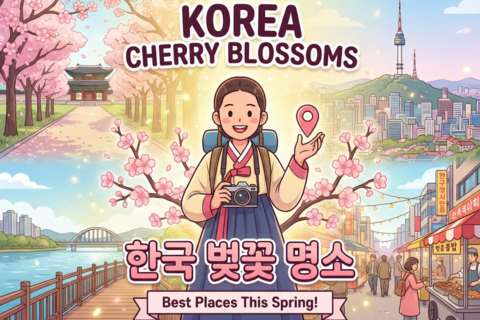
Spring break is coming. Learn basic Korean phrases for directions in Korea so you can ask for help, find places, and travel with more confidence.
Spring Break in Korea: 15 Basic Korean Phrases for Directions
Spring break is coming, and for a lot of travelers, that means one exciting thing: Korea trips are back on the calendar.

It is one of the best times to visit. The weather gets softer, the streets feel more lively, and there are more people exploring cafés, palaces, shopping streets, and cherry blossom spots. But if you are visiting during a busy season, one small skill can make a huge difference.
Knowing a few basic Korean phrases for directions.
You do not need perfect grammar.
You do not need to sound fluent.
You just need a few useful phrases that help you move around with less stress.
If you want to learn Korean for real-life travel, this is a great place to start, alongside our list of Korean travel phrases.
Let’s walk through this together.
Why direction phrases matter so much
When you travel, direction questions come up all the time.
You want to ask:
Where is the subway station?
How do I get there?
Is it far?
Can I walk?
Which way should I go?
These are the kinds of korean phrases to know because they help right away. They are practical, simple, and useful even if your Korean is still very beginner level.
And honestly, using even one short phrase can make your trip feel much more personal. Instead of only pointing at a map, you get to use the korean language in a real situation.
That is a big win.
1. Where is it?
어디예요?
Where is it?
This is one of the most important korean phrases for tourists.
You can attach a place before it:
- 화장실 어디예요? = Where is the bathroom?
- 지하철역 어디예요? = Where is the subway station?
- 버스 정류장 어디예요? = Where is the bus stop?
This is short, polite, and very useful, much like the phrases in our essential Korean phrases for a cafe guide.
2. Where is the subway station?
지하철역 어디예요?
Where is the subway station?
If you are traveling in Seoul or another big city, this is one of the best korean phrases to know. Subways are often the easiest way to get around, as covered in our Korean transport guide.
3. Where is the bus stop?
버스 정류장 어디예요?
Where is the bus stop?
This is another must-know phrase for tourists who want to go beyond the most central areas.
4. How do I get there?
어떻게 가요?
How do I get there?
This is a very natural phrase and one of the most helpful ways to learn korean phrases for travel. It sounds simple and polite, and locals will understand it right away.
You can also point to a place on your phone and ask:
- 여기 어떻게 가요? = How do I get here?
5. Is it far?
멀어요?
Is it far?
This is such a helpful little phrase. If someone gives you directions, you can ask if the place is far before deciding whether to walk.
6. Can I walk there?
걸어갈 수 있어요?
Can I walk there?
Very useful when you are deciding between walking, taking the subway, or calling a taxi.
7. Please tell me the way
길 좀 알려 주세요.
Please tell me the way.
This sounds polite and kind. It is especially useful when you are asking someone directly for help.
If this feels hard at first, that’s completely normal. You do not need to memorize every phrase perfectly. Even learning just this one can help a lot.
8. Straight ahead
직진하세요.
Go straight.
This is one of the direction words you may hear often. Even if you do not use it first, it is very helpful to recognize.
9. Turn left
왼쪽으로 가세요.
Go left.
Or more directly:
왼쪽으로 도세요.
Turn left.
10. Turn right
오른쪽으로 가세요.
Go right.
Or:
오른쪽으로 도세요.
Turn right.
These are great basic korean phrases to practice because left and right come up constantly when asking for directions.
11. It is near here
여기 근처예요.
It is near here.
This is a phrase you may hear from locals when the place is close by.
12. It is in front of the station
역 앞에 있어요.
It is in front of the station.
Location words like 앞에, 뒤에, 옆에, and 안에 are very useful when you learn Korean for travel.
A few you will hear often:
- 앞에 = in front of
- 뒤에 = behind
- 옆에 = next to
- 안에 = inside
13. Please show me on the map
지도에서 보여 주세요.
Please show me on the map.
This one is excellent if speaking feels difficult. It helps bridge the gap between language and visual directions.
You can use this when words are not enough, and that is completely okay.
14. Which exit should I take?
몇 번 출구로 나가야 해요?
Which exit should I take?
This is one of the smartest korean phrases to know for city travel, especially in Seoul where subway exits matter a lot.
15. Thank you for your help
도와주셔서 감사합니다.
Thank you for your help.
This is always a good phrase to end with. It is polite, warm, and appreciated.
A simple mini-dialogue for tourists
Here is a short example of how these korean phrases can work in real life.
Traveler:
지하철역 어디예요?
Where is the subway station?
Local:
저기요. 직진하세요.
Over there. Go straight.
Traveler:
멀어요?
Is it far?
Local:
아니요, 여기 근처예요.
No, it is near here.
Traveler:
감사합니다.
Thank you.
This is the kind of everyday travel exchange that helps you feel more confident. And honestly, confidence matters just as much as vocabulary.
Best phrases to memorize first
If you only want to remember five, start here:
- 어디예요?
- 어떻게 가요?
- 멀어요?
- 길 좀 알려 주세요.
- 지도에서 보여 주세요.
These five cover a lot of real situations and are some of the most practical learn korean phrases for a spring break trip.
How to practice before your trip
The best way to remember travel Korean is to say it out loud.
Try this:
- look at a map
- choose a place
- ask the question in Korean
- answer it out loud with left, right, straight, or near
- repeat until it feels easier
This kind of practice helps turn basic korean phrases into something you can actually use under pressure.
You’re doing great. Let’s keep going.
Final thought
Spring break trips are more fun when you can do small things on your own.
Ask where the station is.
Check which exit to take.
Understand when someone says go straight.
Thank a stranger for helping you.
That is real progress.
So before your Korea trip, do not try to memorize everything. Just focus on a few korean phrases to know for directions. A little Korean can go a very long way.